Mastering Marginal Rates of Substitution
MRS and Indifference Curves
The Shape of Preference
You already know that an indifference curve maps out combinations of two goods that provide the same level of utility or satisfaction. For example, you might be equally happy with 3 slices of pizza and 1 soda as you are with 2 slices of pizza and 3 sodas. Both points lie on the same curve.
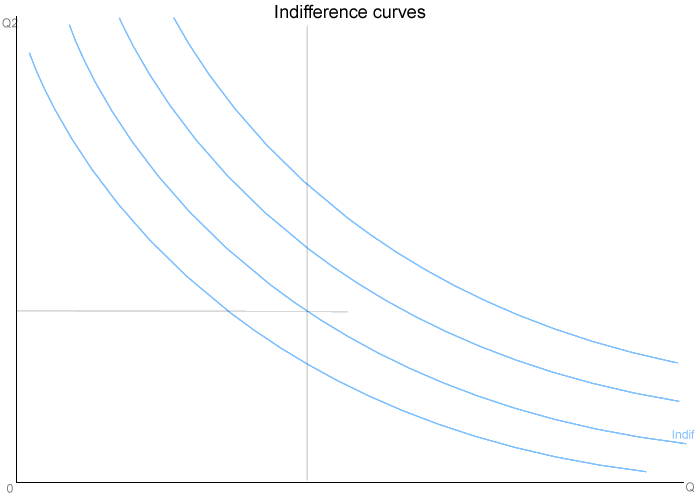
But what does the curve's shape tell us? The slope of an indifference curve at any given point is called the (MRS). It reveals the rate at which you are willing to trade one good for another while staying just as happy. It’s a measure of your personal, subjective valuation of one good in terms of the other.
Mathematically, the MRS is the negative of the slope of the indifference curve. The negative sign is there because to get more of one good (a positive change), you must give up some of the other (a negative change), and the slope itself is negative. Taking the negative of a negative makes the MRS a positive number, which is easier to interpret.
Willingness to Trade
Let’s stick with the pizza and soda example. Imagine you have a lot of pizza and only one soda. Your desire for another soda is high, and you have plenty of pizza to spare. You might be willing to trade 3 slices of pizza for just one more soda. At this point on your indifference curve, your MRS is 3.
Now, imagine the opposite. You have lots of soda but only one slice of pizza left. That last slice is precious. You'd be unwilling to give it up unless you got a lot of soda in return. Here, your MRS is low, perhaps 0.25 (meaning you'd trade a quarter of a slice for a full soda). This changing willingness to trade is why indifference curves are typically bowed inward, a shape known as being This shape reflects the law of diminishing marginal utility; the more you have of something, the less you value one additional unit.
Subjective vs Objective Trade-Offs
It's crucial not to confuse the MRS with the market's price ratio. The MRS is about your internal willingness to trade. The market has its own rate of exchange, determined by prices.
This market exchange rate is called the Marginal Rate of Transformation (MRT). It is the slope of the budget constraint line. The MRT tells you the rate at which you can trade one good for another in the marketplace. For example, if pizza costs $4 and soda costs $2, the market will let you trade 1 slice of pizza for 2 sodas. The MRT is .
Marginal Rate of Transformation
noun
The rate at which one good must be sacrificed to produce a single extra unit of another good, assuming that both goods require the same scarce inputs. In consumer theory, it is the rate at which the market allows a consumer to trade one good for another, equal to the price ratio.
The whole theory of consumer choice boils down to finding the point where your subjective valuation (MRS) equals the objective market rate (MRT). This is the point where your indifference curve is exactly tangent to your budget line. At that point, the rate you're willing to trade at is the same as the rate you can trade at, meaning you've found your optimal consumption bundle and can't make yourself any better off.
Ready to check your understanding?
What does the Marginal Rate of Substitution (MRS) represent?
If your MRS of pizza for soda is 4, what does this mean?
By understanding the slope of the indifference curve, we can quantify a consumer's personal trade-offs and pinpoint exactly where they align with market prices to achieve maximum satisfaction.