Mastering MALDI-TOF Applications
MALDI-TOF Overview
How MALDI-TOF Works
Matrix-Assisted Laser Desorption/Ionization Time-of-Flight (MALDI-TOF) is a mass spectrometry technique designed for analyzing large, non-volatile molecules like proteins, peptides, and polymers. Unlike methods that fragment molecules, MALDI-TOF is a "soft" ionization technique, meaning it keeps these large structures intact during analysis.
The process can be broken down into two main stages. First, the sample is ionized using the MALDI method. Then, the resulting ions are separated based on their mass-to-charge ratio using a time-of-flight (TOF) analyzer. Let's look at each stage.
Creating Ions with Laser and Matrix
The first step in MALDI is preparing the sample. The analyte, which is the substance being studied, is mixed with a solution containing a matrix compound. This mixture is spotted onto a metal plate and allowed to dry, causing the analyte and matrix to co-crystallize.
Matrix
noun
A small, organic compound that strongly absorbs light at the laser's wavelength. Common examples include sinapinic acid and α-cyano-4-hydroxycinnamic acid (CHCA).
The matrix does three important things:
- Absorbs Energy: It absorbs the energy from a pulsed laser (typically a UV laser), preventing the large analyte molecules from being destroyed by the direct laser blast.
- Isolates Analyte: The analyte molecules become embedded within the matrix crystals, separating them from each other.
- Facilitates Ionization: Upon absorbing the laser energy, the matrix vaporizes rapidly, creating a dense plume of gas. Within this plume, charge (protons) is transferred from the excited matrix molecules to the analyte molecules, creating ions, typically with a +1 charge ([M+H]+).
This entire process is called desorption and ionization. Because the energy transfer is indirect and gentle, the analyte molecules are launched into the gas phase as intact ions.
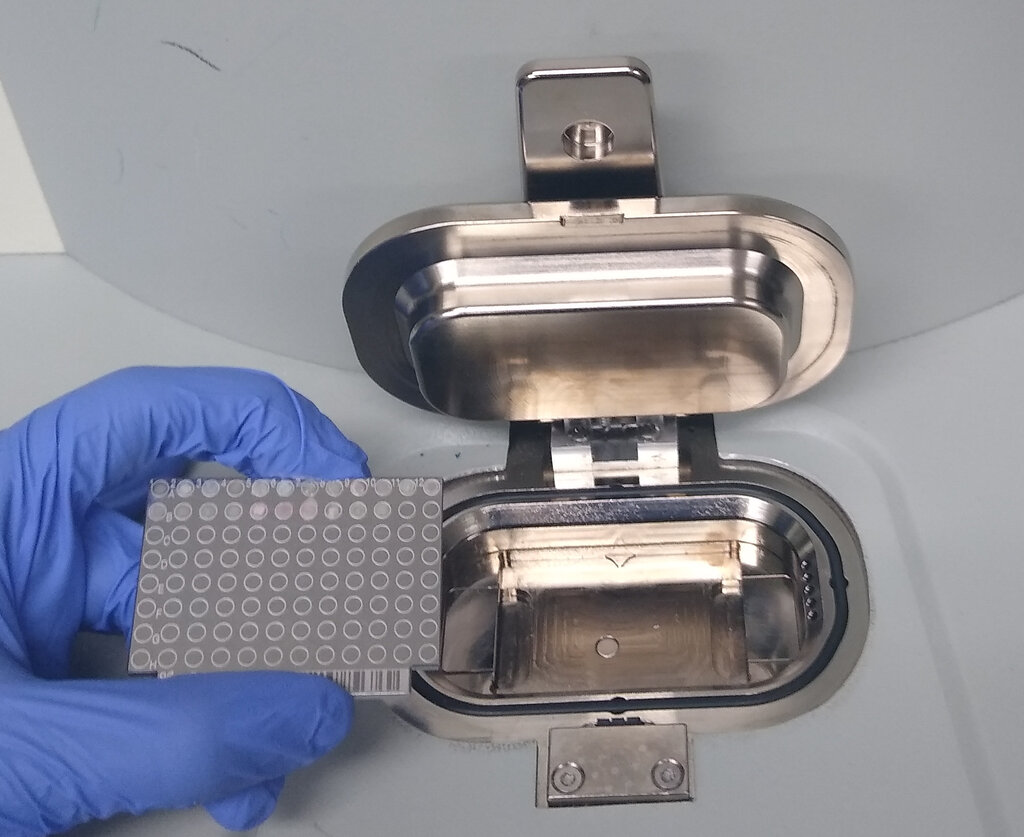
The plate containing the crystallized sample is placed inside the mass spectrometer's vacuum chamber. The laser is fired at the sample spot, triggering the ionization process and sending a cloud of newly formed ions toward the next stage: the mass analyzer.
The Race to the Detector
Once ionized, the molecules enter the Time-of-Flight (TOF) analyzer. It's essentially a long, field-free tube under a deep vacuum.
At the entrance of the tube, all the ions are accelerated by a strong electric field. This gives every ion the same amount of kinetic energy ().
Since every ion has the same kinetic energy, their velocities must depend on their mass. Lighter ions move faster, and heavier ions move slower. It's like a race where the lightest runners are the fastest.
The ions drift down the tube, and the time it takes them to reach a detector at the other end is measured. This "time of flight" is directly related to an ion's mass-to-charge ratio (). By recording when each ion hits the detector, we can construct a mass spectrum.
Advantages and Limitations
Like any technique, MALDI-TOF has distinct strengths and weaknesses that make it suitable for some applications but not others.
| Advantages | Limitations |
|---|---|
| High Mass Range | Can analyze very large molecules (>300,000 Da). |
| High Sensitivity | Requires only a tiny amount of sample (femtomole to attomole range). |
| Speed | Analysis is very fast, often taking only seconds per sample. |
| Salt Tolerance | More tolerant of salts and buffers in the sample compared to other methods like electrospray ionization. |
Many modern instruments incorporate a "reflectron," which is an ion mirror that corrects for small differences in the kinetic energy of ions with the same m/z. This significantly improves the instrument's mass resolution, allowing for more accurate mass measurements.
What is a primary function of the matrix in the MALDI process?
In a Time-of-Flight (TOF) analyzer, ions are accelerated by an electric field to give them all the same kinetic energy. How does this allow for their separation?
This combination of soft ionization and time-of-flight analysis makes MALDI-TOF a powerful tool, especially in fields like proteomics, microbiology, and polymer science.