Mastering Mahjong
Mahjong Basics
The Game of Sparrows
Mahjong is more than just a game; it's a social ritual and a mental workout. Originating in 19th-century China, its name translates to "sparrow" (麻將, májiàng), possibly mimicking the clattering sound of the tiles as they are shuffled, which sounds like the chattering of sparrows.
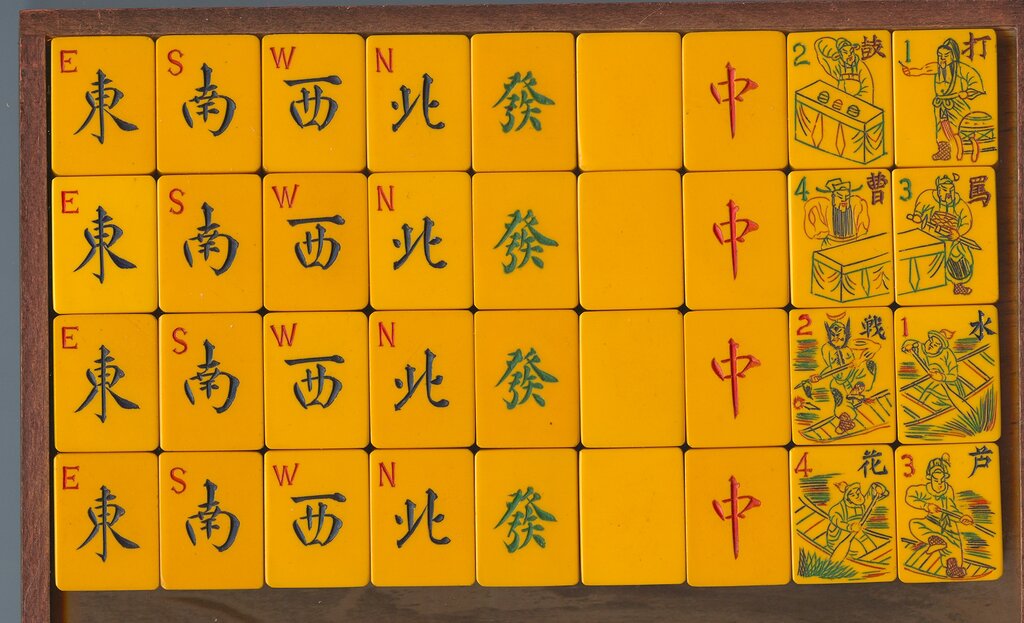
The game spread across the globe in the early 20th century, adapting to different cultures while retaining its core identity. It requires skill, strategy, and a bit of luck. At its heart are the 144 tiles, each with a unique identity and role.
Decoding the Tiles
A standard Mahjong set contains 144 tiles, divided into three main categories: Suits, Honors, and Bonus tiles. Understanding these is the first step to playing.
The largest group is the Suits. There are three suits, each numbered one through nine, with four identical copies of each tile.
- Dots (or Circles): These tiles feature small circles, from one to nine.
- Bamboo (or Bams): These show sticks of bamboo. The 1 Bamboo is often depicted as a bird, like a sparrow or peacock.
- Characters (or Cracks): These tiles feature the Chinese character for a number from one to nine on the bottom, and the character for "ten thousand" (萬, wàn) on the top.
Next are the Honor tiles. These don't have numbers. They are split into two groups:
- Winds: East, South, West, and North. There are four of each.
- Dragons: Red, Green, and White. The White Dragon is often a blank tile or has a simple blue border. There are four of each Dragon tile.
Finally, the Bonus tiles consist of Flowers and Seasons. There are four unique Flower tiles and four unique Season tiles. These are special and are usually set aside when drawn, providing bonus points at the end of a round.
The Goal of the Game
The basic objective in most forms of Mahjong is to be the first player to form a complete hand. Players start with 13 tiles and take turns drawing a new tile and discarding one, aiming to improve their hand.
A winning hand consists of 14 tiles arranged into four sets and one pair.
This structure is often described as 4x3 + 2. The sets and the pair are the building blocks of your hand.
There are two main types of sets you can form:
Pung
noun
A set of three identical tiles, like three 8 Dots or three Red Dragons.
Chow
noun
A sequence of three tiles from the same suit, like a 2, 3, and 4 of Bamboo.
The final piece of a winning hand is the Pair, which is simply two identical tiles. For example, two 5 Characters or two North Wind tiles.
So, a complete hand might look like this: a Pung of 2 Dots, a Chow of 4-5-6 Bamboo, a Pung of Red Dragons, a Chow of 7-8-9 Characters, and a pair of East Winds. By drawing and discarding, you gradually assemble these combinations until your hand is complete.
Ready to test your knowledge of the tiles and the basic goal of Mahjong?
A standard Mahjong set consists of 144 tiles divided into three main categories. What are they?
Which of the following is NOT one of the three suits in Mahjong?
With this foundation, you understand the pieces and the primary objective. The next step is learning how the game flows and how to use these sets to win.