Mastering Magnetostatics and Magnetic Fields
Biot-Savart Law Fundamentals
From Static Charges to Steady Currents
In electrostatics, you learned that a stationary charge creates an electric field. This field, described by Coulomb's Law, radiates outwards in space. But what happens when charges start to move? As long as they move at a constant rate—forming a steady current—they produce a constant magnetic field. This is the realm of magnetostaticss.
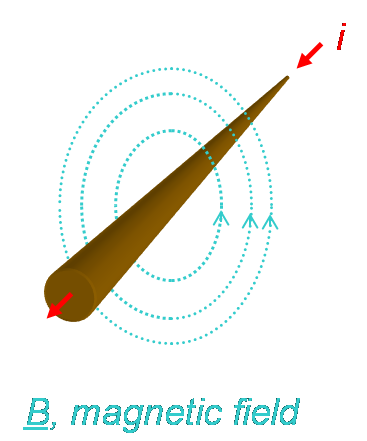
Just as Coulomb's Law is the cornerstone of electrostatics, the Biot-Savart Law is the foundation of magnetostatics. It allows us to calculate the magnetic field generated by a steady current. It's an empirical law, pieced together from experiments, much like its electrostatic counterpart.
Let’s start with a single point charge moving with a constant velocity . It generates a magnetic field at a point in space defined by the position vector from the charge.
This formula should look familiar. It has the same inverse-square dependence on distance, $1/r^2$, as Coulomb's Law. However, the magnetic field's direction is more complex. It depends on the cross product of the charge's velocity and the direction vector, meaning the field is perpendicular to both.
The Law for Wires
In practice, we rarely deal with single point charges. We're usually interested in the magnetic field from a current flowing through a wire. The Biot-Savart Law adapts beautifully for this. We consider the wire as a collection of tiny, infinitesimal segments. Each segment contributes a small piece to the total magnetic field.
For an infinitesimal wire segment carrying a steady current , the differential magnetic field it produces is:
To find the total magnetic field from the entire wire, we simply integrate this expression over the wire's length. This is an application of the superposition principle: the total field is the vector sum of the fields from all the tiny parts. This law was formulated by French physicists in 1820.
Putting It to Work
Let's apply this law to a couple of common scenarios. The maths can get a bit involved, but the physical principle remains the same.
First, consider a long, straight wire carrying a current . We want to find the magnetic field at a distance from the wire.
By setting up the integral and solving it (a standard calculus exercise), we find that for an infinitely long wire, the magnetic field has a simple magnitude:
This result is incredibly useful and forms the basis for another important concept, Ampere's Law, which provides a simpler way to solve problems with high symmetry.
Next, let's find the magnetic field at the very centre of a circular loop of wire with radius carrying a current .
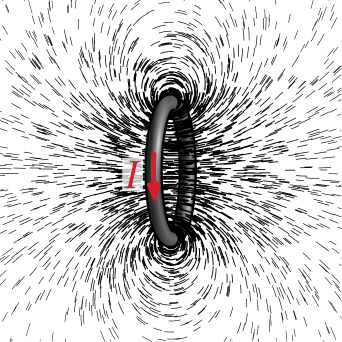
For this case, the geometry simplifies nicely. Every segment of the wire is the same distance from the centre, and the angle between and the position vector is always 90 degrees. When we integrate around the loop, the result for the magnetic field at the centre is:
The direction of the field is perpendicular to the plane of the loop, which you can determine using the right-hand grip rule: if your fingers curl in the direction of the current, your thumb points in the direction of the magnetic field at the centre.
What is the fundamental law in magnetostatics used to calculate the magnetic field generated by a steady current?
According to the Biot-Savart law, the direction of the magnetic field () generated by a charge moving with velocity () is...
The Biot-Savart Law is a powerful tool. It's the magnetic equivalent of Coulomb's Law, allowing us to build up the magnetic field from its source: moving charges.