Mastering Low Visibility Aviation Operations
Introduction to Low Visibility Operations
Flying Through the Fog
Dense fog, heavy rain, or a blizzard can blanket an airport, drastically reducing how far pilots can see. In the past, this meant widespread cancellations and delays. Today, airports and airlines use a specific set of rules to keep flying safely, even when the weather doesn't cooperate. These rules are known as Low Visibility Operations.
Low Visibility Operations (LVO)
noun
A set of procedures that allows aircraft to take off and land safely in weather conditions with significantly reduced visibility.
LVOs are critical for maintaining the flow of air traffic. They allow airports to continue operating, preventing the ripple effect of delays that can disrupt travel for thousands of people. But this efficiency never comes at the cost of safety. LVOs are built on strict, internationally agreed-upon standards that ensure every movement on the ground and in the air is carefully managed.
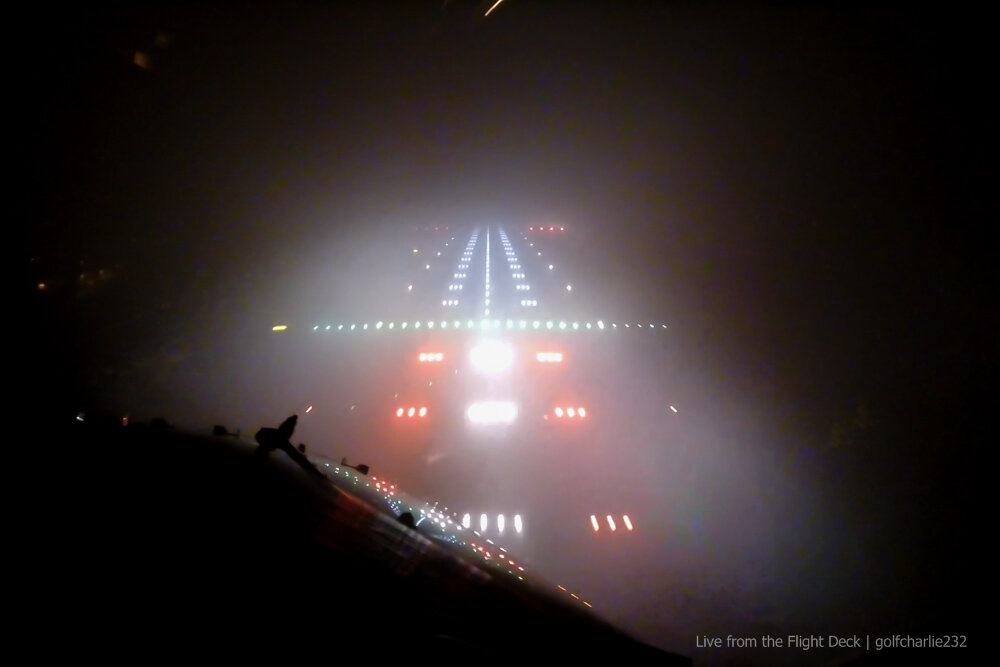
But what exactly qualifies as "low visibility"? It's not just a pilot looking out the window and making a judgment call. Aviation authorities use a precise measurement called Runway Visual Range.
Runway Visual Range (RVR)
noun
The distance down a runway that a pilot of an aircraft on the centerline can see the runway surface markings or the lights delineating the runway.
RVR is measured by instruments called transmissometers placed alongside the runway. They provide pilots and air traffic controllers with real-time, objective data about the visibility exactly where it matters most: on the runway itself. This measurement is typically given in feet or meters.
Activating the Procedures
When the RVR drops below a specific value, an airport doesn't just operate as usual. It formally declares that it's implementing Low Visibility Procedures (LVPs). Think of LVPs as the official rulebook for bad weather operations.
Low Visibility Procedures (LVPs) are special protocols activated at an airport to ensure safety during takeoffs and landings in poor visibility. They are initiated when the Runway Visual Range (RVR) falls below a pre-determined threshold, typically around 600 meters (about 1,800 feet).
Once LVPs are in effect, everything on the airfield moves with greater caution. The number of aircraft allowed to taxi or be near the runway is reduced to prevent collisions. This is why, even with LVOs, you might experience some delays. Safety requires giving each aircraft more space and time.
These procedures cover both departures and arrivals. A takeoff performed under these conditions is called a Low Visibility Take-Off (LVTO). For an LVTO to be permitted, the RVR must be above a certain minimum, which can be as low as 75 meters (about 250 feet) for specially certified aircraft and crews. For landings, the minimum RVR depends on the type of approach being flown and the equipment on the aircraft and at the airport. LVPs remain active until the visibility improves and stays consistently above the required RVR value.
The Decision Point
During a low visibility approach, every pilot has a critical altitude in mind known as the Decision Height. This is the point of no return.
Decision Height (DH)
noun
A specified altitude in a precision approach at which a pilot must decide whether to continue the approach to land or execute a missed approach (a go-around).
When the aircraft reaches the Decision Height, the pilot must have the required visual references in sight, like the runway approach lights. If they can't see them, they are required to abort the landing and fly a "go-around." This is not an emergency; it's a standard safety procedure that ensures a landing is only attempted when it is safe to do so. The specific DH for an approach is published on aeronautical charts and can be as low as just a few hundred feet above the ground.
No visual contact at Decision Height means no landing. The pilot must immediately climb and follow the missed approach procedure.
Ultimately, LVOs are a carefully balanced system. They combine advanced technology, strict regulations, and rigorous training to ensure that air travel can continue safely and efficiently, no matter what the weather looks like outside.