Mastering Low Stakes No Limit Hold'em
Understanding Poker Basics
The Goal of the Game
The objective in No-Limit Texas Hold'em is straightforward: win the pot. The pot is the collection of all the chips bet in a single hand. You can win it in two ways. The first is by having the best five-card poker hand at the end of all the betting rounds. The second, more common way, is to make all of your opponents fold their hands, leaving you as the last player standing.
Each hand is a self-contained contest. You use a combination of two private cards only you can see and five shared community cards to build your best hand. The skill lies in evaluating the strength of your hand, reading your opponents, and making smart bets.
What Beats What
Knowing which hand is stronger than another is fundamental. If you don't know that a flush beats a straight, you're going to have a bad time. The hand rankings are a fixed hierarchy. Here they are, from the unbeatable Royal Flush down to a simple High Card.
| Hand | Description |
|---|---|
| Royal Flush | A, K, Q, J, 10, all of the same suit. The best possible hand. |
| Straight Flush | Five cards in sequence, all of the same suit. |
| Four of a Kind | Four cards of the same rank (e.g., four Queens). |
| Full House | Three cards of one rank and two cards of another. |
| Flush | Any five cards of the same suit, not in sequence. |
| Straight | Five cards in sequence, but not of the same suit. |
| Three of a Kind | Three cards of the same rank. |
| Two Pair | Two cards of one rank, two cards of another rank. |
| One Pair | Two cards of the same rank. |
| High Card | If no one has any of the above, the player with the highest card wins. |
Memorize these rankings. They are the foundation upon which every decision you make is built. For example, if you hold five hearts, you have a flush, which is a very strong hand.

The Flow of a Hand
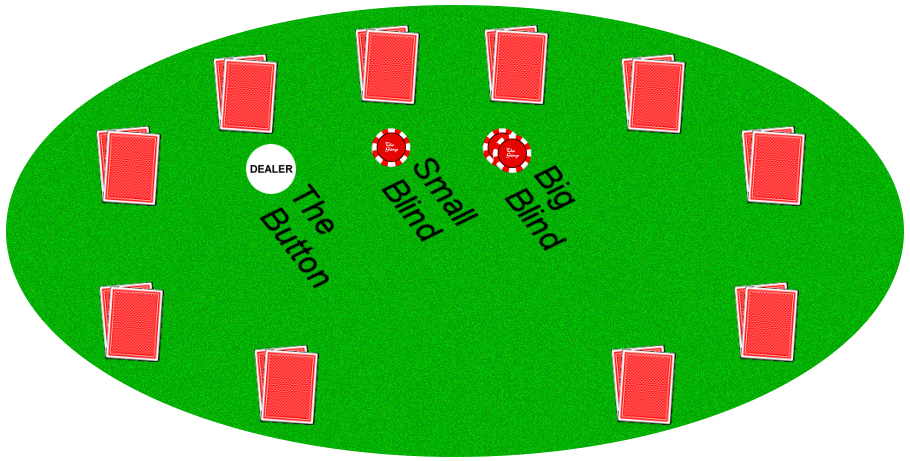
Every hand of Texas Hold'em follows the same sequence. But before any cards are dealt, a few key positions at the table must be established. These positions rotate one spot to the left after each hand.
The Dealer Button is a marker that indicates who is the nominal dealer for the hand. It's the most powerful position because the player on the button acts last in most betting rounds.
To the left of the button are two mandatory bets called the blinds. They exist to ensure there's always something to play for in the pot.
Small Blind
noun
The player immediately to the left of the dealer button, who posts a small, required bet before the cards are dealt.
Big Blind
noun
The player to the left of the small blind, who posts a larger, required bet. This is typically the minimum bet size for the first round.
Once the blinds are posted, the hand begins. It unfolds in up to four distinct stages, each with a round of betting.
1. Pre-Flop: Every player is dealt two private cards, called "hole cards." The first betting round begins, starting with the player to the left of the big blind.
2. The Flop: Three community cards are dealt face-up in the middle of the table. A second round of betting occurs, starting with the first active player to the left of the dealer button.
3. The Turn: A fourth community card is dealt. The third betting round follows, with the same rules as the flop.
4. The River: The fifth and final community card is revealed. The last round of betting takes place.
If two or more players remain after the final bet, it's time for the Showdown. Players reveal their hole cards, and the one who can make the best five-card hand using any combination of their two hole cards and the five community cards wins the pot.
Now that you know the basic structure and rules, you're ready to start thinking about strategy. Let's test your understanding of these core concepts first.
What are the two fundamental ways to win a pot in No-Limit Texas Hold'em?
What is the correct sequence of community cards dealt in a Texas Hold'em hand?