Mastering Logarithms
Introduction to Logarithms
What is a Logarithm?
Exponents answer the question, "What do you get if you multiply a number by itself a certain number of times?" For example, $2^3$ asks you to multiply 2 by itself 3 times, giving you 8.
Logarithms, or "logs" for short, ask the opposite question: "How many times do you need to multiply a base number by itself to get another number?" For the equation $2^x = 8$, the logarithm tells us that $x = 3$. It finds the unknown exponent.
The logarithm of a number is the exponent to which another fixed number, the base, must be raised to produce that number.
We can write this relationship mathematically. The expression is equivalent to the logarithmic equation:
Here's how to read that out loud: "log base of equals ."
- is the base. It's the number being multiplied.
- is the argument. It's the final number we're trying to get to.
- is the logarithm, which is just the exponent from the original expression.
An Inverse Relationship
Logarithms and exponentials are inverse operations. They undo each other, just like subtraction undoes addition and division undoes multiplication.
If you have an exponential function, like , its inverse is the logarithmic function . When you graph them, you can see this relationship clearly. The two functions are perfect reflections of each other across the diagonal line .
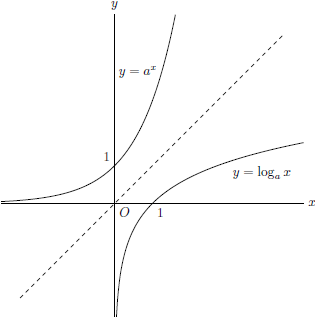
Because they are inverses, one function's action cancels out the other's. This gives us two very useful identities:
- Taking the log of an exponential with the same base gives you the exponent.
For example, . The base-5 logarithm cancels out the base-5 exponential, leaving just the exponent, 2.
- Raising a base to a logarithm with the same base gives you the argument.
For example, . The exponent is , which equals 3. So, .
Basic Logarithm Rules
Logarithms follow certain rules that help us simplify complex expressions. These rules come directly from the laws of exponents. There are three main ones to know.
Product Rule
other
The logarithm of a product is the sum of the logarithms of its factors.
Let's test this with an example. We know . We also know that . According to the product rule:
Since and , we get . It works.
Quotient Rule
other
The logarithm of a quotient is the logarithm of the numerator minus the logarithm of the denominator.
Let's check this one too. We know . We also know that . According to the quotient rule:
Since and , we get . This one holds true as well.
Power Rule
other
The logarithm of a number raised to a power is the power multiplied by the logarithm of the number.
This rule is especially useful for getting variables out of exponents. For example, let's look at . The power rule lets us rewrite this as:
We know that , so the expression simplifies to . This is correct, since , and .
Ready to test your understanding?
Which logarithmic equation is equivalent to the exponential equation ?
A logarithm answers the question: 'How many times do you need to multiply a base number by itself to get another number?'
These fundamental concepts form the basis of working with logarithms. Understanding them is the first step toward using logs to solve more complex problems.