Mastering LLM Prompt Evaluation
Introduction to LLMs
What is a Large Language Model?
A Large Language Model, or LLM, is a type of artificial intelligence trained to understand and generate human-like text. Think of it as a supercharged autocomplete. Instead of just suggesting the next word in your sentence, it predicts the most plausible sequence of words, paragraphs, or even entire articles based on the input it receives.
They're called "large" for two reasons: they are built with a massive number of parameters, which are like the knobs and dials the model tunes during training, and they learn from enormous datasets. This training data includes a vast portion of the public internet, digital books, and other text sources, allowing the model to learn grammar, facts, reasoning styles, and the subtle nuances of language.
Large language models (LLMs) are AI systems that understand and create human language, doing tasks like summarizing articles, answering questions, writing code, and more.
The result is a versatile tool that can draft emails, write code, answer questions, translate languages, and even create stories. The key to interacting with an LLM is the prompt—the initial piece of text you provide to guide its response.

How LLMs Turn Words into Math
Computers don't understand words; they understand numbers. Before an LLM can process text, it must first convert it into a format it can work with. This happens in two main steps: tokenization and embedding.
Tokenization is the process of breaking down a sentence into smaller pieces, called tokens. A token can be a word, a part of a word, or even just a punctuation mark. For example, the sentence "LLMs are powerful tools" might be tokenized into:
["LLMs", " are", " powerful", " tools"]
Next, each token is converted into a numerical representation called an embedding. An embedding is a vector—a long list of numbers—that captures the token's meaning and its relationship to other tokens. Words with similar meanings will have similar numerical vectors. This allows the model to work with the concepts behind the words, not just the words themselves.
This mathematical representation is what allows the model to understand analogies like "man is to king as woman is to queen."
The Secret Sauce: Attention
The core component of modern LLM architecture is the Transformer, and its key innovation is the attention mechanism. Attention allows the model to weigh the importance of different tokens in the input text when generating a response. It helps the model focus on the parts of the input that are most relevant to the task at hand.
Think about how you read. When you see the sentence, "The cat sat on the mat and licked its paw," you instinctively know that "its" refers to the "cat," not the "mat." The attention mechanism gives the LLM a similar ability to track relationships between words, even across long stretches of text. It calculates an "attention score" for each token relative to every other token, effectively deciding how much focus to place on each part of the input to predict the next word.
This ability to focus on context is what makes LLM responses coherent and relevant.
Guiding the Model with Prompts
A prompt is the instruction you give to an LLM. It can be a question, a command, or just a snippet of text to continue. The quality of the prompt directly influences the quality of the output. A clear, specific, and well-structured prompt provides the necessary context for the model to generate the response you want.
For example, asking "Tell me about dogs" is very broad. A better prompt would be, "Explain the typical daily exercise needs for a medium-sized adult dog, like a Labrador Retriever."
This more specific prompt gives the LLM clear constraints and context, leading to a much more useful and focused answer. Learning to write effective prompts, a skill known as prompt engineering, is key to unlocking the full potential of these powerful models.
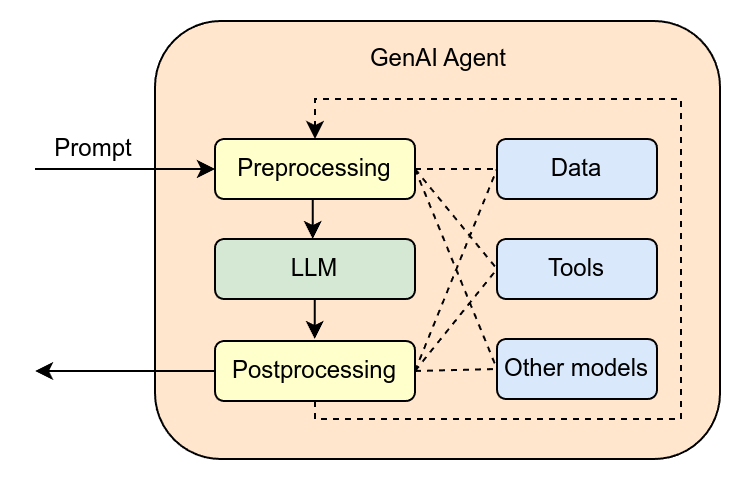
With these foundational concepts, you can better understand how an LLM processes your requests and generates its responses.
Now, let's test your understanding of these core concepts.
Which of the following best describes the primary function of a Large Language Model (LLM)?
Before an LLM can process human language, it must first convert text into numbers. What are the two main steps in this process?
Understanding these building blocks is the first step toward mastering how to work with large language models.