Mastering Linked Lists for Software Engineering
Variant Mechanics and Trade-offs
Pointer Architecture and Trade-offs
You already know that linked lists store data in nodes scattered across memory, connected by pointers. But the way those pointers are structured creates critical trade-offs in performance and memory usage. Let's move past the basics and examine the architectural nuances that matter in a managed environment like .NET.
The most fundamental choice is between a singly and a doubly linked list. A singly linked list node is minimal. It contains the data and a single reference to the next node. This simplicity keeps its memory footprint low. Each node object on the .NET managed heap has a small overhead for its object header and method table pointer, and adding just one more reference for next keeps that overhead lean.
Singly Linked List Node:
[Data | Next Pointer]
A doubly linked list, however, adds a second reference: previous. This immediately doubles the pointer overhead per node. While an extra 8 bytes (on a 64-bit system) might seem trivial, it adds up. For a list with a million nodes, that's an extra 8 megabytes of memory dedicated solely to navigation.
Doubly Linked List Node:
[Previous Pointer | Data | Next Pointer]
The trade-off? Flexibility. That previous pointer allows for bidirectional traversal. You can move forwards and backwards through the list with ease. This makes operations like deleting a node far more efficient. In a singly linked list, to delete a node, you first have to traverse from the head to find the node before it. In a doubly linked list, you already have a direct link and can perform the deletion in constant time, , assuming you have a reference to the node you want to delete.
Another variation is the circular linked list. Here, the next pointer of the final node doesn't point to null. Instead, it loops back and points to the head of the list. This structure is perfect for creating data buffers or implementing round-robin scheduling algorithms, where you need to cycle through a set of items continuously. A media playlist is a classic example. When the last song finishes, it can seamlessly start over from the first.
The main hazard with circular lists is the risk of infinite loops. If your traversal logic doesn't include a specific condition to stop (like checking if you've returned to the head), your program will loop forever.
The Cache Problem
Regardless of the pointer structure, all linked lists share a common performance weakness: s. Because each node can be allocated anywhere in memory, traversing a list involves jumping between potentially distant memory addresses. This is called pointer-chasing.
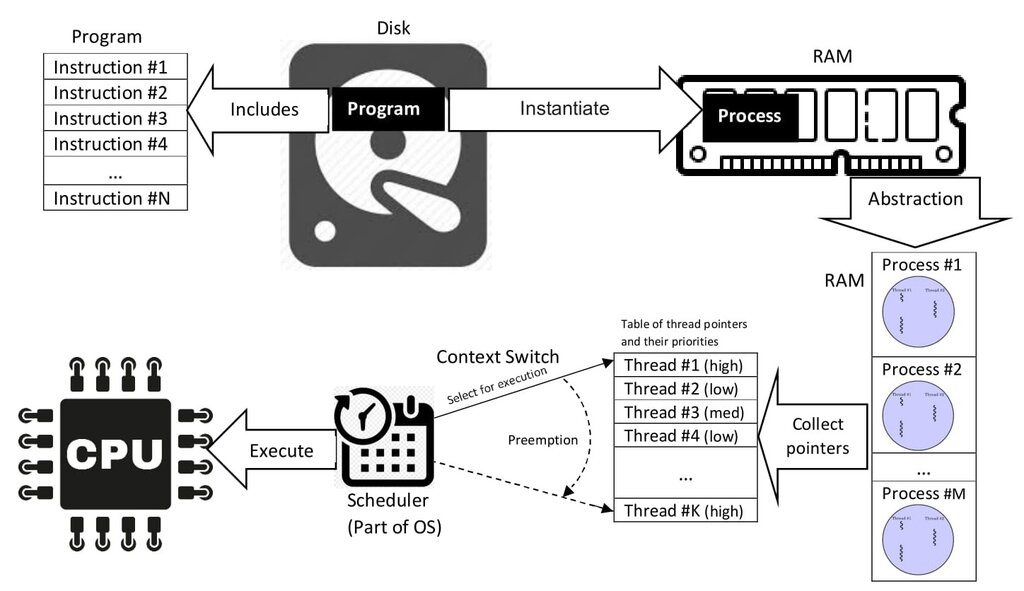
CPUs are optimized for sequential memory access. They predict you'll need the next block of memory and preemptively load it into a fast, local cache. Arrays benefit hugely from this, as their elements are stored one after the other. When you access array[i], array[i+1] is likely already in the cache. With a linked list, fetching node.next is a gamble. The next node could be anywhere, forcing the CPU to stall and fetch from main memory, which is orders of magnitude slower.
Probabilistic Performance
So how can we get the dynamic sizing of a linked list with better search performance? One clever solution is the Skip Lists. A skip list is a probabilistic data structure built on top of a standard linked list. It adds multiple layers of forward pointers, creating express lanes that allow you to bypass many nodes during a search.
When a new node is inserted, a random process determines how many layers of pointers it gets. A few nodes will have pointers on the highest level, more will be on the middle levels, and all nodes exist on the base level. To search, you start at the highest level, follow the pointers until you go too far, then drop down a level and repeat. This allows you to find elements in time on average, putting it on par with balanced binary search trees, but often with a simpler implementation.
Now, let's test your understanding of these trade-offs.
What is the primary trade-off when choosing a doubly linked list over a singly linked list in a 64-bit .NET environment?
Why do linked lists often lead to more CPU cache misses compared to arrays?
Choosing the right list structure depends entirely on your access patterns. If you need pure, forward-only speed with minimal memory, singly linked lists are ideal. For frequent deletions or reverse lookups, the overhead of a doubly linked list is worth it. For logarithmic search in a dynamic list, skip lists offer a powerful alternative to trees.