Mastering Limits and Derivatives
Formal Limits
Approaching From All Sides
Previously, you might have found the limit of a function by simply substituting a value. For many well-behaved functions, this works perfectly. But what happens when we can't just plug in the number? What does it truly mean for a function to approach a certain value?
The core idea of a limit is about observing a function's behaviour as its input gets incredibly close to a specific point, without necessarily reaching it. To do this rigorously, we must consider the approach from two directions: the left and the right.
A limit only exists at a point if the function approaches the same value from both the left-hand side and the right-hand side.
We call these one-sided limits. The limit as approaches a point from the left (from values smaller than ) is written as:
The limit as approaches from the right (from values larger than ) is written as:
If, and only if, , can we say that the overall limit exists and is equal to , written as . If they don't match, the limit at does not exist.
The Precision Game
Saying a function "approaches" a value is intuitive, but maths demands precision. How do we formalise this? The answer lies in the , a concept developed by mathematicians like Bernard Bolzano and Karl Weierstrass.
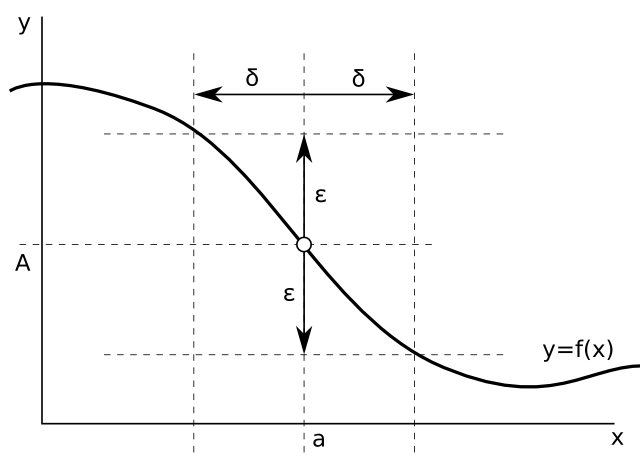
Think of it as a game of precision. I claim that the limit of as approaches is . To challenge me, you specify a small target range around , an error tolerance. This tolerance is called epsilon, or . My task is to find a corresponding range around , called delta or , such that for any I pick within that range (except possibly at itself), the function's value is guaranteed to fall inside your target range.
If I can always find a for any you give me, no matter how tiny, then my claim is correct and the limit is proven. This definition removes all ambiguity from the word "approach".
To Infinity and Beyond
Limits don't just describe behaviour near a specific point. They also help us understand what happens when a function's value or its input grows without bound. This leads to the idea of asymptotes, lines that a curve approaches but never quite touches.
First, consider a function like . As gets closer and closer to 0, from either the left or the right, the value of shoots upwards, becoming infinitely large. We describe this with an infinite limit:
When a function has an infinite limit at a point , its graph has a at that line. It's a vertical boundary that the function will climb or descend alongside, but never cross.
Next, what if we let the input become infinitely large? This is a limit at infinity, and it tells us about the function's long-term behaviour. For the function , as gets extremely large, the +1 and -1 terms become insignificant compared to the terms. The function's value gets closer and closer to .
We write this as:
When a function approaches a finite value as approaches or , the line is a of the graph. It describes the level the function settles at in the long run.
The Squeeze Theorem
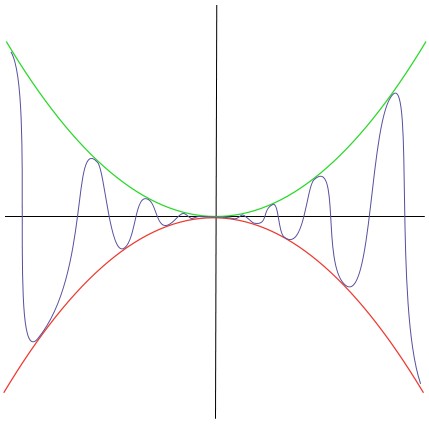
Some limits are tricky to calculate directly. A classic example is the limit of as approaches 0. We can't just substitute , and the part oscillates wildly near zero. So, what can we do?
This is where the comes in handy. The idea is simple: if we can 'squeeze' our difficult function between two other, simpler functions that both approach the same limit at a certain point, then our difficult function must also approach that same limit.
For our example, we know that the sine function is always bounded between -1 and 1:
Since is always non-negative, we can multiply across the inequality without changing the direction of the symbols:
Now we have our function squeezed between and . Let's take the limit of the two 'bread' functions as approaches 0:
Since both the lower and upper bounds go to 0, the Squeeze Theorem tells us that the function trapped in the middle must also go to 0.
For the overall limit to exist and be equal to a value L, what condition must be met?
What is the primary purpose of the epsilon-delta () definition of a limit?
Understanding these formal definitions of limits provides the solid ground on which the rest of calculus is built. They allow us to move from average rates of change to the instantaneous rates you'll see in derivatives.