Mastering LightGBM for Machine Learning
Introduction to Gradient Boosting
Building Better Models Together
In machine learning, a single model, no matter how complex, can sometimes struggle to make accurate predictions. A common strategy to overcome this is to combine multiple models into a team, an approach called ensemble learning. The idea is simple: a team of models can often perform better than any single model on its own.
There are different ways to form such a team. One popular method is boosting, where models are built one after another in a sequence. Each new model's main job is to fix the mistakes made by the models that came before it.
Think of it like a group of students tackling a tough exam. The first student answers all the questions. The teacher then tells the second student which questions the first one got wrong. The second student focuses only on those specific questions. A third student then works on the mistakes made by the first two combined, and so on. By the end, the team's final set of answers is far more accurate than what any single student could have achieved alone.
In boosting, the "students" are simple models called weak learners. A weak learner is a model that performs just slightly better than random guessing. A common choice for a weak learner is a very shallow decision tree, sometimes with only a single split, often called a "decision stump." By adding these weak learners sequentially, each one correcting its predecessor's errors, the ensemble slowly becomes a single, highly accurate predictor.
How Gradient Boosting Works
Gradient boosting is a specific and very effective type of boosting. Like other boosting methods, it builds models sequentially. But it has a clever way of figuring out what mistakes need fixing.
Instead of just identifying which predictions were wrong, it calculates the residuals—the difference between the actual values and the model's predictions. For the next model in the sequence, its goal is not to predict the original target, but to predict these residuals.
Let's say we're trying to predict house prices. The first model makes some predictions. For a house that actually costs $300,000, maybe the model predicts $280,000. The residual is $20,000.
Now, the second model is trained. Its job is to learn to predict that $20,000 residual. By adding the prediction of the second model to the first, our combined prediction gets closer to the true value. This process repeats, with each new model refining the predictions by focusing on the remaining errors.
The "gradient" part comes from an optimization algorithm called Gradient Descent. Each new weak learner is essentially taking a small, calculated step in the direction that most effectively reduces the overall error of the model, much like walking downhill in the fog by always taking a step in the steepest direction.
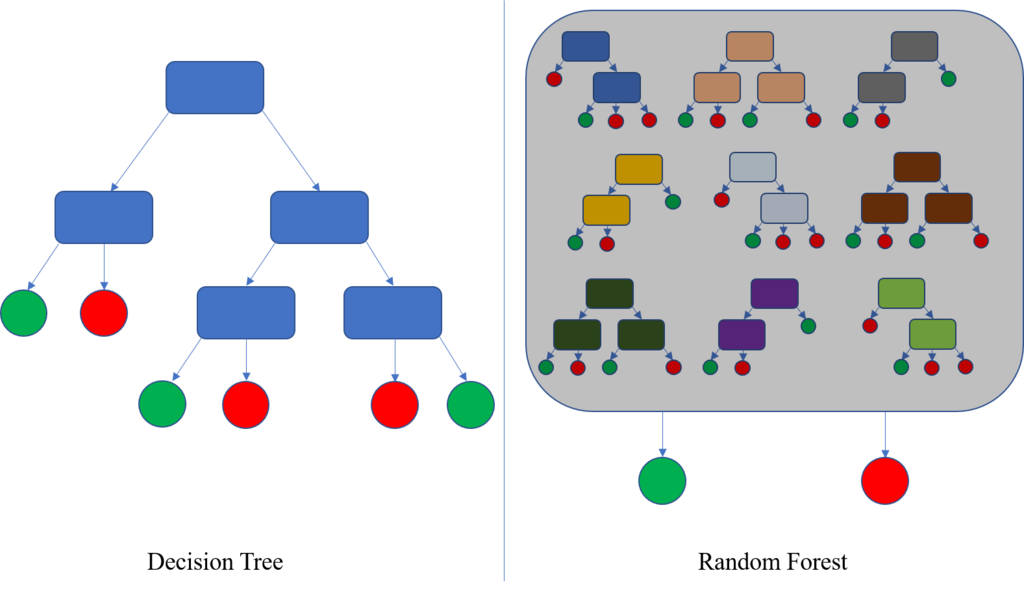
This sequential, error-correcting approach is fundamentally different from other ensemble methods like Bagging, which is used in Random Forests. In Bagging, many models (usually deep decision trees) are trained independently and in parallel on different subsets of the data. Their final predictions are then averaged. Boosting, on the other hand, is a collaborative, step-by-step process.
| Feature | Bagging (e.g., Random Forest) | Boosting (e.g., Gradient Boosting) |
|---|---|---|
| Model Training | Parallel | Sequential |
| Model Goal | Each model solves the original problem | Each model corrects prior models' errors |
| Model Type | Complex (deep trees) | Simple (shallow trees) |
| Main Purpose | Reduce model variance | Reduce model bias and variance |
Why Use Gradient Boosting?
Gradient boosting has become a go-to technique for many data scientists, and for good reason. It offers several key advantages.
First, it delivers state-of-the-art predictive accuracy. For many structured or tabular datasets—think spreadsheets of customer data, financial records, or sensor readings—gradient boosting models are often the top performers in machine learning competitions.
Second, it's incredibly flexible. Gradient boosting can be used for a wide range of tasks, including regression (predicting a number) and classification (predicting a category). It can also handle different types of data and is less sensitive to outliers than some other models.
Finally, it provides clear insights. Because it's often built with decision trees, it's possible to inspect the model and determine which features were most important in making predictions. This helps us understand the "why" behind the model's decisions.
Because of its power and flexibility, gradient boosting is used across many industries. It helps banks detect fraudulent transactions, retailers predict customer churn, and researchers identify promising drug candidates. It excels at finding complex patterns in noisy, real-world data.
What is the primary goal of each new model added in a boosting ensemble?
In gradient boosting, a new model is trained to predict the ____ of the previous model's predictions.
Gradient boosting is a powerful framework that combines many simple models into a single, highly accurate predictor by focusing on correcting errors sequentially. Its performance and versatility make it a vital tool in modern machine learning.