Mastering Karate Transitions and Tactics
Advanced Kihon Mechanics
The Engine of Your Technique
You've learned the basic shapes of punches, blocks, and stances. Now, we move beyond mimicry. The goal is to understand the engine that drives every powerful and effective technique. True karate isn't about isolated arm or leg movements; it's a full-body symphony where power is generated from the ground up.
Every technique begins with your connection to the floor. Think of it as plugging into a power source.
This flow of energy is called the kinetic chain. It’s the sequence of movements that transfers force from your feet, through your legs, amplified by your hips, channelled through your core, and finally unleashed through your fist or foot. Mastering this chain is the difference between a light tap and a devastating strike.
From the Ground Up
Let's break down the journey of a simple reverse punch (gyaku-zuki). The movement doesn't start in your arm. It starts with your back foot pushing firmly into the ground. This push creates an initial force.
This force travels up your leg and causes your hip to rotate powerfully towards the target. This hip rotation acts like a gearbox, multiplying the initial force. The energy then flows through your torso and shoulder, whipping your arm forward. The punch is simply the final, visible expression of this energy transfer.
At the centre of this entire process is your core, known in Japanese as the Hara (腹). Located in the lower abdomen, it's your body's centre of gravity and the command centre for all movement. A strong, stable Hara ensures that the energy generated by your legs and hips is transferred efficiently to your upper body, without any leaks. Engaging your Hara is what connects the lower and upper body into a single, powerful unit.
The Pulling Hand and Perfect Timing
As your punching hand extends, your other hand, the (引き手), snaps back to your hip. This isn't a passive reset. The pulling hand is an active and essential part of the technique. By pulling back sharply, you engage your back and shoulder muscles, creating rotational torque across your torso. The faster and stronger your Hikite, the faster and stronger your punch. They are two sides of the same coin.
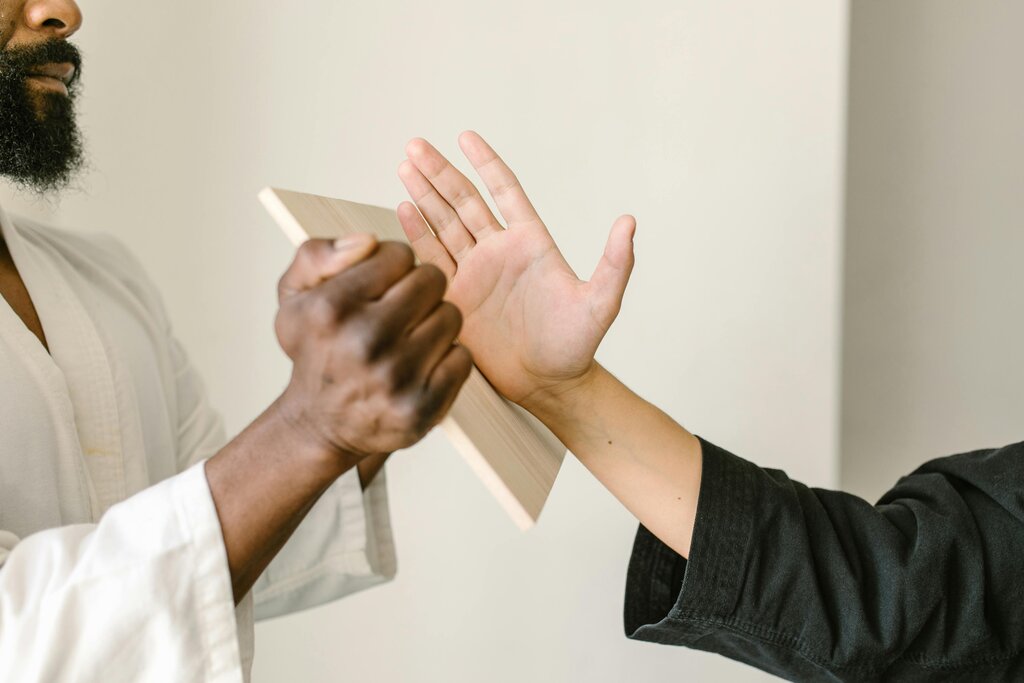
Finally, we come to the moment of impact. This is where Kime (決め) comes in. Kime is often translated as 'focus,' but it's more specific than that. It is the instantaneous tensing of the entire body at the very moment your technique makes contact. The rest of the movement, both before and after, should be relaxed and fluid.
Think of cracking a whip. The whip is loose and fast until the very tip, where it creates a sonic boom. Constant tension makes you slow and rigid. True power comes from the sharp transition from relaxation to tension, focusing all your body's energy into a single point in a fraction of a second.
Your breathing is the final piece that locks everything together. A sharp exhalation from the diaphragm as you execute Kime tenses your core, stabilises your structure, and unifies the body. This is often, but not always, vocalised as a Kiai. This controlled, forceful breath ensures your body is a solid, immovable structure at the point of impact, maximising the power you deliver to the target.
Ready to test your understanding of these core principles?
According to the principle of the kinetic chain, what is the correct sequence for generating power in a reverse punch (gyaku-zuki)?
What is the primary role of the 'Hara' (腹) in karate?
By integrating these concepts of kinetic linking, core stability, rotational torque, and focused timing, your basic techniques will transform. They will become more efficient, powerful, and intentional.