Mastering Karate Mechanics and Application
Bio-mechanical Power Generation
From the Ground Up
A powerful karate strike has little to do with arm strength. True power isn't generated in the limb that strikes; it's transferred through the body in a sequence, starting from the floor. This sequence is called the kinetic chain. Think of it like cracking a whip. The energy starts at the handle (your feet), flows up the length of the whip (your body), and concentrates at the very tip (your fist or foot) with explosive force.
Every technique begins with a connection to the ground. By pushing against the floor, you generate an equal and opposite force that travels back up into your body. This is Ground Reaction Force (GRF), the raw energy source for your strike. Without a stable stance and proper connection to the floor, this energy dissipates, and your technique becomes weak, no matter how strong your arms are.
Your feet initiate the movement, your legs amplify it, your hips direct it, and your arm delivers it. Every link in the chain must work in perfect sequence.
The Engine of the Body
The hips, or koshi in Japanese, act as the transmission for this energy. How you use them is a key differentiator between karate styles. Styles like Shotokan often emphasize a large, powerful hip rotation. The hips twist fully, generating significant momentum that travels through the torso and out through the limb. This is ideal for long-range techniques where you have time and space to build up maximum force.
In contrast, styles like Goju-ryu frequently use a rapid, vibrating hip action. Instead of a full rotation, the hips tense and release in a short, sharp pulse. This method is devastating at close range, where large movements are impractical. It creates a shocking, penetrating power without telegraphing the movement.
Focus and Breath
Generating power is only half the battle. You have to deliver it effectively. This is where breathing and focus come in. Many karate styles use a technique called Ibuki breathing. This is a hard, audible exhalation that tenses the core muscles, creating intra-abdominal pressure. This pressure turns your torso into a solid, unbendable unit, ensuring that no energy is lost as it travels from your hips to your striking limb. Your body becomes a rigid conduit for power.
The final, critical element is kime. This Japanese term translates roughly to 'focus' or 'decision.' In practice, it's the instantaneous tensing of the entire body at the moment of impact. To generate speed, your muscles must be relaxed during the initial movement. Then, for a split second, every muscle contracts, focusing all the kinetic energy into the target. This transition from relaxation to tension is what gives a karate strike its signature penetrating power. Without kime, a punch is just a push.
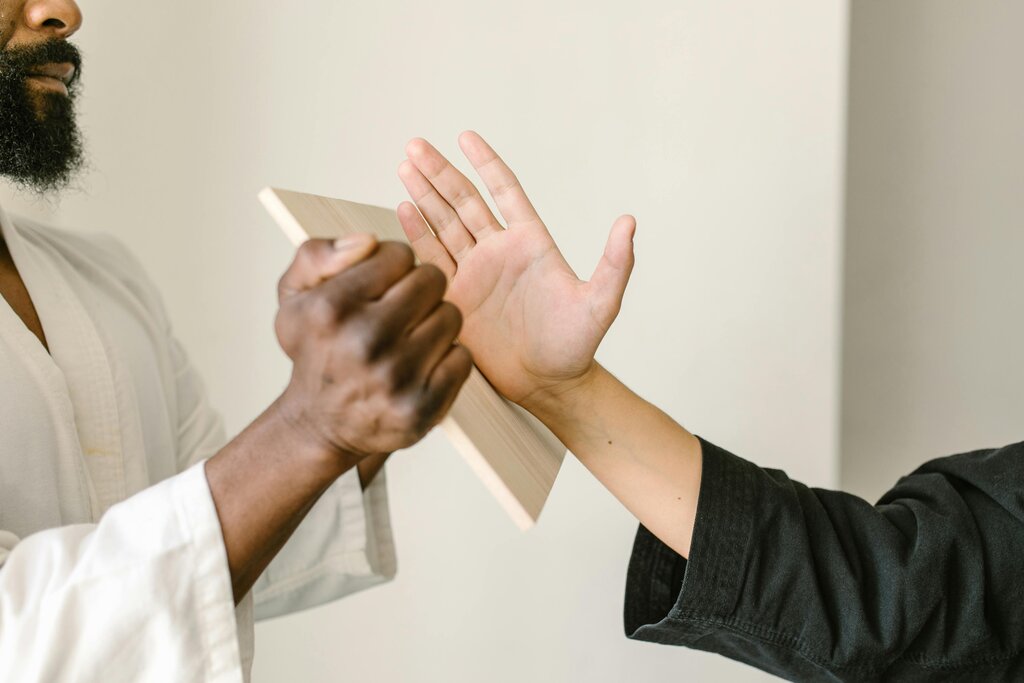
Mastering these elements transforms your karate. You stop relying on the brute strength of individual muscles and start using your entire body as an integrated system for generating and delivering overwhelming force. It's the difference between moving your body and your body moving as one.
Time to test your knowledge on these core principles.
According to the principles of the kinetic chain, where does the power for a strong karate strike originate?
What is the primary function of 'koshi' (the hips) in generating power?
By integrating these biomechanical principles, you can develop techniques that are not only powerful but also efficient, turning your entire body into a finely tuned weapon.