Mastering Karate Dynamics and Practical Application
Style Mechanics Comparison
Shotokan: Linear Power
Shotokan's approach to power is direct and explosive. It relies on long, deep stances like Zenkutsu-dachi to create a stable base, lowering the body's centre of gravity. From this rooted position, practitioners generate tremendous linear force. Think of it like a piston firing: energy travels in a straight line from the floor, up through the legs, and is amplified by a sharp rotation of the hips.
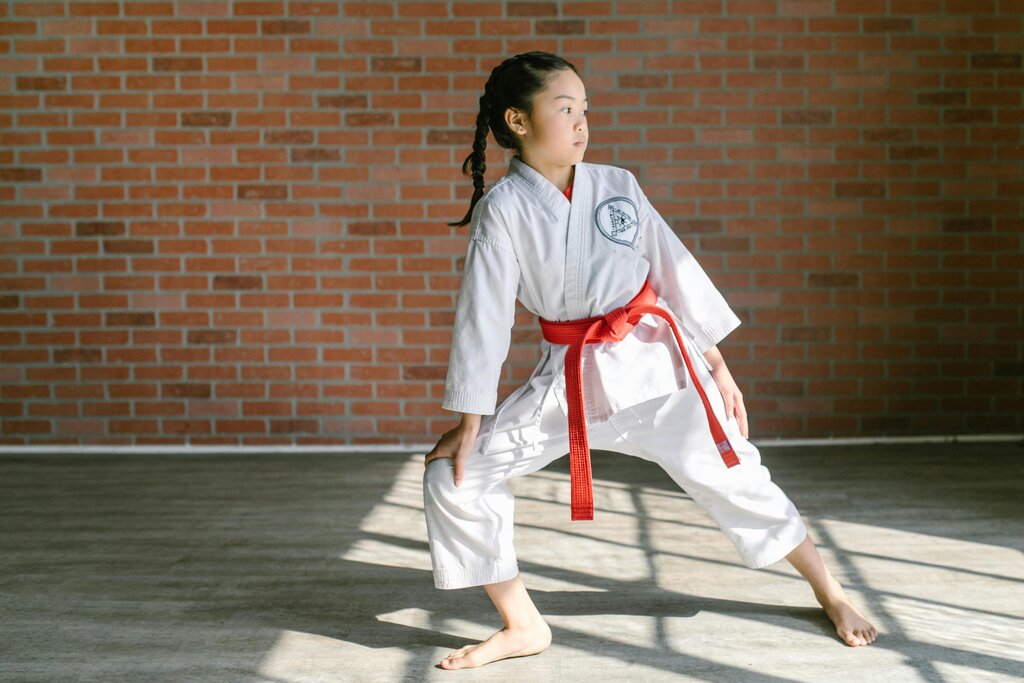
This culminates in a concept called at the moment of impact. It’s a full-body contraction that focuses all generated energy into a single point. The hips are the engine. In Shotokan, the hip movement is often a full, sharp rotation that snaps back to its original position, ready for the next move. This method is incredibly powerful but requires a solid structure and precise timing to be effective.
Goju-Ryu: Circular and Sticky
Goju-Ryu, meaning 'hard-soft style', takes a different path. Its mechanics are rooted in the Sanchin stance, a shorter, more pigeon-toed stance that creates constant muscular tension. This style favours close-quarters combat, where linear power is less practical. Instead of meeting force with force, Goju-Ryu redirects it using circular blocks and movements.
The goal is to absorb the opponent's energy, disrupt their balance, and counter along a different angle.
A key principle here is which translates to 'sticky hands'. This involves maintaining contact with an opponent's limbs to feel their intent and control their movement. Power isn't generated by explosive hip rotation alone, but through a grounded, 'heavy' feeling that seems to emanate from the core. The hips still rotate, but it's a grinding, connected motion rather than Shotokan's sharp snap.
Wado-Ryu: Evasion and Flow
Wado-Ryu, 'the way of harmony', incorporates principles from Shindō Yōshin-ryū Jujutsu. Its defining characteristic is efficiency. Wado-Ryu practitioners prefer to avoid attacks rather than block them directly. This is achieved through , or body shifting.
Instead of deep stances, Wado-Ryu uses higher, more natural stances that allow for rapid movement. The goal is to move just enough to let the attack pass by, conserving energy and creating an opening. This is often described as 'Nagashi' or flowing. The body moves like water, yielding to the attack's force and redirecting it. Hip movement is minimal and subtle, used to guide the body's shift rather than to generate explosive power.
Breathing and Tension
The way these styles handle breathing and tension is also distinct. Goju-Ryu is famous for its [{
Shotokan and Wado-Ryu, on the other hand, use 'Nogare' breathing, which is softer and less obvious. The exhalation is quiet and natural, timed with the technique. Tension is minimised until the moment of Kime, allowing for faster movement. Wado-Ryu takes this even further, emphasising relaxation to facilitate its fluid Tai Sabaki. For them, unnecessary tension is the enemy of speed and harmony.
Which of the following concepts is central to Wado-Ryu's philosophy of avoiding attacks through body shifting?
The Goju-Ryu style is known for its hard, audible, tensed abdominal breathing method.
Ultimately, each style offers a different solution to the same problem. Whether through linear force, circular control, or evasive flow, the mechanics are finely tuned to the core principles of the art.