Mastering Jazz Improvisation
Jazz Harmony Basics
The Building Blocks of Jazz
Jazz harmony is built on chords, but it goes deeper than the simple major and minor triads you might know. Jazz musicians use richer, more colorful chords, often with four or more notes. These are the sounds that give jazz its unique character.
Let's start with the basics and expand from there. In the key of C major, a simple C major triad is C-E-G. To make it a jazzier major 7th chord, we add the 7th note of the C major scale, which is B.
This chord sounds relaxed and thoughtful. For a minor 7th chord, we start with a minor triad (root, flat 3rd, 5th) and add a flat 7th.
Minor 7th chords sound more melancholic or soulful. Now for the most important chord in jazz: the dominant 7th. It's built like a major chord but with a flat 7th. This combination creates a tense, unresolved sound that desperately wants to move to a more stable chord.
Think of the dominant 7th as a musical cliffhanger. Its job is to build anticipation.
Two other important chord types add unique colors. Diminished 7th chords are built entirely from minor thirds, giving them a tense, symmetrical, and often dark sound. They're great for connecting other chords. An augmented chord raises the fifth, creating a dreamy, unsettled feeling.
| Chord Type | Formula (from Root) | Sound/Feel |
|---|---|---|
| Major 7th (Cmaj7) | 1, 3, 5, 7 | Bright, relaxed |
| Minor 7th (Cm7) | 1, ♭3, 5, ♭7 | Soulful, somber |
| Dominant 7th (C7) | 1, 3, 5, ♭7 | Tense, unresolved |
| Diminished 7th (C°7) | 1, ♭3, ♭5, ♭♭7 | Tense, dramatic |
| Augmented (C+) | 1, 3, ♯5 | Unsettled, dreamy |
The Most Important Progression
If chords are the words of jazz, chord progressions are the sentences. And the most common sentence in the jazz language is the ii-V-I (two-five-one) progression.
These Roman numerals refer to chords built on the second, fifth, and first notes of a major scale. In the key of C major, the notes are C, D, E, F, G, A, B. So a ii-V-I looks like this:
- ii: A minor 7th chord built on D (the 2nd note) → Dm7
- V: A dominant 7th chord built on G (the 5th note) → G7
- I: A major 7th chord built on C (the 1st note) → Cmaj7
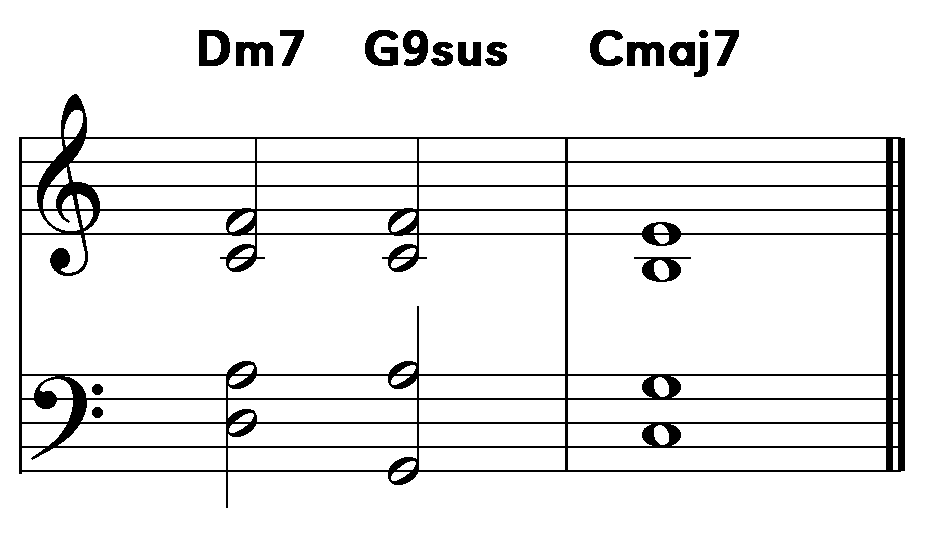
The magic of the ii-V-I lies in its perfect story arc of tension and release. The Dm7 (ii) sets the stage. The G7 (V) builds tension. And the Cmaj7 (I) provides a satisfying resolution, bringing you back home.
The ii-V-I progression (e.g., Dm7–G7–Cmaj7 in the key of C) is everywhere in jazz.
Once you learn to recognize this progression by ear, you'll start hearing it in countless jazz standards. It's the foundation for improvisation, giving soloists a clear path to follow as the harmony changes.
Adding Your Own Flavor
Jazz is all about personal expression, and that includes changing up the harmony. One way musicians do this is with chord substitution, which means swapping a chord in a progression with a different but related one. This adds surprise and harmonic interest without losing the overall direction of the music.
A classic example is the tritone substitution. A tritone is an interval of three whole steps. You can substitute any dominant 7th chord with another dominant 7th chord whose root is a tritone away.
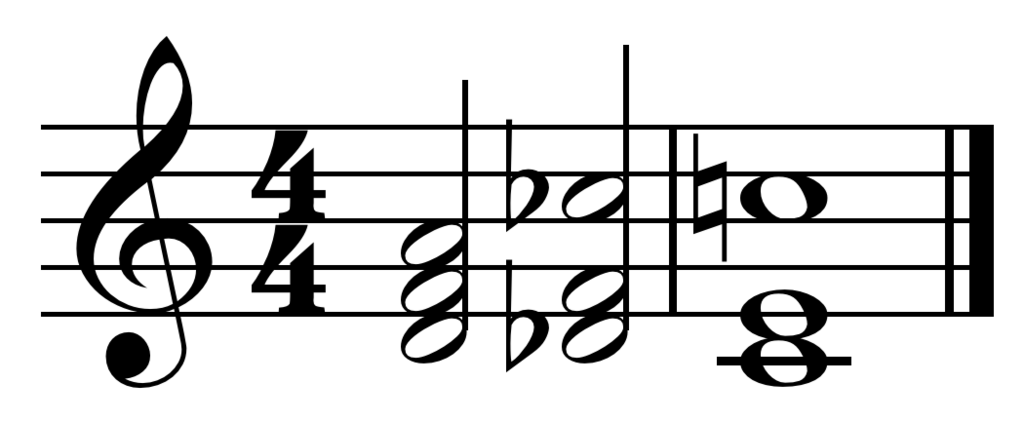
Let's look at our ii-V-I in C major: Dm7 - G7 - Cmaj7. The V chord is G7. A tritone away from G is D♭.
So, we can swap the G7 for a D♭7.
The progression becomes Dm7 - D♭7 - Cmaj7. Why does this work? G7 and D♭7 share two very important notes, the 3rd and the 7th (B and F in G7, and F and C♭/B in D♭7). These are the notes that create the dominant sound and make the chord want to resolve. The substitution gives the bass line a smooth, descending chromatic movement (D → D♭ → C), which sounds fantastic.
Another common substitution involves using a diminished chord. You can often place a diminished 7th chord a half-step below your target chord to create a strong pull towards it. For example, to lead into a Dm7 chord, you could play a C♯dim7 right before it.
This creates the progression C♯dim7 → Dm7. It adds a touch of drama and sophistication. Understanding these basic substitutions opens up a new world of harmonic possibilities for both improvisation and composing.
In jazz harmony, what is the primary function of a dominant 7th chord within a progression?
What are the correct chords for a ii-V-I progression in the key of G Major?
Mastering these concepts is your first step into the rich world of jazz harmony. By understanding the chords, the fundamental ii-V-I progression, and how to substitute, you're building a foundation for creative and compelling improvisation.