Mastering Jazz Improvisation and Harmonic Fluency
Extended Chord Navigation
Beyond Chord Tones
You already know how to outline changes using basic chord tones. Now, let's add a new layer of colour. Chord extensions like the 9th, 11th, and 13th aren't just extra notes to sprinkle in; they're melodic destinations that give your solos a modern, sophisticated sound.
A powerful way to conceptualise these notes is by thinking in terms of upper structure triads. An upper structure triad is a simple major or minor triad built on top of a basic seventh chord. This combination creates a richer, more complex harmony.
For example, take a Cmaj7 chord (C-E-G-B). If you play a G major triad (G-B-D) over it, you're reinforcing the 5th (G) and major 7th (B) while adding the 9th (D). The resulting sound is a Cmaj9. The notes of the upper structure triad become your new melodic targets.
This approach simplifies complex harmony. Instead of hunting for the 9th, #11th, or 13th of a chord, you can simply think of playing a familiar triad shape from a different starting point. For a G7 chord, try playing a D major triad (D-F#-A) on top. This gives you the 5th (D), the major 7th which acts as the 13th of G7 (F#), and the 9th (A).
Targeting 9ths and 13ths
In post-bop soloing, the 9th and 13th are prime melodic targets. They create a sense of sophistication and forward motion, especially over the V chord in a ii-V-I progression. Landing on an extension at a key moment adds tension that makes the resolution to the I chord even more satisfying.
Think about a ii-V-I in C major: Dm7 - G7 - Cmaj7. When you're playing over the G7, instead of just targeting the usual chord tones (G-B-D-F), aim for the 9th (A) or the 13th (E). Your line might move from a chord tone of Dm7, land on the 'A' over the G7, and then resolve smoothly down to the G (the 5th) of Cmaj7.
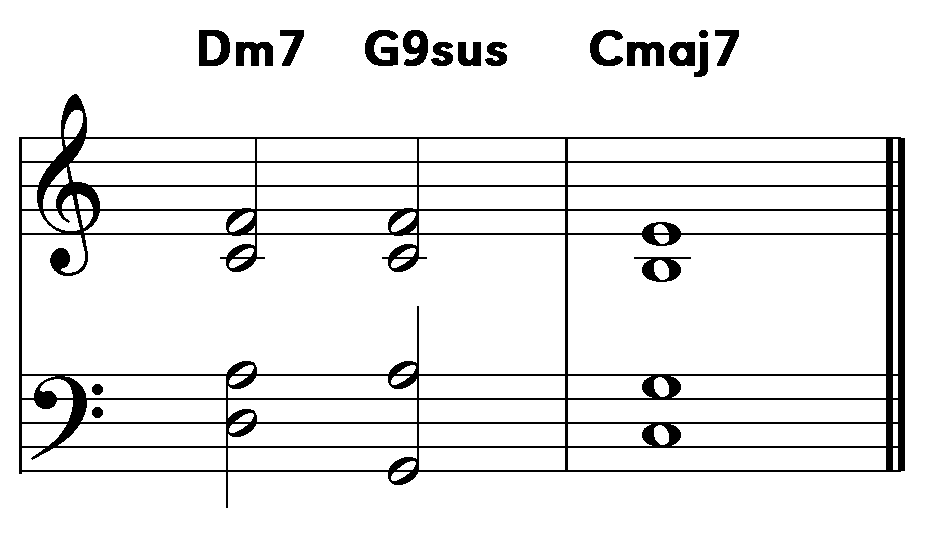
This leads to the idea of extension voice leading. It's the art of moving between these colour tones just as you would with basic chord tones. A great way to practise this is to arpeggiate the upper structures. Over that Dm7 - G7 - Cmaj7 progression, try playing a C major triad (the upper structure for Dm9) followed by a D major triad (an upper structure for G13), and resolving to a G major triad (the upper structure for Cmaj9). You create a smooth, melodic contour that perfectly outlines the harmony while sounding fresh.
Mapping Extensions
To use extensions effectively, you need to know where they are on your instrument without thinking. The goal is to see the 9th, 11th, and 13th as integral parts of the chord shape, not as distant, theoretical notes.
On a keyboard, for a Cmaj7, the 9th (D) is a whole step above the root, the 11th (F) is a half step above the 3rd, and the 13th (A) is a whole step above the 5th. On a guitar, these extensions fall into predictable patterns around your standard chord and scale shapes. Spend time mapping them out for common chord types (maj7, m7, dom7) in different positions.
A quick note on the 11th: In its natural form, the 11th often clashes with the major 3rd of a chord. That's why you'll frequently see it sharpened (the #11), especially on major and dominant chords, which creates a lyrical, Lydian sound. The natural 11th, however, works beautifully on minor chords, where there is no major 3rd to clash with. It's also the defining note of a 'sus' chord, where it replaces the 3rd entirely.
Harmonising a melody with 11ths can create a suspended, open sound, famously used in the music of pianists like McCoy Tyner. This often involves stacking fourths instead of the traditional thirds, creating quartal harmony. For example, playing C-F-Bb over a C minor chord creates a rich Cm11 voicing.
Ready to test your understanding? This quiz covers how to identify and apply these concepts in a musical context.
What is the primary function of an upper structure triad in jazz harmony?
When playing over a Cmaj7 chord (C-E-G-B), superimposing a G major triad (G-B-D) on top primarily adds which extension?
Integrating these extensions into your playing will bridge the gap between simply playing the chords and crafting truly melodic lines that flow through the changes.