Mastering IUPAC Organic Nomenclature
Parent Chain Selection
Finding the Main Chain
Every organic molecule has a backbone, a principal carbon chain that serves as its foundation. Naming any alkane starts with correctly identifying this chain. Think of it as finding the longest road on a map before you start naming the smaller streets branching off it. This main chain gives the molecule its base name, or 'root word'.
The first and most important rule is simple: find the longest continuous chain of carbon atoms. You can trace the path without lifting your finger. It doesn't have to be a straight line on the page; carbons can zig and zag. Count carefully from every possible endpoint to find the maximum length.
For example, in 3,4-dimethylhexane, the longest chain has six carbons, not the shorter paths you might see at first glance.
Breaking a Tie
What happens if there's a tie? Sometimes, you might find two or more different chains with the exact same maximum length. When this occurs, we have a tie-breaker rule.
Rule 2: If there are multiple chains of the same longest length, choose the one with the most side chains.
These side chains, or branches, are called substituents in official IUPAC nomenclature terminology. More branches mean a more complex name, but it also gives a more precise description of the molecule's structure. Picking the chain with the most substituents is the correct approach.
The main chain you select determines the root word of the alkane's name. This root is based on Greek or Latin numbers and tells everyone how many carbons form the molecule's backbone.
Root Words
Once you've identified the principal carbon chain, you can assign its root word. For the first four alkanes, the names are historical. After that, they follow a standard numerical prefix system.
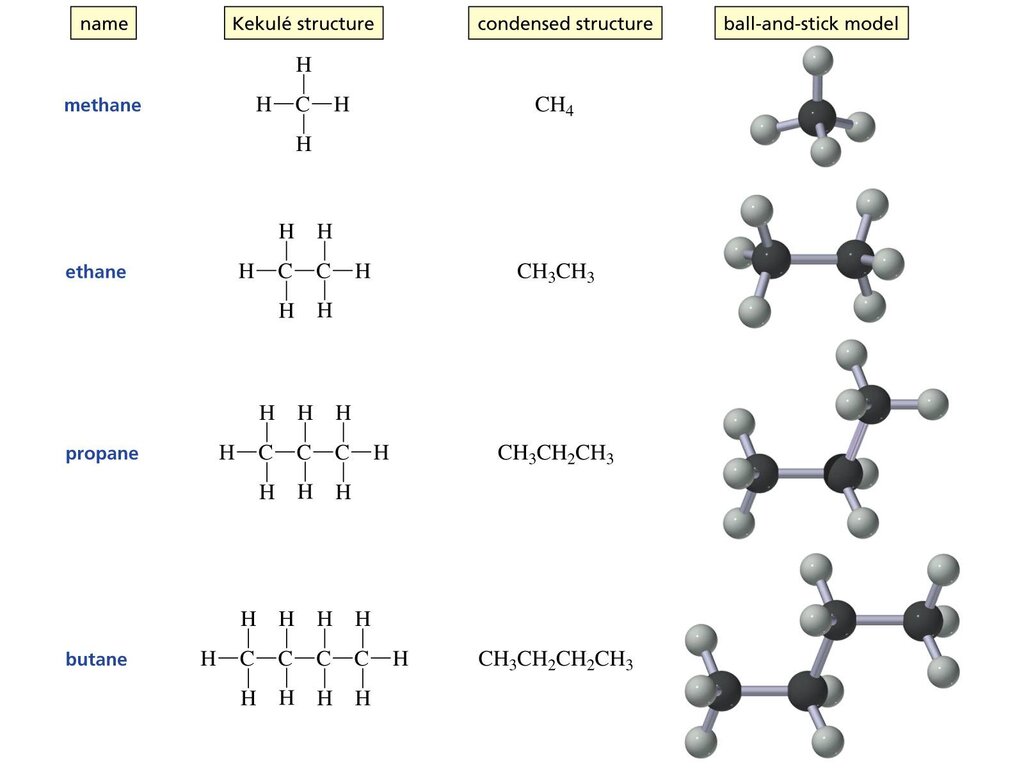
Here are the root words for chains up to ten carbons long. While chains can be much longer, these are the most common ones you'll encounter.
| Number of Carbons | Root Word | Alkane Name |
|---|---|---|
| 1 | meth- | Methane |
| 2 | eth- | Ethane |
| 3 | prop- | Propane |
| 4 | but- | Butane |
| 5 | pent- | Pentane |
| 6 | hex- | Hexane |
| 7 | hept- | Heptane |
| 8 | oct- | Octane |
| 9 | non- | Nonane |
| 10 | dec- | Decane |
Mastering these two rules—longest chain, then most substituents—is the critical first step. It provides the 'last name' of the molecule. Next, we'll learn how to name the 'first names', the substituents themselves.
Ready to test your chain-spotting skills?
What is the primary, most crucial rule for identifying the backbone of an alkane molecule?
If you find two or more carbon chains of the exact same maximum length in a molecule, how do you decide which one is the principal chain?
Great job. Identifying the parent chain is a foundational skill in organic chemistry. Once you can do it automatically, the rest of the naming process becomes much easier.