Mastering iPaaS Architecture and Implementation
Architectural Shifts
The Great Integration Shift
For a long time, enterprise software integration looked like a city with a single, massive central train station. Every piece of data, every request, had to travel to the central hub before being routed to its final destination. This was the world of the Enterprise Service Bus, or ESB.
The ESB was an on-premises middleware solution that acted as a universal translator and traffic cop for all a company's internal applications. It enforced order and consistency. In this hub-and-spoke model, the ESB was the hub, and every application was a spoke. This worked well when most applications were monolithic and lived inside the company's own data centers.
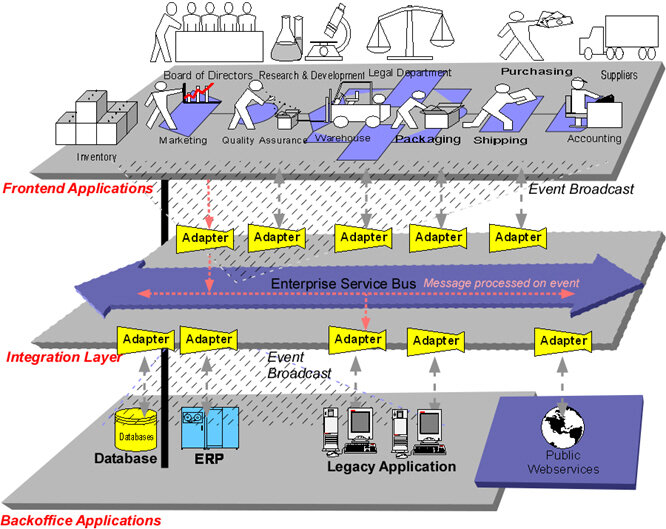
Then, the world changed. The rise of Software as a Service (SaaS) meant critical applications—from CRM to HR—now lived outside the company's walls, in the cloud. Suddenly, the centralized ESB model became a bottleneck. Trying to route every connection to dozens of external SaaS apps through a single on-premises hub was slow, brittle, and expensive. This phenomenon, often called "SaaS sprawl," broke the old integration paradigm.
The central hub designed for internal order became a single point of failure in a distributed, cloud-based world.
From Monolith to Network
The solution was a fundamental architectural shift away from a centralized bus to a distributed network. This new model is embodied by Integration Platform as a Service (iPaaS). Unlike the on-premises ESB, an iPaaS is cloud-native. It’s designed from the ground up to connect applications and data sources regardless of where they live: on-premises, in a private cloud, or across multiple public clouds like AWS and Azure.
Instead of a rigid hub-and-spoke system, iPaaS promotes a more flexible and decentralized approach. It moves away from a single, monolithic piece of middleware toward a collection of smaller, reusable, and composable integration services.
This new approach is powered by a strategy called API-led connectivity. Instead of having a central team of specialists build every integration, this model exposes an organization's data and capabilities through modern, reusable APIs. These APIs are like standardized building blocks. Different teams can then discover these blocks and use them to compose new services and applications quickly, without needing to understand the complexity of the underlying systems.
Patterns for a Hybrid World
Today's enterprises rarely operate in a single environment. They have a mix of on-premises systems, private clouds, and services running on multiple public cloud providers like AWS, Google Cloud, and Azure. This is the reality of hybrid and multi-cloud IT.
Managing integration in this complex landscape is a primary strength of iPaaS. It provides the tools to connect and synchronize data across these disparate environments. For example, an iPaaS can ensure that when a sales record is updated in a cloud CRM like Salesforce, the corresponding customer data is also updated in an on-premises billing system. It acts as the connective tissue for the entire hybrid enterprise, enabling seamless data flow no matter where the applications reside.
The move from ESB to iPaaS isn't just a technology upgrade; it's a strategic shift. It's the move from a centralized, monolithic architecture designed for a stable, internal world to a decentralized, composable architecture built for a dynamic, interconnected, and multi-cloud future.
Time to check your understanding of these architectural changes.
What was the primary architectural model of a traditional Enterprise Service Bus (ESB)?
What major technological trend was the primary catalyst for the shift from ESB to iPaaS?
Understanding this transition from centralized to distributed integration is key to building modern, scalable enterprise systems.