Mastering Internal Alchemy: Neurotransmitters and Hormones
Receptor Binding Mechanics
The Dance of Binding
A hormone or neurotransmitter binding to a receptor isn't a simple on-off switch. It’s more like a handshake, with two key qualities: how tightly the hands grip, and how much action that handshake inspires. These qualities are called affinity and intrinsic efficacy.
Affinity is the strength of the bond between a ligand (the signaling molecule) and its receptor. A high-affinity ligand fits its receptor perfectly, like a key in the right lock, and tends to stay bound for longer. A low-affinity ligand has a looser, more transient connection.
Intrinsic efficacy, on the other hand, describes the ability of that ligand-receptor complex to produce a biological response. It's not about how well it binds, but about what happens after it binds. A molecule can have high affinity, sticking to the receptor like glue, but have zero intrinsic efficacy, triggering no response at all. Such molecules are called antagonists.
Ligand
noun
A molecule that binds to another, usually larger, molecule. In this context, ligands are neurotransmitters, hormones, or drugs that bind to cellular receptors.
Measuring the Bond
We can quantify the affinity of a ligand for its receptor using a value called the dissociation constant, or . It represents the concentration of a ligand required to occupy exactly 50% of the available receptors at equilibrium.
A low value means a very small amount of ligand is needed to bind to half the receptors, indicating high affinity. Conversely, a high value means a lot of ligand is required to achieve 50% occupancy, indicating low affinity.
Amplifying the Signal
A single binding event rarely causes a single cellular action. More often, it triggers a cascade that amplifies the initial signal, a process called signal transduction. One of the most common mechanisms for this involves (GPCRs).
When a ligand binds to a GPCR, it doesn't just open a channel. Instead, it activates a G-protein inside the cell. This G-protein then activates an enzyme, such as adenylyl cyclase. This enzyme is a catalyst, and it begins rapidly converting ATP into a small molecule called cyclic AMP (cAMP). This process creates a massive signal gain: one receptor binding can generate thousands of cAMP molecules.
These cAMP molecules are known as second messengers. They are small, diffusible molecules that spread the signal throughout the cell's interior, activating other proteins like protein kinases, which in turn phosphorylate and alter the function of numerous target proteins. Calcium ions () are another classic example of a second messenger, with their intracellular concentration tightly controlled and released to trigger specific events.
Genomic Signaling
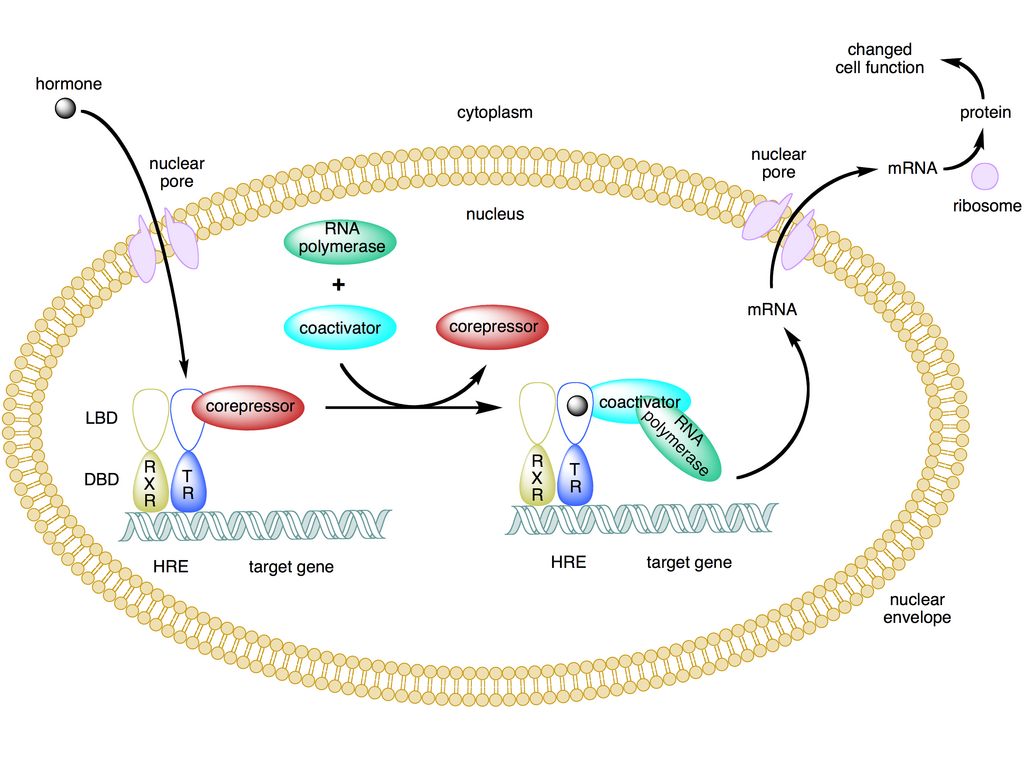
Not all signals are fast and fleeting. Some hormones, particularly lipophilic (fat-soluble) steroids like estrogen and cortisol, play a longer game. Because they can easily diffuse through the fatty cell membrane, their receptors aren't on the cell surface. Instead, they bind to nuclear receptors located inside the cytoplasm or the nucleus itself.
This binding event creates a hormone-receptor complex that functions as a —a protein that can bind directly to specific sequences of DNA. By doing so, it can turn genes on or off, fundamentally altering the proteins the cell produces. This genomic signaling is much slower than a GPCR cascade, often taking hours or even days to manifest a full response. However, the changes it produces are profound and long-lasting, affecting everything from cell growth and differentiation to metabolism.
Now let's review the key terms we've covered.
Time to check your understanding of these signaling concepts.
A new drug is developed that binds very tightly to a specific receptor but produces no biological response after binding. How would this drug be characterized?
A low dissociation constant () value signifies high affinity.
From the lightning-fast twitch of a muscle fiber triggered by an ion channel to the slow, life-altering changes directed by steroid hormones, the principles of affinity, efficacy, and amplification govern how our cells communicate and respond to their environment.