Mastering Intermediate Mathematics for Real World Success
Symbolic Logical Reasoning
From Numbers to Symbols
In arithmetic, we work with concrete numbers. We know that $2 + 2 = 4$. But what happens when a number is missing? Imagine you're running a small cafe. You know your total daily earnings were £500, and you know you spent £150 on supplies. But you forgot to record your profit. We have a missing piece of the puzzle.
This is where algebra begins. We use a symbol, often a letter like $x$, to stand in for that unknown value. This symbol is called a variable. It's a placeholder for a number we want to find. Instead of a blank space, we can write a mathematical sentence:
Profit = Total Earnings - Supply Costs
$x = 500 - 150$
Using a variable turns a mystery into a problem we can solve. It’s the first step in moving from simple calculation to logical reasoning with symbols.
Turning Words into Equations
The real power of algebra is its ability to model the real world. We can translate everyday problems into the language of mathematics. This process involves reading a problem, identifying the unknown quantity, and expressing the relationships between the known and unknown values.
Let’s try one. A mobile phone plan costs £20 per month, plus £0.10 for every megabyte of data used over the monthly limit. If your bill for one month was £25, how many megabytes of data did you go over?
First, what's our unknown? It's the number of megabytes used over the limit. Let's call it . Now, let's build the equation. The total cost (£25) is the sum of the base fee (£20) and the extra data cost. The extra data cost is £0.10 multiplied by the number of extra megabytes, . So, we can write:
We've just turned a paragraph of text into a single, solvable This is the core skill of algebraic problem-solving.
The Golden Rule of Equations
An equation is like a perfectly balanced scale. If you add a small weight to one side, you must add the same weight to the other side to keep it level. If you take something away from one side, you must take the same amount from the other.
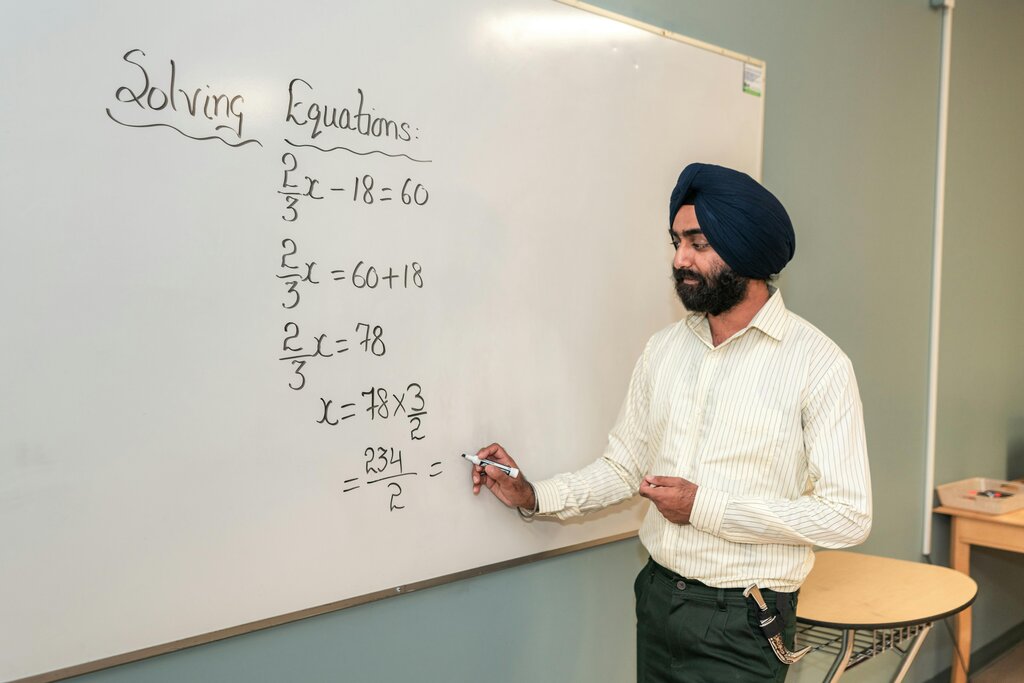
This is the most important principle in algebra: Whatever you do to one side of an equation, you must do to the other side. This rule allows us to manipulate and rearrange equations without breaking the equality. Our goal is to use this rule to isolate the variable, getting it all by itself on one side of the equals sign. This reveals its value.
To isolate a variable, we use inverse operations. These are operations that 'undo' each other. Addition and subtraction are inverses. Multiplication and division are inverses.
Let's look at our phone bill equation: . Our goal is to get by itself.
First, we want to undo the '+ 20'. The inverse operation is subtracting 20. To keep the scale balanced, we must subtract 20 from both sides:
Now, is being multiplied by 0.10. To undo this, we use the inverse operation: division. We divide both sides by 0.10:
So, you went over your data limit by 50 megabytes. By applying inverse operations and keeping the equation balanced, we found our unknown.
Tidying Up Your Equation
Sometimes, equations look more complicated than they really are. Before you start applying inverse operations, it's good practice to simplify each side of the equation as much as possible. This usually involves combining
Like terms are terms that contain the same variable raised to the same power. For example, in the expression , the terms and are like terms because they both contain the variable . We can combine them by adding their coefficients (the numbers in front). So, becomes . The term is not a like term, so it stays separate.
Imagine you have 5 apples and someone gives you 2 more apples; you now have 7 apples. But if they also give you 3 bananas, you can't combine the apples and bananas into one group. You have 7 apples and 3 bananas. It's the same idea with variables.
By moving from concrete numbers to abstract symbols, learning to translate problems, and applying the rules of balance and simplification, you build the foundation for all of algebra. It's a powerful way of thinking that allows you to model and solve complex problems in a logical, step-by-step manner.
What is the primary purpose of a variable, like 'x', in algebra?
A taxi charges a flat fee of £3 plus £1.50 for every mile travelled. If a journey costs £18, which equation correctly represents this situation, where 'm' is the number of miles?