Mastering Intermediate Calisthenics and Bodyweight Mechanics
Leverage and Mechanical Advantage
The Physics of Strength
To get stronger with only your bodyweight, you need to think less like a bodybuilder and more like a physicist. Moving beyond basic reps means understanding how to manipulate forces. The key to unlocking advanced calisthenics lies not in adding weight, but in changing leverage.
The central concept here is torque. Think of it as rotational force. When you push a door open, you apply force. Torque is the measure of how effective that push is at making the door rotate on its hinges. Pushing near the handle, far from the hinges, requires little effort. Pushing right next to the hinges requires immense effort to get the same rotation. The exercise is the same—opening a door—but the difficulty changes based on where you apply the force.
Your Body as a Lever
Your body is a system of levers. Your bones act as the rigid bars, and your joints are the fulcrums, or pivot points. The moment arm is the distance from the joint to the point where force is applied—either by your muscles or by gravity acting on your body.
To make a bodyweight exercise harder, you don't need to increase your weight (). Instead, you increase the length of the moment arm (). A longer moment arm demands more torque from your muscles to move or stabilise the joint. This is the secret to in calisthenics.
By increasing the moment arm, you force your muscles to produce more torque to overcome the same amount of bodyweight.
This principle applies to every advanced movement. An iron cross is difficult not just because you're holding your bodyweight, but because your hands are so far from your body's midline, creating enormous moment arms at the shoulder joint. A front lever is harder than a tuck front lever because extending your legs moves your center of gravity further from your hands, lengthening the lever.
From Push-up to Planche
Let's apply this to a familiar exercise: the push-up. In a standard push-up, your hands are roughly below your shoulders. To make it harder, you can perform a pseudo-planche push-up. This involves leaning your body forward so your hands are closer to your waist.
This forward lean dramatically changes the physics. It shifts your center of gravity forward, significantly increasing the moment arm relative to your shoulder joints. Your shoulders and chest now have to produce much more torque to press your body up. You haven't added any external weight, but you've made the exercise exponentially harder simply by manipulating leverage.
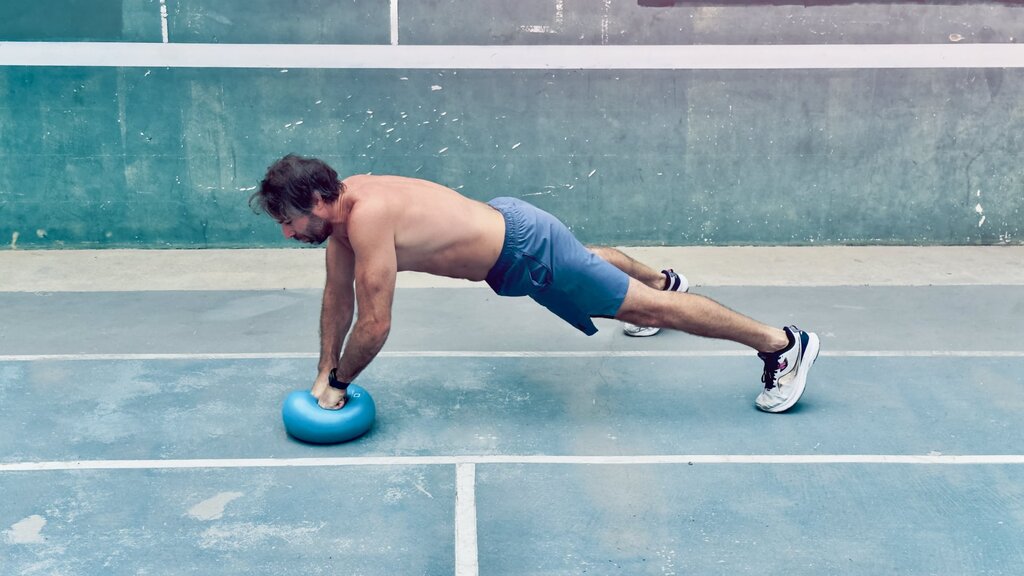
To support these extreme positions, your stabilising muscles must be incredibly strong. The (shoulder blade) becomes a critical anchor point. In a pseudo-planche lean, you need strong scapular protraction—the action of pushing your shoulder blades forward and apart, creating a slightly rounded upper back. This creates a stable platform for your shoulders to press from.
Conversely, scapular retraction, squeezing the shoulder blades together, is key for movements like rows and front levers. Mastering control over your scapulae is non-negotiable for injury prevention and strength progression in advanced calisthenics.
With calisthenics, you achieve progressive overload by manipulating leverage, stability, and volume.
Let's review the key terms we've covered.
Now, let's test your understanding of these concepts.
What is the primary method for achieving progressive overload in calisthenics, as described in the text?
Why is a pseudo-planche push-up harder than a standard push-up?
By viewing every exercise through the lens of torque and leverage, you can understand the 'why' behind different progressions. You're no longer just counting reps; you're engineering a stronger body.