Mastering Intermediate Arabic Connectivity
Verb Root System
The Architecture of Words
At the heart of Arabic vocabulary lies a beautifully logical system. Instead of memorising thousands of unrelated words, you learn to see the building blocks. Most words in Arabic are built from a three-consonant root, known as a Jidhr (جِذْر). This root holds the core, essential meaning, like a strand of DNA containing the blueprint for an entire family of related concepts.
Think of the root as the raw material. It isn't a word on its own, but it's where meaning begins.
Let's take one of the most common examples: the root K-T-B (ك-ت-ب). Every word derived from this root will have something to do with the concept of 'writing'. The three root consonants will always appear in that same order, but vowels and sometimes other consonants are slotted in around them to create new words.
| Word (Arabic) | Word (Transliteration) | Meaning | Root Consonants |
|---|---|---|---|
| كَتَبَ | kataba | he wrote | K-T-B |
| كِتَاب | kitāb | book | K-T-B |
| مَكْتَب | maktab | office, desk | K-T-B |
| كَاتِب | kātib | writer | K-T-B |
| مَكْتُوب | maktūb | written | K-T-B |
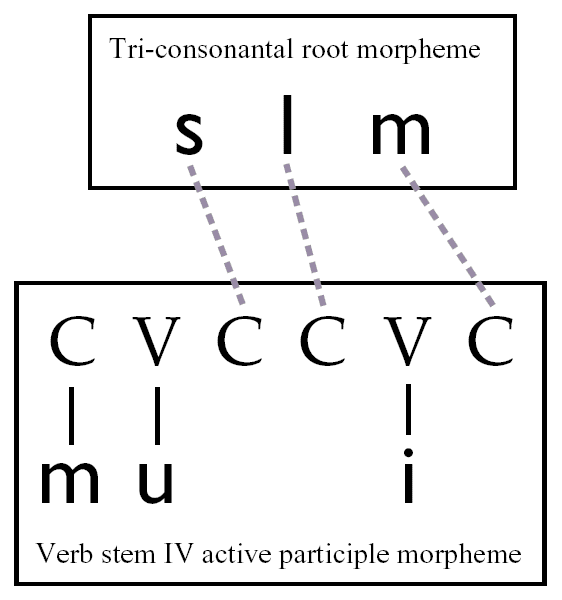
Notice how K-T-B appears in order in every word. The magic happens through the application of a pattern, or (وَزْن). These patterns are templates of vowels and consonants that you pour the root into. Each Wazn adds a specific layer of meaning to the root's core concept, such as turning an action into a place, a person, or an object. This method of word formation is a classic example of —where the root's letters aren't simply tacked on to each other in a line.
Fields of Meaning
Every root generates a 'semantic field'—a family of words all connected to the root's core idea. Mastering one root doesn't just teach you one word; it gives you access to ten, twenty, or even more.
Consider the root D-R-S (د-ر-س), which is related to 'studying' or 'learning'. From this single root, we get:
- dars (دَرْس): a lesson
- madrasa (مَدْرَسَة): a school (the place of study)
- mudarris (مُدَرِّس): a teacher (the person who causes study)
- dirāsa (دِرَاسَة): the act of studying, a study
Once you recognise the root and the pattern, you can start making educated guesses about the meanings of words you've never seen before. It transforms vocabulary building from a memory game into a puzzle.
By understanding how root letters (حروف الجذر) form different words, learners begin to see patterns, logic, and beautiful connections.
Predicting the Unseen
This system is powerfully predictive. Many patterns have consistent meanings. For example, the pattern faa'il (فَاعِل) often denotes the person or agent who performs the action of the root. We saw this with kātib (writer) from K-T-B. If you know the root S-B-H (س-ب-ح) means 'to swim', you can correctly predict that sābiH (سَابِح) means 'swimmer'.
Similarly, the pattern starting with ma- often indicates a place. From D-R-S (to study) we get madrasa (school). From K-T-B (to write) we get maktab (office). From KH-B-Z (خ-ب-ز), 'to bake', we get makhbaz (مَخْبَز), a bakery.
Internalising the common roots and patterns is the single most effective way to rapidly expand your Arabic vocabulary. It allows you to move beyond simple memorisation and begin to think within the language's own internal logic.
Now, let's test your understanding of how these concepts work together.
What is the term for the three-consonant root that holds the core meaning in an Arabic word?
The root K-T-B (ك-ت-ب) is related to 'writing'. What would a 'maktab' (مَكْتَب), a word following a common pattern for places, most likely be?
Understanding this structure is a major milestone. It's the key that unlocks the incredible richness and regularity of the Arabic language.