Mastering Intermediate Algorithms and Data Structures
Trees
What Are Trees?
In the world of data structures, a tree is a way of organizing information hierarchically. Think of a family tree or a company's organizational chart. There's a single starting point, and from there, everything branches out. This structure is incredibly useful for representing data that has a natural parent-child relationship.
Let's break down the terminology:
- Node: Each item in the tree. It holds a value.
- Edge: The line connecting two nodes. It represents their relationship.
- Root: The top node of the tree, the one with no parent.
- Parent: A node that has at least one node connected below it.
- Child: A node that has a parent node above it.
- Leaf: A node with no children. It's at the very bottom of a branch.
Common Types of Trees
Not all trees are the same. Their rules and structures are adapted for different tasks. One of the most common is the binary tree.
A binary tree is a tree where each node has at most two children, referred to as the left child and the right child.
Binary trees are simple, but we can make them more powerful by adding a rule. This gives us the Binary Search Tree (BST). In a BST, for any given node, all values in its left subtree are less than the node's value, and all values in its right subtree are greater. This ordering makes searching for a value extremely fast. Instead of checking every item, you can discard half the tree at every step.
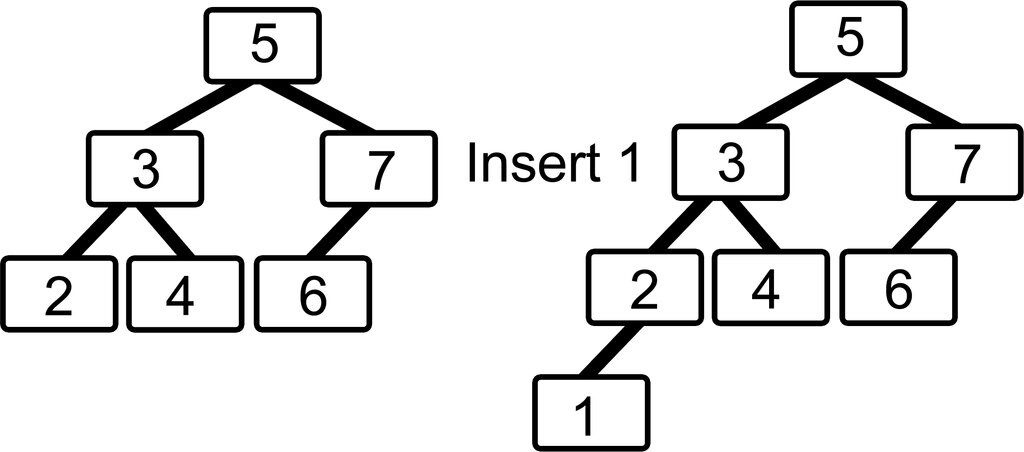
The problem with a basic BST is that it can become unbalanced. If you add numbers in sorted order (1, 2, 3, 4, 5), you don't get a bushy tree. You get a long, skinny chain that's no better than a linked list for searching.
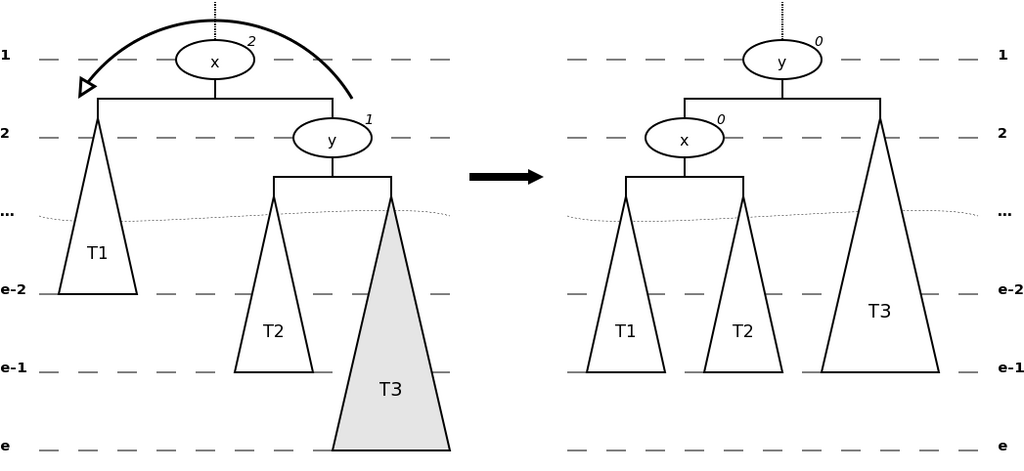
To solve this, computer scientists invented self-balancing trees. An AVL tree is a type of self-balancing BST. It performs small rotations on its nodes after insertions or deletions to ensure the tree remains relatively balanced. This keeps search times low, guaranteeing efficiency.
When dealing with massive datasets, like in databases or file systems, even an AVL tree can be inefficient. Reading from a disk is slow, so we want to minimize how many times we do it. This is where B-trees come in. A B-tree is a more general tree where nodes can have many children. By storing more keys in each node, the tree becomes shorter and wider. This structure is optimized for systems that read and write large blocks of data, as it reduces the number of disk accesses needed to find an item.
Walking Through a Tree
To be useful, we need a systematic way to visit every node in a tree. This process is called traversal. There are three main ways to do it, and they're all defined recursively.
- In-order Traversal: Visit the left subtree, then the root node, then the right subtree. For a BST, this is convenient because it visits the nodes in ascending order.
- Pre-order Traversal: Visit the root node first, then the left subtree, then the right subtree. This is useful for creating a copy of a tree.
- Post-order Traversal: Visit the left subtree, then the right subtree, and finally the root node. This is often used to delete a tree, as you delete the children before their parent.
These traversals form the basis for the core operations on a tree: searching, inserting, and deleting. Searching in a BST, for example, is a process of comparing a value to a node and deciding whether to go left or right. Insertion involves searching for the correct empty spot to add a new node. Deletion is the trickiest, as removing a node requires carefully rearranging its children to maintain the tree's structure.
What is a "leaf" in the context of a tree data structure?
In a valid Binary Search Tree (BST), all values in a node's left subtree must be less than the node's value.
Trees are a foundational concept. They show up in many places, from the file systems on our computers to the way compilers parse code. Understanding them is a key step in learning how to manage data efficiently.