Mastering Integral Calculus
Introduction to Antiderivatives
The Reverse of Differentiation
So far, we've focused on differentiation, the process of finding the rate of change of a function. For example, if we have the function , its derivative is . But what if we go in the opposite direction? What if we start with the derivative, say , and want to find the original function?
This reverse process is called antidifferentiation. The function we find is called an antiderivative.
Antiderivative
noun
A function is an antiderivative of a function if the derivative of is . In other words, .
Let's stick with our example. We know that an antiderivative of is because the derivative of is . But is that the only one?
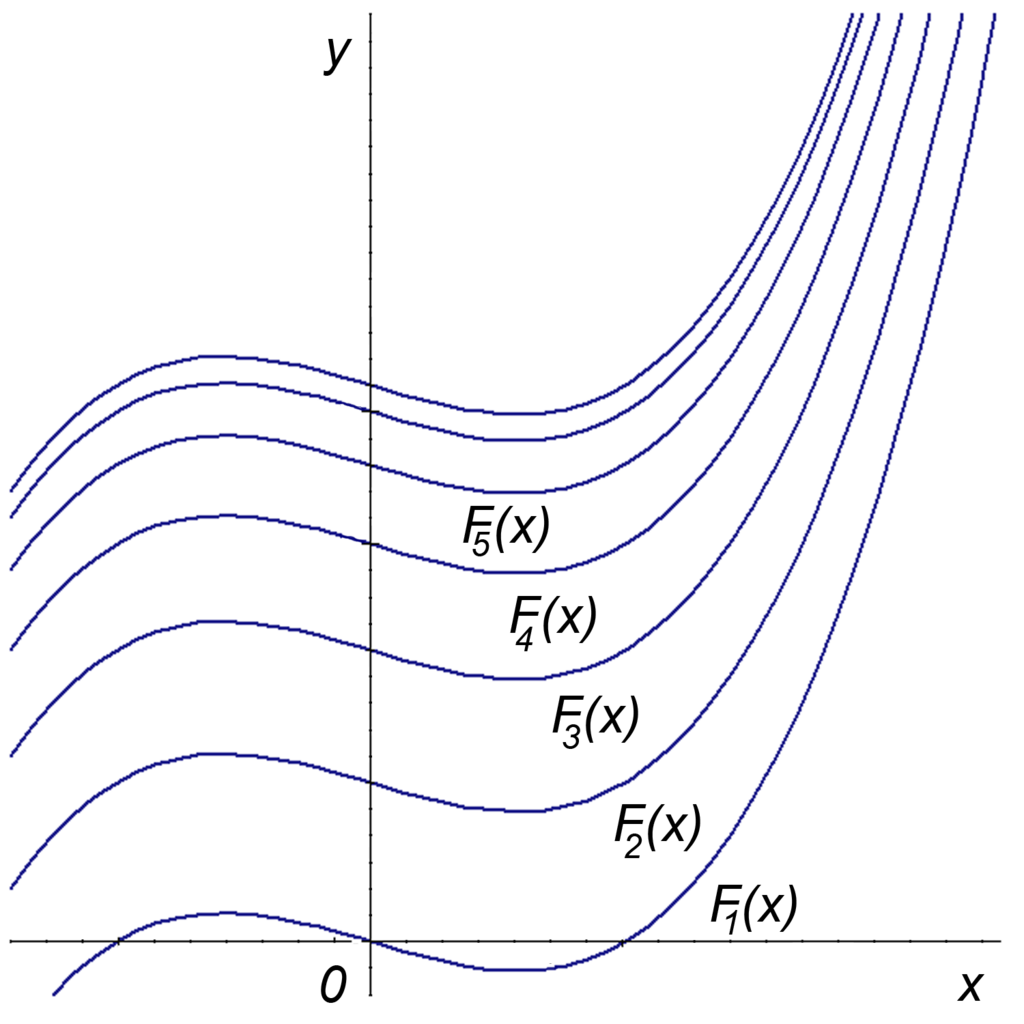
Think about the function . What's its derivative? It's also , since the derivative of a constant is zero. The same goes for . Its derivative is also .
It seems there are infinitely many antiderivatives for any given function, all differing by a constant. We account for this by adding a "constant of integration," which we represent with the letter .
The general antiderivative of is .
This family of functions includes all possible antiderivatives. The value of simply shifts the function's graph up or down the y-axis, without changing its shape or the slope of its tangent line at any point.
Finding Antiderivatives
Finding an antiderivative is also called integration. The notation for finding the antiderivative of a function is called an indefinite integral:
The symbol is the integral sign. The function is the integrand, and indicates that we are integrating with respect to the variable . Don't forget the !
Just as we have rules for differentiation, we have rules for integration. Many are just the reverse of the differentiation rules we already know. The most fundamental one is the Power Rule for Integration.
The Power Rule for Integration: To find the integral of , you add one to the exponent and then divide by the new exponent.
Let's try it out. To find the integral of , we add 1 to the exponent (making it 5) and divide by 5.
We can check this by taking the derivative. The derivative of is , which simplifies back to . It works!
Basic Integration Rules
Here are a few more essential rules. They follow directly from their derivative counterparts.
| Rule Name | Formula | Example |
|---|---|---|
| Constant Rule | ||
| Constant Multiple | ||
| Sum/Difference Rule |
Let's combine these rules to solve a more complex integral.
Find the indefinite integral of .
First, we can write the integral expression:
Using the Sum/Difference Rule, we can integrate each term separately:
Now, we apply the Constant Multiple Rule and the Power Rule to each term:
Finally, we simplify the expression. Notice we only need one at the end to represent the constant for the entire antiderivative.
Antidifferentiation is a fundamental skill in calculus. By reversing the process of differentiation, it opens the door to solving a whole new class of problems, like calculating the area under a curve or the distance traveled by an object.
Ready to check your understanding?
The process of finding the original function from its derivative is also known as:
Why is the constant of integration, + C, added to every indefinite integral?
Great work. Mastering these basic rules is the first step toward understanding the full power of integration.