Mastering Indian Classical Dance Traditions
Comparative Stylistic Foundations
A Map of Movement
You already know that Indian classical dance is built on the foundations of Nritta and Nritya. But just as language develops regional dialects, dance evolves with geography. The strict, geometric precision of Bharatanatyam from the south morphs into different forms as you travel across India. In the north, Kathak tells stories with dizzying spins and rhythmic footwork. In the east, the dances become softer: Odissi from Odisha, the devotional Sattriya from Assam, and the graceful Manipuri.
To the southwest, Kerala gives us two dramatic forms: the feminine, swaying Mohiniyattam and the elaborate, masked dance-drama of Kathakali. Each of these eight recognized classical forms shares a common ancestry but speaks with a unique physical vocabulary. The primary difference isn't in the story they tell, but in the shape the body makes to tell it.
The Body's Geometry
The core of this physical vocabulary is Bhangi, or posture. Bharatanatyam is dominated by symmetrical, linear poses. Its foundational stance, Araimandi, is a demanding half-sit with knees and feet turned out 180 degrees, creating sharp, triangular shapes. This creates an aesthetic of contained energy and precise geometry.
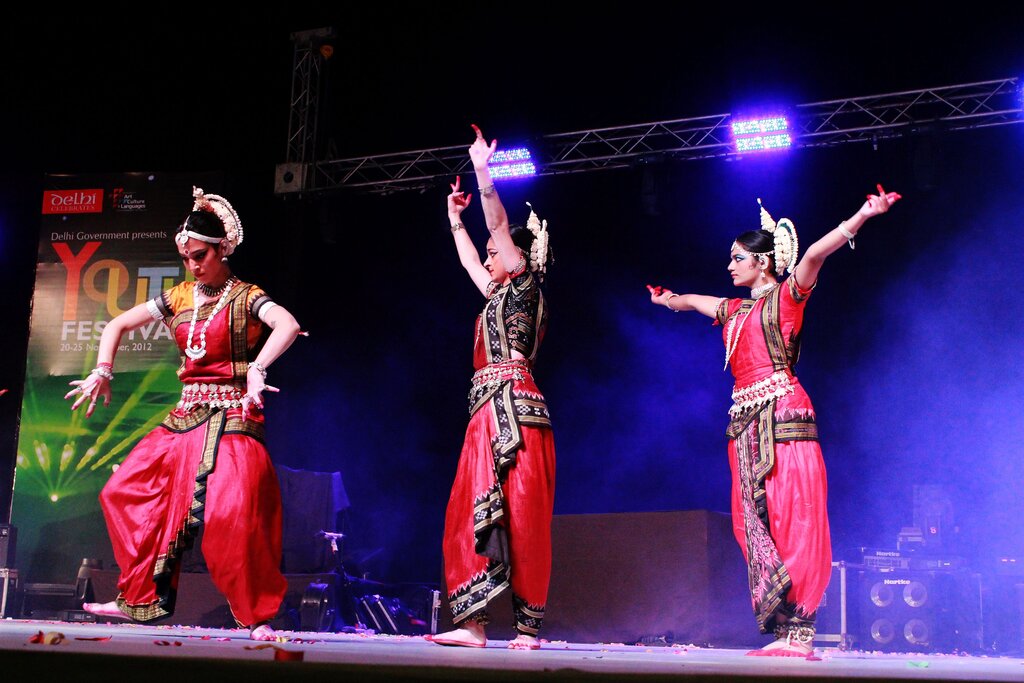
Contrast this with Odissi. Its signature posture is the Tribhangi, or 'three-bend' pose. The body curves in a gentle 'S' shape at the neck, torso, and knees. This creates a fluid, lyrical quality, almost like the temple sculptures of Odisha have come to life. Mohiniyattam takes this fluidity even further with Atibhanga, an exaggerated side-to-side swaying motion that is circular and gentle, mimicking the ripples of water or the swaying of a palm tree.
These stylistic shifts can be understood through the concepts of Margi and Desi. The Margi tradition refers to the classical, codified path laid out in ancient texts like the , which serves as a common theoretical root for all Indian classical arts. It's the pan-Indian grammar.
Desi traditions are the regional interpretations—the dialects. While Bharatanatyam hews very closely to the Margi principles described in the text, forms like Odissi and Mohiniyattam are rich with Desi influences, incorporating local customs, music, and aesthetics to create their distinct identities.
Foundations at the Feet
Nowhere are the differences more apparent than in the footwork. As mentioned, Bharatanatyam's Araimandi requires a full 180-degree turnout of the feet. This turnout is maintained throughout the performance, creating the dance's signature sharp lines and powerful, grounded movements.
Other styles use a more natural foot position. Kathak, for instance, is performed with the feet largely parallel. This allows for the rapid, complex rhythmic footwork and lightning-fast spins (chakkars) that are the hallmark of the style. The focus is not on creating static geometric shapes, but on producing intricate sound and dizzying speed. This fundamental difference in foot placement dictates the entire range of possible movements for a dancer.
| Dance Form | Region | Core Aesthetic | Key Posture (Bhangi) | Footwork |
|---|---|---|---|---|
| Bharatanatyam | South (Tamil Nadu) | Geometric, Linear | Samabhanga, Araimandi | 180-degree turnout |
| Odissi | East (Odisha) | Fluid, Lyrical | Tribhangi | Moderate turnout |
| Mohiniyattam | Southwest (Kerala) | Circular, Swaying | Atibhanga | Natural, parallel |
| Kathak | North | Rhythmic, Storytelling | Samabhanga (upright) | Parallel feet |
Let's review the core concepts that distinguish these beautiful art forms.
Now, test your understanding of these regional variations.
Which dance form is characterized by the Tribhangi, or 'three-bend', posture, creating a gentle 'S' curve in the body?
A dancer performing with rapid, rhythmic footwork and lightning-fast spins (chakkars) is most likely practicing which style?
By understanding these key differences in posture, aesthetic, and footwork, you can begin to appreciate each classical dance not just as a variation, but as a complete artistic language in its own right.