Mastering Imbalanced Datasets
Understanding Imbalanced Datasets
The Problem of Imbalance
In a perfect world, the data we use to train machine learning models would be neat, tidy, and perfectly balanced. Each category we want to predict would have an equal number of examples. But in the real world, data is often messy and skewed. This leads to a common challenge: imbalanced datasets.
Imbalanced Dataset
noun
A dataset where the number of observations per class is not equally distributed. Typically, one class (the majority class) has a very large number of examples, while another (the minority class) has very few.
Think of it like trying to find a specific type of needle in a giant haystack. If you have a million pieces of hay (the majority class) and only ten needles (the minority class), it's easy to build a model that's great at identifying hay. The real challenge is finding the needles.
Real-World Scenarios
Imbalanced datasets aren't a niche problem; they appear in many critical applications.
Fraud Detection: In banking, the vast majority of credit card transactions are legitimate. Fraudulent transactions are rare. A dataset for training a fraud detection model might have millions of normal transactions for every one case of fraud.
Medical Diagnosis: When screening for a rare disease, most patients will test negative. The number of positive cases (the minority class) will be tiny compared to the number of negative cases (the majority class).
Spam Filtering: While it might feel like you get a lot of junk mail, spam emails are still a minority compared to all the legitimate emails sent every day. An email classifier deals with an imbalance between spam and "ham" (not spam).
In each of these cases, the event we care most about predicting is the rare one.
| Use Case | Majority Class (Many Examples) | Minority Class (Few Examples) |
|---|---|---|
| Credit Card Fraud | Legitimate Transactions | Fraudulent Transactions |
| Medical Screening | No Disease Detected | Disease Detected |
| Customer Churn | Customers Who Stay | Customers Who Cancel |
Why Imbalance Is a Trap
Machine learning models are trained to minimize errors and maximize accuracy. With an imbalanced dataset, a model can achieve high accuracy by simply guessing the majority class every single time. It's a lazy but effective strategy for looking good on paper.
Imagine a dataset with 99% non-fraudulent transactions and 1% fraudulent ones. A model that predicts "not fraud" for every single transaction will be 99% accurate. But it will be completely useless for its actual purpose: catching fraud.
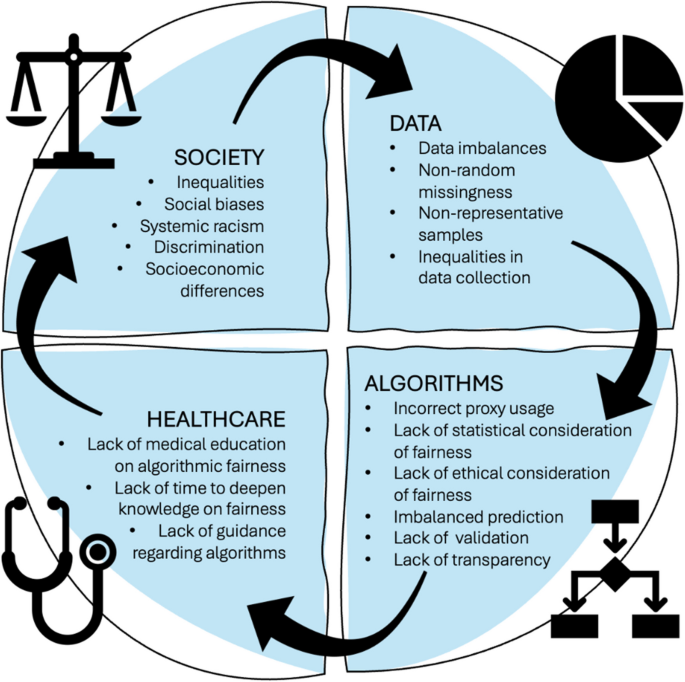
This creates a significant bias. The model learns the patterns of the majority class very well but fails to learn the characteristics of the minority class. It becomes insensitive to the very outcomes we need it to identify. This isn't just a technical issue; it has serious consequences.
A biased medical diagnostic tool might miss a rare cancer, or a faulty fraud detection system could cost a company millions. The goal isn't just high accuracy, but a model that is both effective and fair, capable of identifying the rare but critical cases.
Recognizing that your dataset is imbalanced is the first step. If a model seems too good to be true, especially on a problem where one outcome is much rarer than another, it's worth checking the class distribution. A model's real value lies not in its overall accuracy, but in its ability to make correct predictions on the data that matters most.