Mastering IGBT Power Electronics
IGBT Physics and Operation
The Hybrid Powerhouse
The Insulated Gate Bipolar Transistor, or IGBT, is a clever hybrid. It combines the simple gate drive of a MOSFET with the high-current and low-saturation-voltage capabilities of a bipolar junction transistor (BJT). Think of it as getting the best of both worlds: the easy control of a voltage-driven device and the raw power-handling muscle of a current-driven one. This unique combination makes IGBTs essential components in high-power applications like electric vehicles, variable-frequency drives, and renewable energy systems.
A Four-Layer Sandwich
At its core, an IGBT's structure is a four-layer stack of alternating semiconductor types, creating an N-P-N-P arrangement. This vertical structure is built to handle high voltages and large currents efficiently. The top N+ layer forms the emitter, while the bottom P+ layer is the collector. The P-region is known as the body, and the crucial, lightly doped N-region is called the N-drift region. An insulated gate, just like in a MOSFET, sits on top, controlling the entire device's operation.
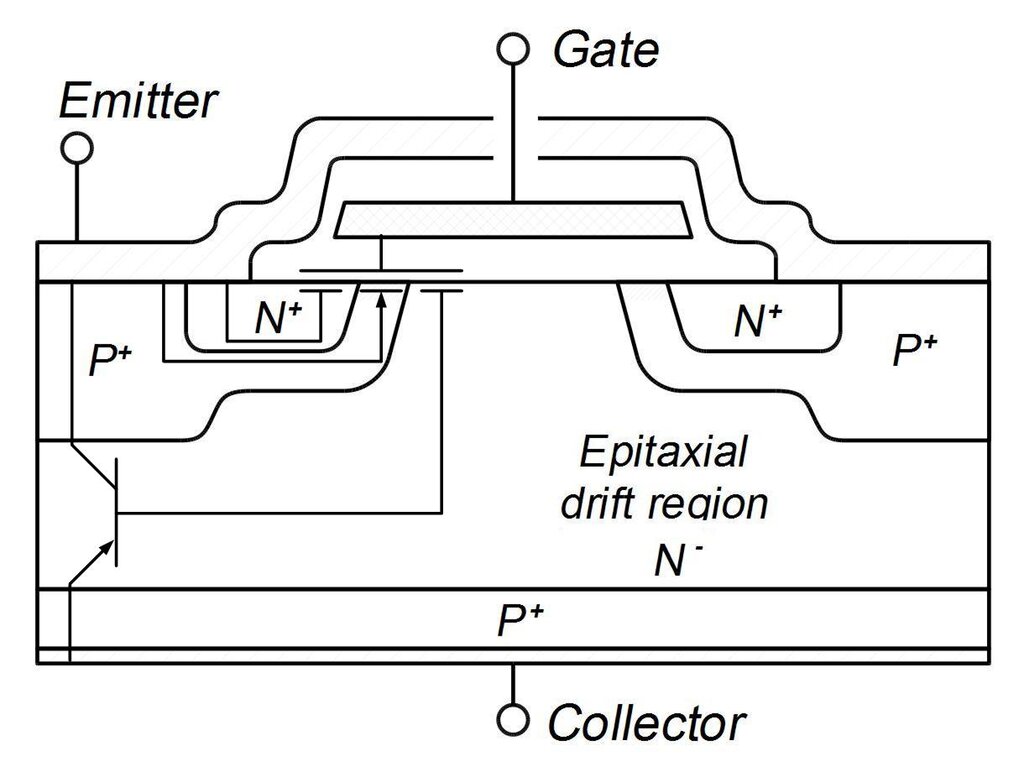
This physical layout isn't just a random stack. Each layer plays a precise role in how the IGBT switches on and conducts current, blending the actions of its two parent technologies.
The Two-Transistor Model
The easiest way to understand how an IGBT works is to look at its equivalent circuit. Functionally, it behaves like an N-channel MOSFET connected to a wide-base PNP bipolar transistor in a Darlington-like configuration. The MOSFET's drain is connected to the BJT's base, and its source is connected to the BJT's emitter. The IGBT's main terminals, the collector and emitter, correspond to the PNP transistor's collector and emitter. The control terminal, the gate, is the MOSFET's gate. In this setup, the user-friendly MOSFET acts as the driver, controlling the powerful but more complex PNP transistor.
When a positive voltage is applied between the gate and emitter, it creates an inversion layer in the P-body region, forming a conductive channel. This allows electrons to flow from the N+ emitter into the N-drift region. This electron flow is effectively the base current for the PNP transistor, turning it on and allowing a much larger current of holes to flow from the P+ collector, through the drift region, to the N+ emitter.
Conductivity and Current
The IGBT's secret weapon is its ability to handle immense current with a very low voltage drop. This efficiency comes from a process called within the N-drift region. While a power MOSFET relies solely on electrons (majority carriers) to conduct current through its drift region, an IGBT operates differently. The P+ collector injects a high concentration of holes (minority carriers) into the N-drift region when the device is on. This flood of positive charge carriers drastically increases the region's conductivity.
This effectively neutralizes the resistance of the lightly doped N-drift region. Without it, this region would need to be very thick to block high voltages when the device is off, resulting in high resistance when it's on. By flooding it with both electrons and holes, the IGBT achieves both high voltage blocking and low on-state resistance, a combination that's difficult to achieve with a MOSFET alone.
So, the N-drift region serves a dual purpose. In the off-state, its thickness and low doping level allow it to withstand a high blocking voltage. In the on-state, conductivity modulation transforms it into a highly conductive path for current. It’s this elegant design that bridges the gap between high voltage and high current capabilities.
An IGBT combines the simple gate drive of a MOSFET with which key characteristic of a Bipolar Junction Transistor (BJT)?
In the equivalent circuit of an IGBT, an N-channel MOSFET controls a PNP bipolar transistor.
The IGBT's clever fusion of MOSFET and BJT principles makes it a cornerstone of modern power electronics, enabling efficient control over massive amounts of electrical energy.