Mastering IB Diploma Physics
Dynamics and Rotational Mechanics
The Physics of Moving in Circles
So far, we've focused on motion in a straight line. But what happens when an object turns? Think of a car rounding a bend or a planet orbiting the sun. This is uniform circular motion, where an object moves in a circle at a constant speed. Notice the wording: constant speed, not constant velocity. Since velocity is a vector, its direction is constantly changing as the object moves along its circular path. A change in velocity, even if it's just a change in direction, means there's an acceleration.
This acceleration is always directed towards the centre of the circle. It's what pulls the object away from a straight-line path and keeps it moving in a circle. We call this centripetal acceleration which literally means "centre-seeking".
According to Newton's Second Law (), if there's an acceleration, there must be a net force causing it. The net force that causes centripetal acceleration is called centripetal force. It's crucial to understand that this isn't a new, fundamental force of nature. It's simply the label we give to the net force that points towards the centre of the circle. This force could be tension in a string, friction between tyres and a road, or even gravity.
Loops and Turns
Let's apply this to a roller coaster going through a vertical loop. At the bottom of the loop, you feel pressed into your seat. Your weight (gravity, ) pulls you down, but the normal force from the seat pushes you up. The upward normal force must be greater than your weight to provide the net upward force needed to curve your path upwards. At the top of the loop, both gravity and the normal force (if you're still touching the seat) point downwards, towards the centre of the circle. Together, they provide the necessary centripetal force. To stay in the loop without falling, the car must have a minimum speed such that the force of gravity alone is enough to provide the required centripetal acceleration. This is why roller coasters need to be going fast to complete a loop safely. Many modern roller coasters use a instead of a perfect circle to manage these forces more effectively.
For any rotating object, we can also describe its motion using angular velocity, , which measures the rate of change of the angle in radians per second. The linear speed, , of a point on the object is related to its angular velocity and its distance from the centre of rotation, .
Newton's Law of Gravitation
The force that keeps planets in orbit around the Sun is gravity. Isaac Newton proposed that this force is universal, meaning it acts between any two objects with mass, anywhere in the universe. The strength of this attractive force depends on the masses of the two objects and the distance between their centres.
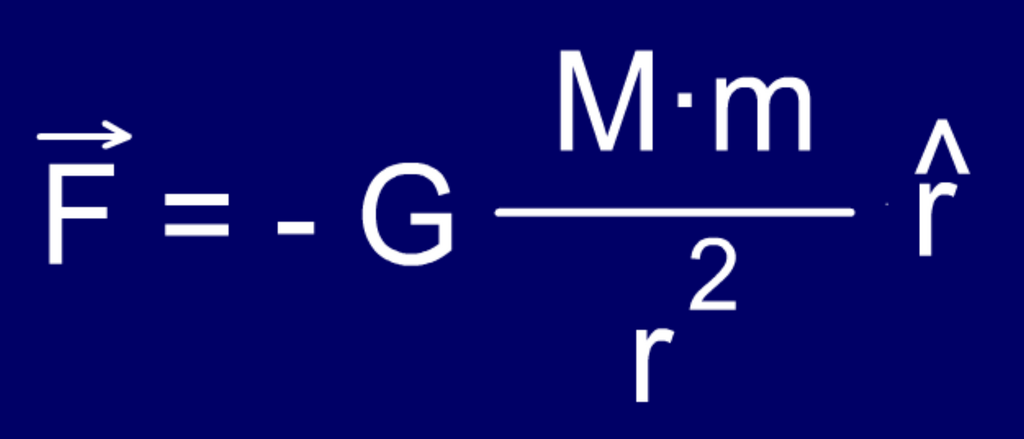
From this law, we can also define the gravitational field strength, , at a certain point in space. It's the gravitational force per unit mass that a small test mass would experience at that location. For a large body like a planet of mass , the field strength at a distance from its centre is:
For an object in a stable orbit, like a satellite around the Earth, the gravitational force provides the necessary centripetal force. By setting the gravitational force equal to the centripetal force, we can derive an expression for the required orbital speed.
By cancelling the mass of the satellite, , and one factor of from both sides, we can solve for the orbital speed, .
This powerful equation explains why satellites in lower orbits must travel faster than those in higher orbits. It's a direct link between circular motion and the fundamental force of gravity, governing the dance of planets, moons, and stars across the cosmos.
An object is in uniform circular motion. Which of the following statements is true?
What is the direction of the centripetal acceleration for a car driving in a circle at a constant speed?