Mastering Homemade Gesso and Monochromatic Acrylics
Professional Gesso Chemistry
The Gesso Formula
Store-bought gesso gets the job done, but understanding its components allows you to create a truly custom surface. Professional gesso isn't a single product; it's a recipe with three core ingredients: a binder, a pigment, and a filler. The binder is the glue. The pigment provides opacity and color. The filler, often called the ground, adds bulk and creates the texture, or "tooth," that your paint will grip onto.
By tweaking the ratios and types of these ingredients, you gain precise control over your canvas's absorbency, texture, and flexibility. This is crucial for monochromatic work, where the physical surface plays a huge role in how light interacts with layered washes.
Binders: The Glue That Holds It Together
The binder determines the structural properties of your ground. Your choice here is a trade-off between modern flexibility and traditional rigidity.
Acrylic Polymer Emulsion is the modern standard. It's essentially a liquid plastic—tiny acrylic particles suspended in water. As the water evaporates, these particles fuse into a flexible, water-resistant film. This flexibility makes it ideal for stretched canvas, which expands and contracts with changes in temperature and humidity. Because it's made of the same acrylic polymer as your paints, it forms a perfect chemical bond, ensuring your painting won't delaminate over time.
Rabbit Skin Glue (RSG) is the traditional choice, used by Old Masters for centuries. It's an animal collagen that, when mixed with water and heated, forms a powerful adhesive. Unlike acrylic polymer, RSG is hygroscopic, meaning it constantly absorbs and releases moisture from the air. This makes it brittle. While it creates a wonderfully absorbent surface for rigid supports like wood panels, using it on canvas is a recipe for cracking as the fabric flexes.
| Feature | Acrylic Polymer | Rabbit Skin Glue |
|---|---|---|
| Flexibility | High (Excellent for canvas) | Low (Best for rigid panels) |
| Water Resistance | High once cured | Low (Re-absorbs moisture) |
| Compatibility | Excellent with acrylics | Requires oil-based primer for oils |
| Preparation | Simple mixing | Requires heating, careful handling |
Pigments and Fillers: Building the Surface
While the binder creates the foundation, the pigment and filler define the painting experience. The pigment makes the surface opaque, while the filler adds the physical texture your brush will feel.
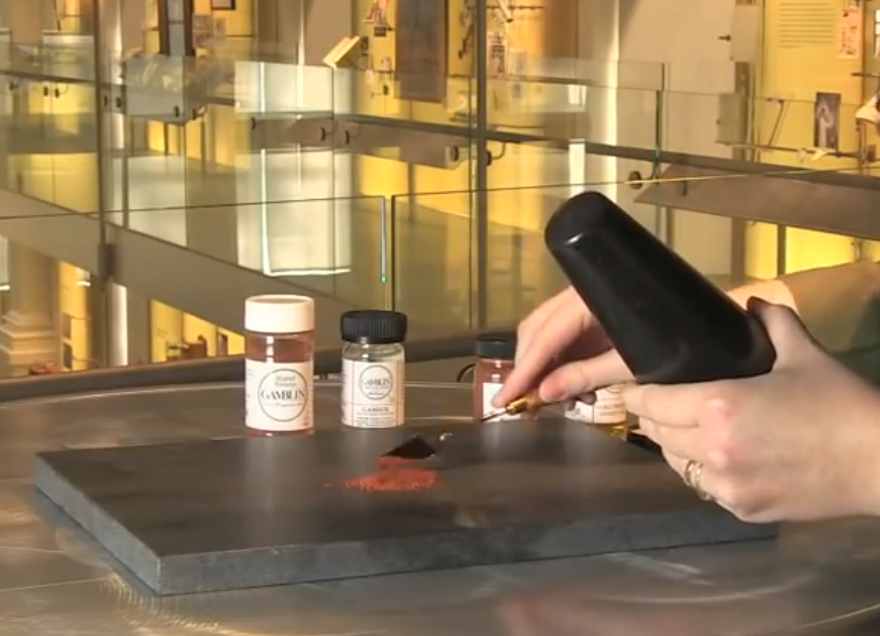
For opacity, Titanium Dioxide (TiO₂) is the undisputed champion in modern gesso. It provides the brightest, most opaque white, covering the underlying surface with just a few coats. Zinc White (ZnO) is another option, though less common now. It's more translucent and creates a slightly more brittle paint film, making it less ideal as a flexible ground for acrylics.
The real character of your surface comes from the filler. This is what creates the tooth.
Tooth
noun
The fine-grained texture of a surface that allows paint or drawing media to adhere to it. A surface with more tooth has a rougher, more abrasive feel.
The most common filler is Calcium Carbonate (CaCO₃). It’s cheap, effective, and comes in several forms. The two you’ll encounter most are chalk and marble dust.
- Marble Dust has larger, more irregular particles. It creates a grittier, more absorbent surface with a very noticeable tooth. This is excellent for techniques where you want to build up heavy, textured layers.
- Chalk has finer, more uniform particles. It produces a smoother, less absorbent ground that's closer to the finish of a pre-primed canvas. This is better for detailed work and smooth washes.
By mixing different fillers, you can fine-tune the texture. Some recipes even include Talc to create an exceptionally smooth, almost silky surface, though this reduces tooth and absorbency.
Balancing the Recipe
Creating your own gesso is a balancing act. For a flexible canvas, you need an acrylic polymer binder. For a rigid wood panel, you could use RSG for its unique absorbency, but acrylic still works perfectly well.
The ratio of filler to binder determines the final character. A higher ratio of Calcium Carbonate to acrylic polymer will create a more absorbent,
A higher ratio of filler to binder creates a more absorbent, chalky surface with more tooth, mimicking a traditional ground. A lower ratio results in a smoother, less absorbent, more plastic-like surface. Experimentation is key. Start with a simple recipe, like one part marble dust to one part acrylic binder, and adjust from there to find the surface that best suits your monochromatic technique.
What are the three core ingredients of a professional gesso recipe?
An artist wants to create a heavily textured surface with a lot of "tooth" to grip thick layers of paint. Which filler would be the best choice for their custom gesso?