Mastering Histone Modifying Enzymes
Introduction to Epigenetics
Beyond the DNA Sequence
Your DNA contains the blueprint for building and operating your entire body. Think of it as a massive cookbook, with each gene being a recipe for a specific protein. But having the cookbook isn't enough. Your cells also need a way to know which recipes to use, when to use them, and how often. Not every cell needs every recipe all the time. A brain cell, for example, has different needs than a skin cell, even though both contain the exact same DNA cookbook.
This is where epigenetics comes in. It's a layer of instructions on top of your DNA that tells your genes when to switch on or off.
These instructions don't change the DNA sequence itself, just how it's read. Imagine your cookbook again. Epigenetic marks are like sticky notes, bookmarks, and paper clips. A sticky note might say "Make this!" on one recipe, while a paper clip might hold two pages together, hiding a recipe that isn't needed. These marks can be added or removed in response to your environment, diet, and experiences.
Epigenetics is the study of how people's behavior and environments influence the way their genes are expressed, even though their DNA sequence is itself unchanged.
How DNA is Packaged
To understand epigenetics, we first need to look at how DNA is stored in our cells. If you stretched out the DNA from a single human cell, it would be about six feet long. To fit all of that into a microscopic nucleus, the DNA needs to be expertly packaged.
This packaging is achieved by wrapping the DNA around proteins called histones. A segment of DNA wrapped around a core of eight histone proteins is called a nucleosome. Think of the histones as spools and the DNA as a very long thread.
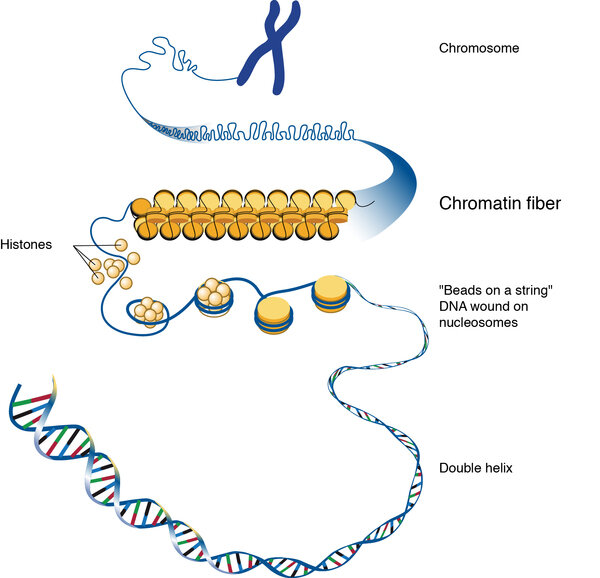
These nucleosomes are then further coiled and compacted into a structure called chromatin. The way chromatin is structured is crucial for gene expression. When chromatin is loosely packed, it's called euchromatin. The DNA is accessible, and the genes in that region can be easily read and turned on.
When chromatin is tightly packed, it's called heterochromatin. In this state, the DNA is condensed and hidden, making the genes inaccessible. They are effectively silenced.
Epigenetic marks control whether a region of chromatin is open (euchromatin) or closed (heterochromatin), thus regulating gene activity.
Key Epigenetic Mechanisms
Two of the most well-studied epigenetic mechanisms are DNA methylation and histone modifications. They act as the writers of the sticky notes and the placers of the paper clips on your genome.
Methylation
noun
A common epigenetic signaling tool that involves adding a methyl group to a DNA base.
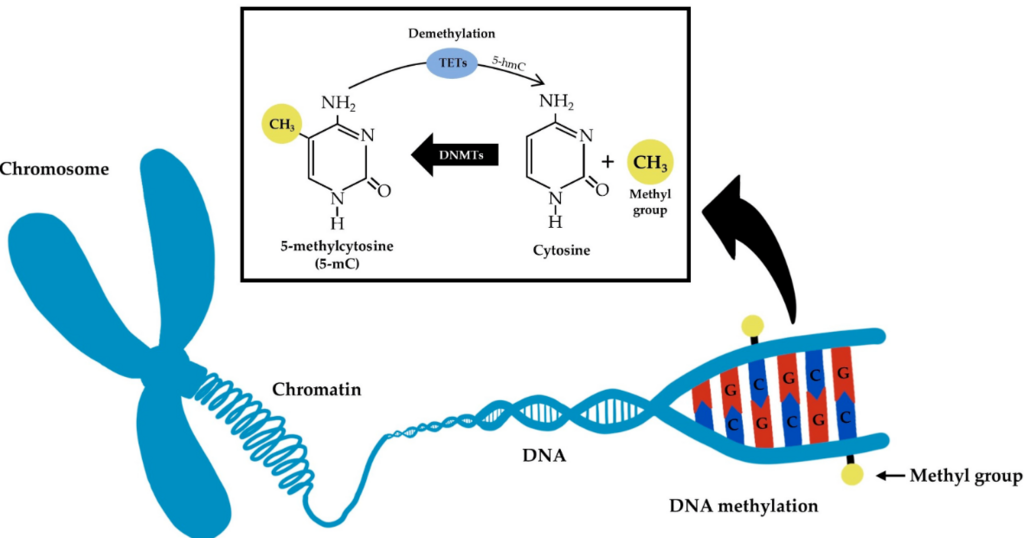
DNA methylation typically involves adding a small chemical tag, a methyl group (), directly onto a cytosine base in the DNA sequence. This usually happens in regions called CpG islands, where a cytosine nucleotide is followed by a guanine nucleotide.
High levels of methylation in a gene's promoter region, which is the 'on' switch, generally prevent the gene from being read. This effectively silences the gene. It’s like putting a lock on a recipe page so no one can read it.
The other major mechanism is histone modification. The histone proteins have tails that stick out from the nucleosome, and these tails can be tagged with various chemical groups. Unlike DNA methylation, which almost always means 'off,' histone modifications are more nuanced.
Some modifications, like acetylation, tend to loosen the chromatin structure, making genes more accessible (euchromatin). This is like putting a bookmark on a page to make it easy to find. Other modifications, like certain types of methylation on the histones themselves, can lead to more compact chromatin (heterochromatin), silencing genes.
Histone Modifications: Histone modifications are post-translational changes to the histone proteins, such as acetylation, methylation, phosphorylation, and ubiquitination, which can alter chromatin structure and gene expression.
Together, these epigenetic marks create a complex regulatory code that fine-tunes gene expression in every cell, allowing an organism to adapt and respond to its environment without changing its fundamental genetic blueprint.
Ready to test your knowledge?
What is the central concept of epigenetics?
What is a nucleosome?
These mechanisms form the foundation of how our cells manage their genetic information, playing a critical role in everything from development to disease.