Mastering High-Stakes Heists
Understanding High-Security Facilities
Defense in Depth
High-security facilities aren't protected by a single, impenetrable wall. Instead, they rely on a strategy called "defense in depth." This approach uses multiple, overlapping layers of security. If one layer fails, another is already in place to stop the threat. Each layer is designed to deter, detect, delay, and respond to potential risks.
The U.S. National Archives in Washington, D.C., is a prime example. It protects priceless documents like the Declaration of Independence and the Constitution. Its security is a complex blend of physical barriers, advanced technology, and strict procedures, creating a formidable defense system from the curb to the vault.

Physical Barriers and Access Control
The first line of defense is the building itself. The National Archives is a massive structure made of concrete and steel, presenting a significant initial obstacle. But modern physical security goes far beyond strong walls. It involves creating a series of controlled zones, each with progressively tighter access restrictions.
Imagine moving through the facility. You might start in an unrestricted public area, then pass through a checkpoint into a controlled zone for staff. Access to more sensitive areas, like document storage, would be limited to a small number of authorized personnel, and finally, the most critical assets are held in an exclusion zone. This tiered system ensures that individuals only have access to the areas they absolutely need.
Moving between these zones requires passing through access control points. These aren't just simple locks. They often use multi-factor authentication, such as a keycard combined with a PIN or a biometric scan (fingerprint or iris). This system enforces the principle of least privilege, a core security concept where users are granted the minimum levels of access necessary to perform their job functions.
The more sensitive the asset, the more layers of control an individual must pass through to access it. This minimizes the risk of both external and internal threats.
Surveillance and Environmental Systems
Every inch of a high-security facility is monitored. Modern surveillance is an integrated network of high-definition cameras, motion detectors, thermal sensors, and even pressure plates. All this data feeds into a central security operations center (SOC), where analysts monitor for anomalies 24/7.
But threats aren't always human. For the National Archives, the environment itself is a constant risk to the fragile documents it holds. To combat this, the Charters of Freedom are housed in custom-built, sealed encasements filled with humidified argon, an inert gas that prevents oxidation. These cases are stored in a massive underground vault designed to withstand a nuclear blast.
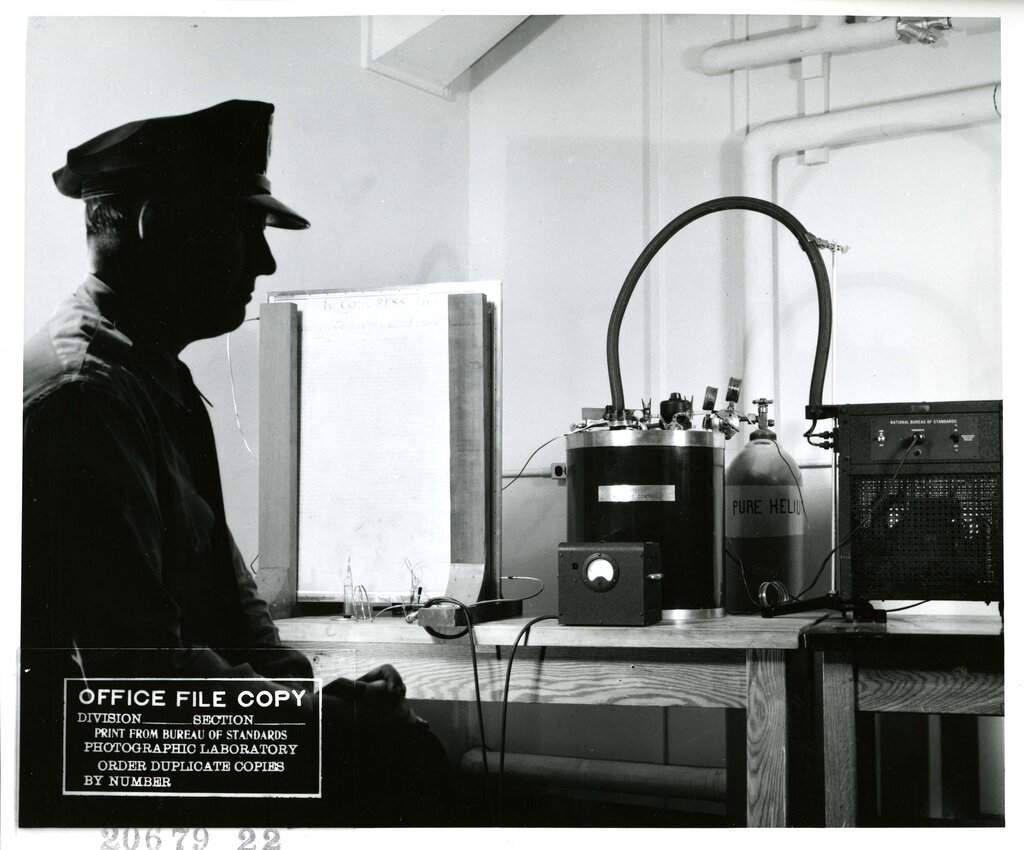
Environmental controls are just as critical as intrusion detection. The vault's systems constantly manage temperature and humidity to precise levels. Advanced fire suppression systems use inert gas or chemical agents instead of water, which would instantly destroy the priceless parchment. At night, the Charters are lowered deep into the vault for maximum protection.
Testing the Defenses
A security system is only effective if it works. That's why facilities conduct regular vulnerability assessments. This process involves actively trying to identify and exploit weaknesses in the security posture.
These assessments aren't just about technology. They test every layer of the system. A penetration testing team, often called a "red team," might try to bypass physical barriers, trick employees into granting access (social engineering), or find flaws in the digital network. The goal is to think like an adversary to find weak points before a real one does.
A typical assessment follows a clear methodology:
| Step | Description |
|---|---|
| 1. Planning | Define the scope of the test. What systems, areas, and methods will be used? |
| 2. Information Gathering | Collect intelligence on the facility, its staff, and its procedures. |
| 3. Threat Modeling | Identify potential adversaries and the tactics they might use. |
| 4. Vulnerability Analysis | Systematically probe for weaknesses in physical, technical, and human systems. |
| 5. Exploitation | Attempt to bypass security controls based on the identified vulnerabilities. |
| 6. Reporting | Document all findings, detail the risks, and provide recommendations for remediation. |
By constantly testing and refining their defenses, high-security facilities like the National Archives can adapt to new threats and ensure their precious contents remain safe for future generations.
What is the core principle of the "defense in depth" security strategy?
Requiring a keycard and a biometric scan to enter a secure area is an example of what?