Mastering High School Wrestling Officiating
Pre-Match Duties
Before the Whistle
Your responsibilities as a wrestling official begin long before the first match. The work you do in the minutes and hours leading up to competition establishes your authority, ensures athlete safety, and sets the tone for a fair event. A well-managed pre-match routine prevents problems from ever reaching the mat.
Weigh-Ins and Inspections
Overseeing the weigh-in is your first official duty. While the primary purpose is to certify each wrestler's weight class, your role is also to conduct a thorough health and equipment check. This is a critical legal and safety checkpoint.
During this inspection, you are the final authority on a wrestler's eligibility to compete. Pay close attention to grooming standards. Fingernails must be short and smooth. Hair must be cut to an acceptable length or secured in a legal hair cover. All jewelry must be removed. Most importantly, you must carefully check each athlete for any . If a wrestler has a questionable lesion but presents a current, valid clearance form from a physician, they may be permitted to compete.
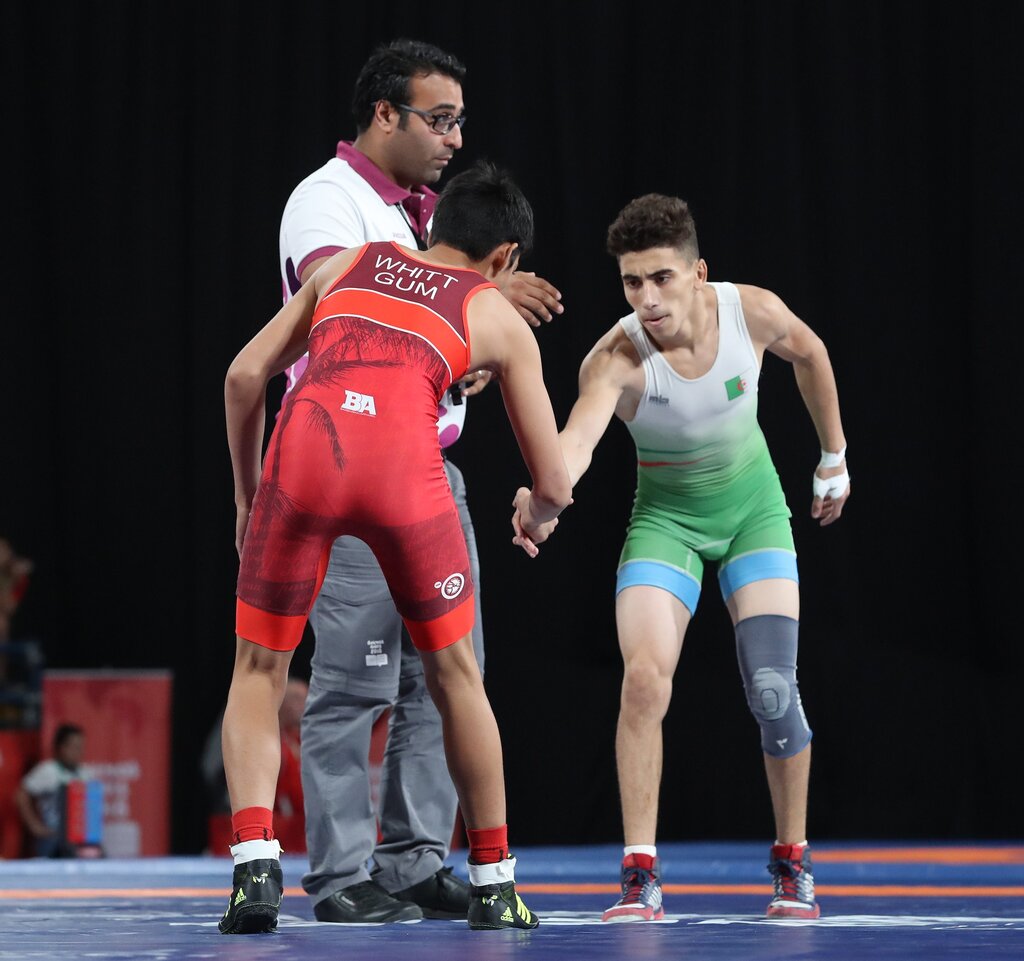
Next, verify that each wrestler's uniform and equipment meet all . The singlet should be school-issued, fit snugly, and not be overly cut. If worn, undergarments must be single-piece and not extend below the knee. Ear guards are mandatory and must be worn as intended by the manufacturer, without extra padding or tape. Special equipment, like knee pads or face masks, must also be checked to ensure they are free of hard or abrasive materials.
Setting Expectations
The pre-match meeting with coaches and team captains is your opportunity to establish control and ensure everyone understands the rules of engagement. This meeting should be brief, professional, and held at the scorer's table about five minutes before competition begins.
During the meeting, cover these key points:
- Introduce yourself and other officials.
- Confirm team captains and verify that all wrestlers are legally equipped and properly groomed.
- Briefly review any specific rules or points of emphasis for the event.
- Ask coaches to identify the designated medical professional authorized to make injury decisions.
- Conduct the coin toss to determine which team sends their wrestler to the mat first for odd-numbered weight classes.
Confirming the designated medical trainer is a crucial step. In the event of an injury, you need to know who has the authority to assess a wrestler's ability to continue. This prevents confusion and ensures decisions are made by a qualified individual.
The Competition Area
Your final pre-match responsibility is a thorough inspection of the mat and the surrounding area. Safety is the top priority. Walk the entire surface of the mat, checking for tears, gaps between sections, or wet spots from cleaning. Ensure the mat is properly secured and that there are no hazards like tables, chairs, or bags within the safety perimeter.
Verify that the scorer's table is equipped with a functioning clock and scoring system. Confirm the personnel know how to operate it. Check that any team benches are placed a safe distance from the mat. Once you're confident the entire area is secure, you can signal for the first wrestlers to report to the mat.
Let's review what you've learned about pre-match duties.
Besides certifying a wrestler's weight, what is a primary responsibility of the official during the weigh-in?
During a pre-match inspection, a wrestler has a questionable skin lesion but provides a doctor's note. What must be true about this note for the wrestler to be cleared to compete?
By diligently performing these duties, you ensure the competition starts on a foundation of safety, fairness, and professionalism.