Mastering Heterogeneous Mixtures
Heterogeneous Phase Boundaries
Phases and Interfaces
When you mix things, they don't always blend perfectly. A heterogeneous mixture is one where you can see distinct parts. Each of these distinct parts is called a phase. A phase is any region of a system that has uniform physical and chemical properties. It’s a zone where everything is the same, from its density to its chemical composition.
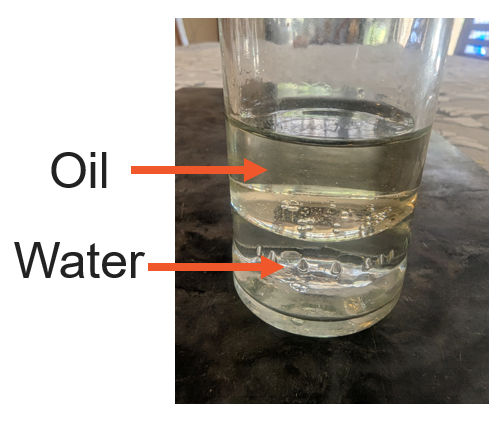
The classic example is oil and water. Both are liquids, but they refuse to mix. The oil clumps together and the water clumps together, forming two separate layers. Each layer is a distinct phase. Where these two phases meet, there's a clear boundary. This boundary is called an —it's the surface separating one phase from another.
Visible and Invisible Divisions
Heterogeneity isn't always obvious. Sometimes the phases are large enough to see with the naked eye, a property we call macroscopic heterogeneity. Think of a salad dressing with herbs and oil, or a rock like granite with its visible crystals of different minerals. The different components are clearly distinct.
Other times, the separation is on a much smaller scale. Microscopic heterogeneity occurs when the distinct phases are too small to see without magnification. Milk, for instance, looks uniform. But under a microscope, you'd see tiny globules of fat suspended in a watery solution. These are known as —mixtures where one substance of microscopically dispersed insoluble particles is suspended throughout another substance.
Even if substances are in the same state of matter, like two liquids or two solids, they can form a heterogeneous mixture if they have different properties and don't mix.
Multi-Phase Systems
Systems aren't limited to just two phases. It's common to find mixtures with three or even more. Consider a glass of fizzy soda with ice cubes. You have a solid phase (the ice), a liquid phase (the soda), and a gas phase (the carbon dioxide bubbles). That’s a three-phase system right there.
By identifying phases and the interfaces between them, we can understand why some substances mix and others remain separate. This concept is fundamental to many processes, from cooking to industrial chemistry. The boundaries tell a story about the properties of the materials involved.
What is the term for a region within a system that has uniform physical and chemical properties?
Milk appears uniform to the naked eye, but under a microscope, it reveals tiny globules of fat suspended in a watery solution. This is an example of what?