Mastering Guitar Fretboard Navigation
Fretboard Basics
The Six Strings
Let's start with the very basics: the names of your guitar's six strings. In standard tuning, the strings are named E, A, D, G, B, and E, going from the thickest string (closest to your chin) to the thinnest (closest to the floor). The thickest string is the 6th string, and the thinnest is the 1st.
A common mnemonic to remember the string names is Eddie Ate Dynamite, Good Bye Eddie.
Notice that both the thickest and thinnest strings are the note E. They are just two octaves apart, which is something we'll touch on later.
What Frets Do
The neck of the guitar is divided by thin metal strips called frets. When you press a string down behind a fret, you shorten its vibrating length, which raises its pitch. Each fret you move up the neck raises the pitch by one half-step, the smallest interval in Western music.
The fret numbering starts at the headstock (the part with the tuning pegs). Playing a string without pressing any frets is called playing it "open," or fret 0. The first fret is the one closest to the headstock, and the numbers increase as you move toward the guitar's body.
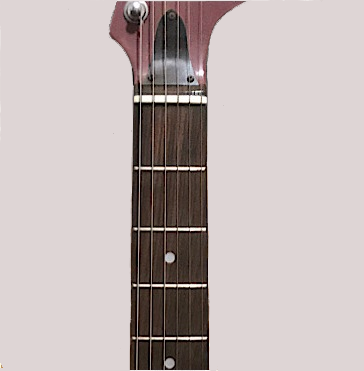
So, if you play the low E string open, you get an E note. If you press down on the first fret of that same string, you get an F note, which is one half-step higher than E.
The 12th Fret Rule
There are 12 unique notes in music. After you go up 12 half-steps (which means 12 frets on the guitar), the cycle of notes starts over again, but at a higher pitch. This higher-pitched version of the same note is called an octave.
On the guitar, this creates a simple and powerful rule: the note at the 12th fret of any string is the same as the open string, just one octave higher. Most guitars have dot inlays on the 12th fret (often two dots) to mark this important spot.
The 12th fret is the octave of the open strings, so memorizing the notes at this fret is essential.
For example, the open 6th string is E. The 12th fret on that string is also E. The open 5th string is A, and the 12th fret on that string is A. This pattern holds true for every string. Once you pass the 12th fret, the sequence of notes you found from frets 1 to 11 just repeats itself.
Understanding this layout is the first step. Knowing the string names, what frets do, and how the notes repeat at the 12th fret gives you a map of the entire fretboard.
In standard tuning, what are the names of the guitar strings from the thickest (6th string) to the thinnest (1st string)?
What is the relationship between the note of an open string and the note at its 12th fret?
With these fundamentals, you're ready to start finding your way around the neck.