Mastering gRPC Communication
Introduction to gRPC
What is gRPC?
Imagine you need to ask a coworker in another office to perform a task for you. You could send a detailed email (like a REST API call), but it might be slow and require careful formatting. Or, you could just call them and ask, making it feel like they're right in the next room. That's the basic idea behind Remote Procedure Calls, or RPC.
In gRPC, a client application can directly call a method on a server application on a different machine as if it were a local object, making it easier for you to create distributed applications and services.
gRPC is a modern, high-performance framework for RPC developed by Google. It's designed to make communication between different services—often called microservices—fast and efficient. Instead of crafting HTTP requests by hand, developers can simply call functions on a remote server as if they were local functions within their own code. gRPC handles all the complex networking and data translation behind the scenes.
gRPC vs REST
For many years, REST has been the standard for building APIs. It uses familiar HTTP methods like GET, POST, and PUT and typically transfers data using JSON, a human-readable text format. While REST is flexible and widely understood, it's not always the most efficient choice.
gRPC takes a different approach. It uses HTTP/2, a newer version of the protocol that allows for more advanced communication patterns. And instead of JSON, it uses Protocol Buffers (or Protobufs) to structure and send data. Protobufs are a binary format, which means they are much smaller and faster for computers to process than text-based JSON.
| Feature | gRPC | REST |
|---|---|---|
| Transport | HTTP/2 | HTTP/1.1, HTTP/2 |
| Data Format | Protocol Buffers (Binary) | JSON (Text) |
| API Contract | .proto file | OpenAPI/Swagger |
| Communication | Unary, Server Streaming, Client Streaming, Bidirectional Streaming | Request-Response |
| Performance | High | Moderate |
This difference in data format is a key reason for gRPC's performance advantage.
Besides raw speed, gRPC's use of HTTP/2 enables powerful features that aren't possible with the standard REST model. One of the biggest is streaming. A server can send a continuous stream of data to a client, a client can send a stream to the server, or they can both stream data back and forth at the same time. This is incredibly useful for things like real-time notifications, live data feeds, or uploading large files.
Core Components
The gRPC architecture is built around a few key ideas. The most important is the service definition.
By default, gRPC uses protocol buffers as the Interface Definition Language (IDL) for describing both the service interface and the structure of the payload messages.
An Interface Definition Language, or IDL, is just a way to formally describe how the client and server will talk to each other. In gRPC, this is done in a special file called a .proto file. This file acts as a contract. It defines the available services, the methods (functions) each service offers, and the structure of the messages they accept and return.
The
.protofile is the single source of truth for your API. Both the client and the server use it to generate the necessary code for communication.
Once you have a .proto file, the gRPC framework uses it to automatically generate code for both your client and server in your chosen programming language. The server gets a skeleton interface that it needs to implement with actual logic. The client gets a 'stub' that has all the same methods defined in the .proto file. When the client calls a method on the stub, gRPC packages up the request, sends it to the server, waits for the response, and returns it to the client. The entire network communication is abstracted away.
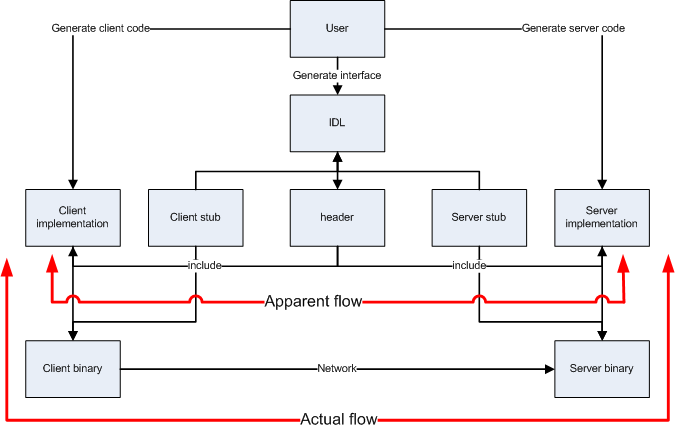
This code generation is a huge advantage. It eliminates the need for developers on different teams to write boilerplate code for sending and receiving data. It also ensures that the client and server are always in sync. If the API contract in the .proto file changes, the code has to be regenerated, and any breaking changes will be caught at compile time, not at runtime.
Let's check your understanding of these foundational concepts.
What data serialization format does gRPC primarily use, known for its efficiency and binary nature?
What is the primary role of a .proto file in a gRPC application?
In short, gRPC provides a robust and efficient way for services to communicate. By defining a clear contract and using modern technologies like HTTP/2 and Protocol Buffers, it helps developers build fast, scalable, and reliable distributed systems.