Mastering Gregg Shorthand Anniversary Edition
Introduction to Gregg Shorthand
A Faster Way to Write
Before keyboards became common, people who needed to write quickly relied on shorthand. It's a system of symbols and abbreviations that lets you capture spoken words much faster than traditional longhand. In 1888, an Irish-born educator named John Robert Gregg published his own version, which would become one of the most popular shorthand systems in the world.
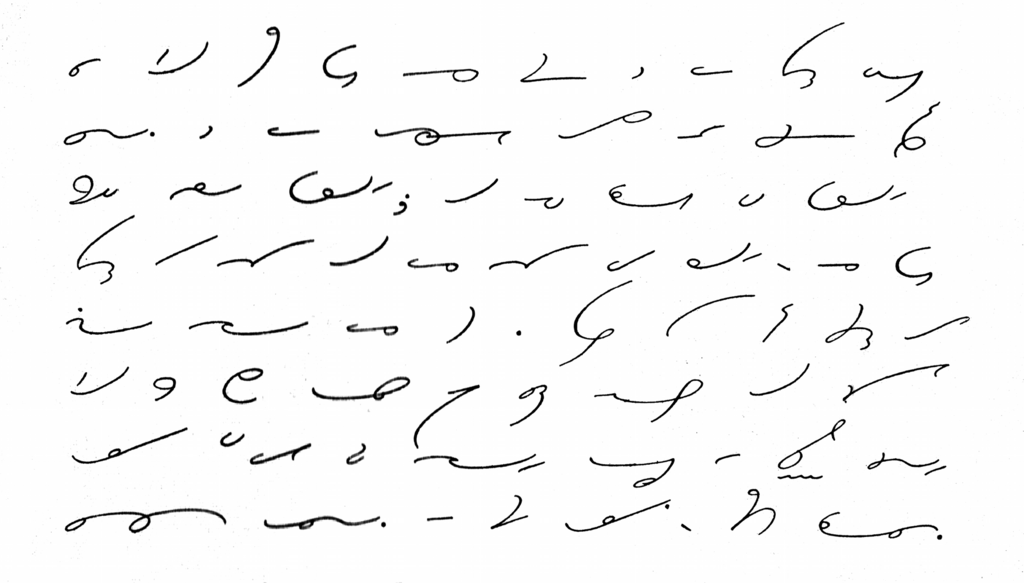
Gregg wanted to create a system that was simpler and more natural to write than existing methods. His goal was a “light-line phonography for the million.” He based his entire system on the curves and lines of a simple ellipse, making it flow smoothly from the pen.
Writing with Sound
The most important principle of Gregg Shorthand is that it's phonetic. This means the symbols represent sounds, not letters. You write what you hear, not what you spell. This is a huge advantage for speed. English spelling is full of silent letters and inconsistencies. Think of the words "laugh," "know," or "through." In Gregg, you'd only write the sounds that are actually pronounced.
For example, the word "laugh" would be written phonetically as "l-a-f."
This phonetic approach set it apart. While other systems like Pitman Shorthand were also phonetic, Pitman required using thick and thin strokes to distinguish between sounds. This meant you had to press harder for some symbols, which could slow you down and required a flexible pen nib. Gregg’s system used only “light-line” strokes of the same thickness, so it could be written with any writing instrument, including a simple pencil.
| Feature | Gregg Shorthand | Pitman Shorthand |
|---|---|---|
| Basis | Phonetic | Phonetic |
| Strokes | Light-line (uniform thickness) | Shaded (thick and thin) |
| Writing Motion | Cursive, based on ellipses | More angular, position-based |
Applications in the Real World
For decades, Gregg Shorthand was an essential skill in many professions. Secretaries used it to take dictation, journalists used it to record interviews and speeches, and court reporters relied on it to create an accurate transcript of legal proceedings. Anyone who needed to capture information quickly and accurately could benefit from learning it.
While technology has changed how we write, the principles behind Gregg Shorthand are still relevant. It’s a masterclass in efficiency and designing a system around natural human motion. Understanding its phonetic basis is the first step to appreciating its cleverness.
Ready to check your understanding?
What is the most important principle of Gregg Shorthand?
A key advantage of Gregg Shorthand over the Pitman system was that Gregg's system could be written with a simple pencil.
Now that you've got the basics down, you're ready to start learning the symbols themselves.