Mastering Green's Theorem
Vector Fields
Fields of Arrows
Imagine you're looking at a weather map. At every single point on the map, you could measure the temperature. That's a scalar field—a function that assigns a single number (a scalar) to every point in a space. But what about the wind? At every point, the wind has both a speed and a direction. To describe that, you need a vector.
This leads us to the idea of a vector field. It’s a function that assigns a vector to each point in a plane or in space. Instead of just a number, every location gets its own arrow with a specific length and direction.
Vector Field
noun
A function that assigns a vector to each point in its domain. Vector fields are used to model phenomena like fluid flow, gravity, or electric fields.
Ocean currents are a perfect real-world example. At any location on the ocean's surface, the water is moving with a certain speed in a particular direction. A vector field can represent this entire system of currents by placing an arrow at each point to show the water's velocity there.
Vector Fields in 2D
In a two-dimensional plane, a vector field is a function that assigns a vector to each point . We can write this function using its component functions, and :
Here, gives the horizontal component of the vector at point , and gives the vertical component.
Let's look at an example. Consider the vector field . What does this look like? We can plug in a few points to get a feel for it.
At the point (1, 0), the vector is . It points straight up. At (0, 1), the vector is . It points left. At (-1, 0), the vector is . It points straight down.
If we plot more points, we see a pattern emerge: the vectors seem to be rotating counter-clockwise around the origin.
This type of swirling motion is common in models of fluid dynamics, like a whirlpool, or in describing the magnetic field around a wire.
Vector Fields in 3D
The concept extends naturally to three dimensions. A 3D vector field assigns a vector to each point in space. The formula just gains a third component, , for the -direction.
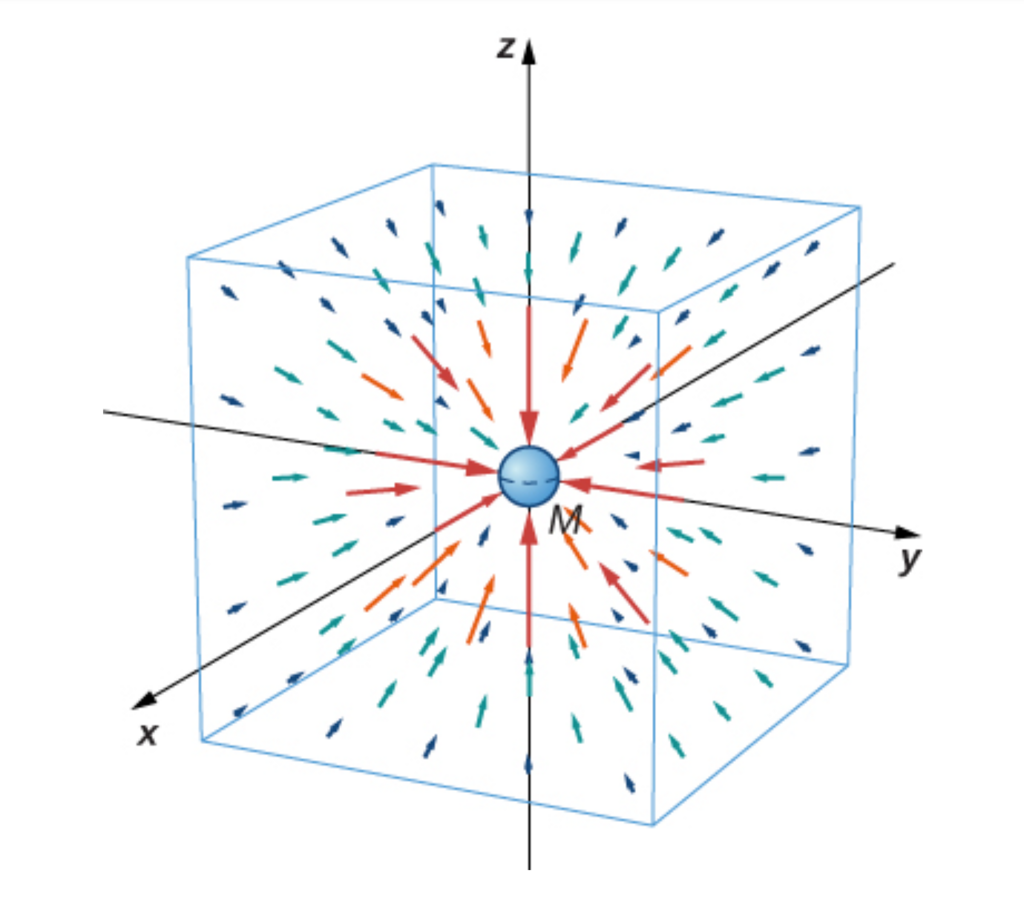
One of the most fundamental vector fields in physics is the gravitational field. For a mass at the origin, the gravitational force exerted on a smaller mass at point is given by Newton's Law of Universal Gravitation. The force vector always points from back toward the origin.
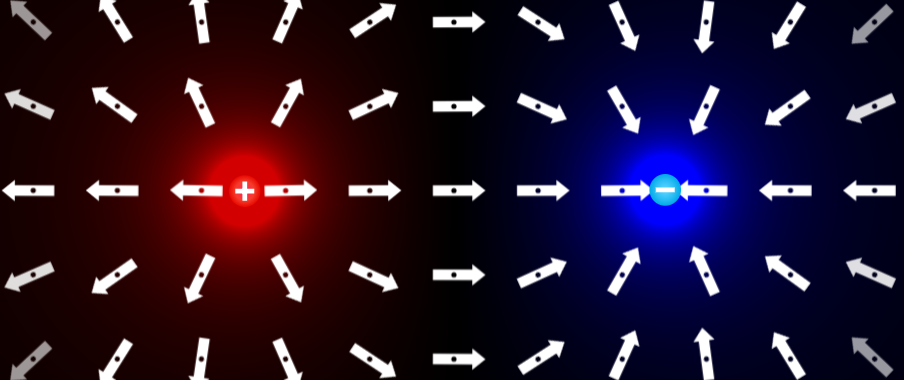
Another great example is an electric field. The image below shows the vector field created by two point charges: a positive charge (source) and a negative charge (sink). The arrows show the direction of the force that would be exerted on a positive test charge placed at that point. The vectors radiate away from the positive charge and curve toward the negative charge.
Not all vector fields are complex. The simplest type is a constant vector field, where every point is assigned the exact same vector. For example, describes a field where every arrow points straight down with a length of 1. You could think of this as a simplified model for gravity near the Earth's surface, where the force is approximately constant.
What does a vector field assign to each point in a space?
For the vector field , what is the vector at the point (0, 1)?
Vector fields provide a powerful way to visualize forces and flows that change over a region. By mapping vectors to points, we can understand the behavior of complex systems in physics, engineering, and beyond.