Mastering Gradient Boosted Trees
Introduction to Gradient Boosting
Building Models Sequentially
Imagine you're assembling a team to predict house prices. Instead of hiring one superstar expert, you hire a series of apprentices. The first apprentice makes a rough estimate for all the houses. They'll be wrong, but it's a start. The second apprentice doesn't look at the original house features; they only look at the errors the first apprentice made. Their entire job is to predict those errors.
You then add the second apprentice's predictions to the first's, creating a slightly better combined estimate. The third apprentice then looks at the errors of this new, combined estimate and tries to correct for them. This process repeats, with each new model focusing on the mistakes left by the team before it. This is the core idea behind gradient boosting.
Gradient boosting is an ensemble technique that builds a strong predictive model by sequentially adding weaker models, each correcting the errors of its predecessor.
The Power of Weak Learners
The individual models in this sequence are called weak learners. A weak learner is a simple model that performs just slightly better than random guessing. It doesn't need to be powerful on its own. In fact, it's better if it isn't. Its job is to find a subtle pattern in the errors of the previous models.
By far, the most common type of weak learner used in gradient boosting is a shallow decision tree. A decision tree asks a series of simple yes/no questions to arrive at a prediction. For boosting, these trees are often very simple, sometimes with only a few splits. They are fast to create and good at finding specific patterns in the data's remaining errors.
By adding up the contributions of many simple models, the final ensemble can capture very complex patterns without overfitting the data, which is when a model learns the training data too well, including its noise.
Boosting vs Bagging
Gradient boosting is often compared to another popular ensemble method called bagging. The most famous example of bagging is the Random Forest algorithm. While both methods use multiple decision trees, their philosophies are completely different.
Bagging is about teamwork through democracy. It trains many independent decision trees on different random samples of the data. To make a final prediction, it takes a vote (for classification) or an average (for regression) from all the trees. The models don't know about each other; they work in parallel.
Boosting is about teamwork through mentorship. The models are built sequentially, and each new model is explicitly trained to fix the shortcomings of the ones that came before it. They are highly dependent on each other.
| Feature | Bagging (e.g., Random Forest) | Boosting (e.g., Gradient Boosting) |
|---|---|---|
| Process | Parallel | Sequential |
| Model Dependence | Independent | Dependent |
| Main Goal | Reduce variance | Reduce bias and variance |
| How it works | Averages predictions from many models | Combines models to correct prior errors |
Bagging is effective at reducing variance, which means it helps prevent a model from being too sensitive to the specific training data it saw. Boosting tackles both bias (the model's underlying assumptions) and variance by incrementally building a more accurate model.
Where Does the 'Gradient' Come In?
The term "gradient" points to the mathematical optimization happening under the hood. To measure the model's errors, we use a loss function. The goal of training is to find model parameters that minimize this function. A common loss function for regression is mean squared error, , where is the true value and is the model's prediction.
Gradient boosting uses an algorithm called gradient descent to minimize the loss. Think of the loss function as a hilly landscape. Your goal is to find the lowest valley. At any point, the gradient is the direction of the steepest ascent. The negative gradient is the direction of steepest descent, or the fastest way downhill.
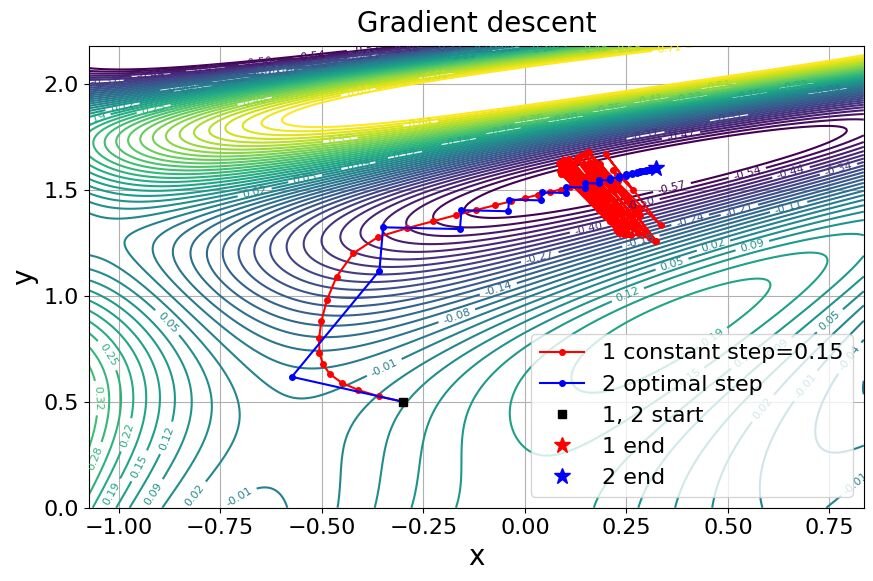
Instead of tweaking the parameters of one giant model, gradient boosting adds a new weak learner that best approximates the negative gradient of the loss function. In simple terms, each new model is trained to point the overall ensemble in the direction that most rapidly reduces its error. This clever use of gradient descent is what makes the technique so powerful and adaptable.
What is the fundamental principle behind how a gradient boosting model learns?
In the context of gradient boosting, a 'weak learner' is typically a complex, deep model designed for high individual accuracy.