Mastering Grade 9 Physics
Forces and Motion
The Language of Motion
Everything in the universe is moving. Even when you're sitting still, the Earth is spinning on its axis and orbiting the sun. To understand the rules that govern this constant dance, we first need a clear way to describe motion itself.
velocity
noun
The rate at which an object changes its position, in a specific direction.
Velocity isn't just about speed; it's about speed and direction. A car traveling at 60 mph east has a different velocity than a car traveling 60 mph west. If either the speed or the direction changes, the velocity changes.
acceleration
noun
The rate of change of velocity over time.
Anytime an object's velocity changes, it's accelerating. This includes speeding up, slowing down (which is just negative acceleration, or deceleration), or even just changing direction. A satellite in a circular orbit around Earth is constantly accelerating because its direction is always changing, even if its speed is constant.
The Law of Inertia
For centuries, people thought that the natural state of an object was to be at rest. It seemed obvious, if you slide a book across a table, it eventually stops. But Isaac Newton realized this was a misunderstanding. The book stops because of a force: friction. If you could remove friction, the book would slide forever.
This insight led to his first law of motion, often called the law of inertia.
An object at rest stays at rest and an object in motion stays in motion with the same speed and in the same direction unless acted upon by an unbalanced force.
Inertia is an object's resistance to a change in its state of motion. The more massive an object is, the more inertia it has. It's harder to get a bowling ball moving than a tennis ball, and it's also harder to stop it once it's rolling.
Force, Mass, and Acceleration
If an unbalanced force does act on an object, what happens? It accelerates. Newton's second law gives us the precise relationship between force, mass, and acceleration. It’s one of the most important equations in all of physics.
Here's what it means:
- F is the net force acting on an object.
- m is the object's mass.
- a is the acceleration the object experiences.
This formula tells us that a stronger force produces more acceleration, and for the same force, a more massive object accelerates less. If you push a small grocery cart and a heavily loaded one with the same effort, the small one speeds up much faster.
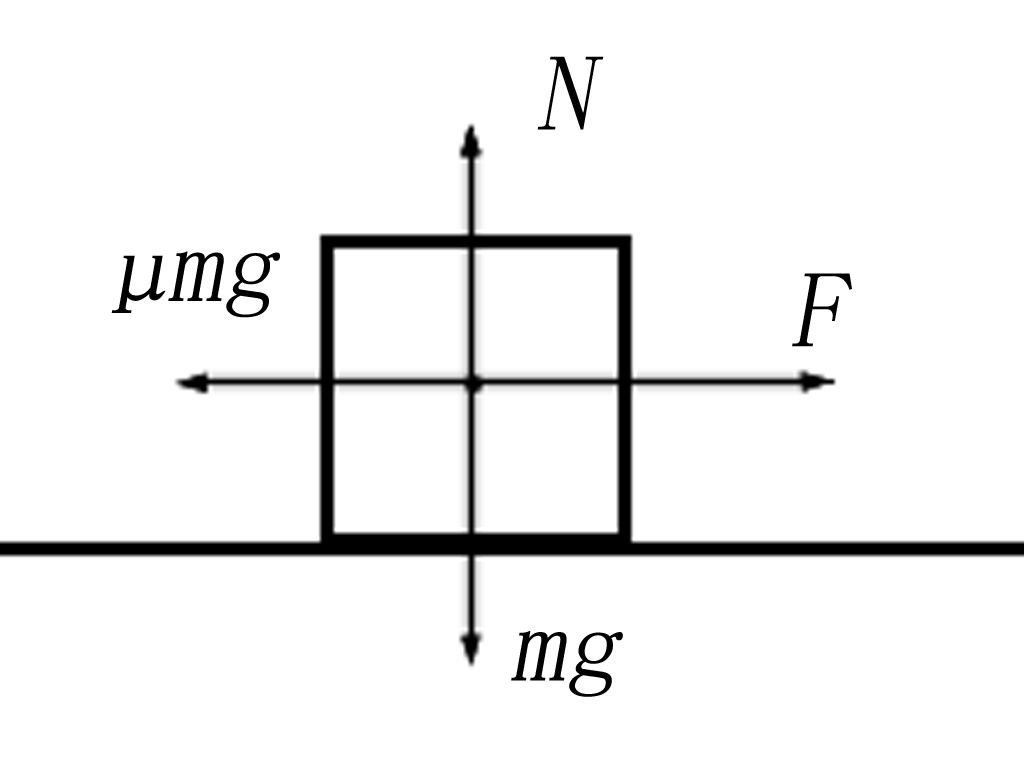
This law also helps us understand the difference between two commonly confused concepts: mass and weight.
| Concept | Definition | Changes with Location? |
|---|---|---|
| Mass | The amount of matter in an object. A measure of its inertia. | No |
| Weight | The force of gravity acting on an object's mass (). | Yes |
An astronaut has the same mass whether they are on Earth or the Moon. Their body is made of the same amount of "stuff." However, their weight is much less on the Moon because the Moon's gravitational pull is weaker.
This brings us to a famous misconception. Do heavier objects fall faster? The answer is no. According to Newton's second law, a more massive object requires a greater force to accelerate at the same rate. Conveniently, gravity provides that greater force. A 10kg object is pulled by gravity ten times more strongly than a 1kg object, so they end up accelerating downward at the same rate (about on Earth), ignoring air resistance.
Action and Reaction
Newton’s third law describes something fundamental about how forces work. They always come in pairs.
For every action, there is an equal and opposite reaction.
When you push on a wall, the wall pushes back on you with an equal amount of force. When a rocket expels hot gas downwards (the action), the gas pushes the rocket upwards (the reaction). You can't have one without the other.
It might seem strange. If the forces are equal and opposite, why does anything move? The key is that the forces act on different objects. The rocket pushes on the gas, and the gas pushes on the rocket. Since the rocket has much more mass than the gas, the same amount of force produces a much smaller acceleration for the rocket than for the gas, but it's enough to lift it into the sky.

These three laws are the foundation of classical mechanics. They describe how objects from baseballs to planets move through the universe.
A race car is driving around a circular track at a constant speed of 150 mph. Which of the following statements is true?
Imagine sliding a hockey puck across a perfectly frictionless, infinite ice rink. According to Newton's First Law of Motion (the law of inertia), what would happen to the puck?
Understanding these core principles of force and motion is the first step to seeing the world as a physicist does.