Mastering Google Ad Manager
Introduction to Google Ad Manager
What Is Google Ad Manager?
Think of a popular website or news app you use. You'll notice ads strategically placed around the content. Google Ad Manager (GAM) is the powerful platform that publishers—the owners of those websites and apps—use to manage all this advertising space. It's their command center for selling ad inventory, delivering the ads, and maximizing the money they make from them.
At its core, GAM is a comprehensive ad management platform. It helps publishers control which ads appear on their site, who they're shown to, and how much they earn from each impression. Instead of dealing with dozens of different advertisers and networks individually, publishers can use GAM to streamline the entire process from a single place.
A Quick History Lesson
Google Ad Manager wasn't built from scratch. Its story begins with a company called DoubleClick, an online advertising pioneer that Google acquired in 2007. DoubleClick had two main products: DoubleClick for Publishers (DFP), which helped publishers manage their ad inventory directly, and DoubleClick Ad Exchange (AdX), an auction-based marketplace for buying and selling ad space in real time.
For years, these two services operated separately. Publishers would use DFP for their direct-sold campaigns and AdX to fill leftover space. In 2018, Google decided to simplify things by merging them into one unified platform: Google Ad Manager. This integration combined the ad serving and management tools of DFP with the real-time auction power of AdX, creating the powerful, all-in-one tool publishers use today.
Key Features and How It Works
So, what does Google Ad Manager actually do? It handles several critical tasks that keep the digital ad world running smoothly.
Inventory Management: Publishers use GAM to define and organize all the available ad slots on their websites and apps. They can label each space—like “Homepage Top Banner” or “Article Sidebar”—and set rules for how it can be sold.
Ad Serving: This is the most fundamental function. When a user visits a page, GAM’s ad server instantly decides which ad to show in each available slot based on the publisher’s rules, targeting criteria, and which advertiser is willing to pay the most.
Trafficking & Targeting: Setting up an ad campaign is called “trafficking.” This involves uploading the ad creative (the image or video) and defining its delivery settings. Publishers can target ads to specific audiences based on things like geography, device type, or browsing behavior, ensuring the ads are relevant to the user.
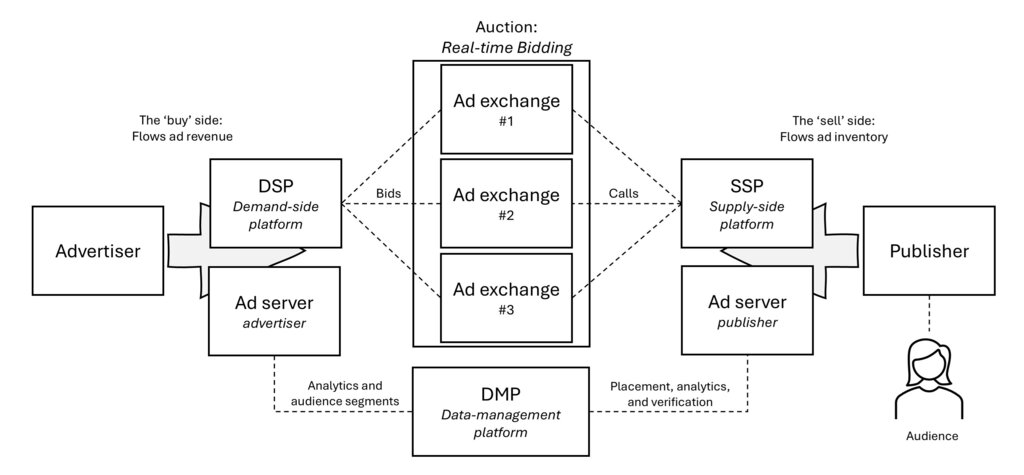
Yield Optimization: “Yield” refers to the revenue generated from ad inventory. GAM helps publishers maximize this by creating a competitive auction for their ad space. It connects them to a massive pool of advertisers, including those using Google Ads and other ad exchanges, who all bid against each other for the chance to show their ad. This real-time bidding process drives up the price and helps the publisher earn more.
GAM's Role in the Ad World
It's easy to confuse Google Ad Manager with Google Ads, but they serve opposite sides of the market. Google Ads is for advertisers who want to buy ad space to promote their products. Google Ad Manager is for publishers who want to sell their ad space.
Think of GAM as the air traffic control tower for a website's advertising. It manages all incoming demand from various sources—direct deals with advertisers, the Google Ads network, and other third-party exchanges—and directs each ad to land in the right spot at the right time. By providing tools for managing, selling, and optimizing ad inventory, GAM empowers publishers to turn their content into a sustainable source of revenue.
Let's check your understanding of these foundational concepts.
What is the primary purpose of Google Ad Manager?
Google Ad Manager (GAM) and Google Ads serve opposite sides of the advertising market. GAM is for ______, while Google Ads is for ______.
Now you have a solid overview of what Google Ad Manager is, how it evolved, and the crucial role it plays in helping publishers manage and monetize their digital properties.