Mastering Geometric Art Mastery
Advanced Pattern Construction
Beyond the Basics with Classic Tools
You already know how to draw a square or a circle. Now, we'll use those same simple tools—the compass and straightedge—to build intricate patterns with mathematical precision. These aren't just drawing implements; they are instruments for enforcing geometric rules directly onto paper. A straightedge draws the shortest path between two points, and a compass creates a set of all points equidistant from a center. Together, they allow us to construct complex networks from a few simple axioms.
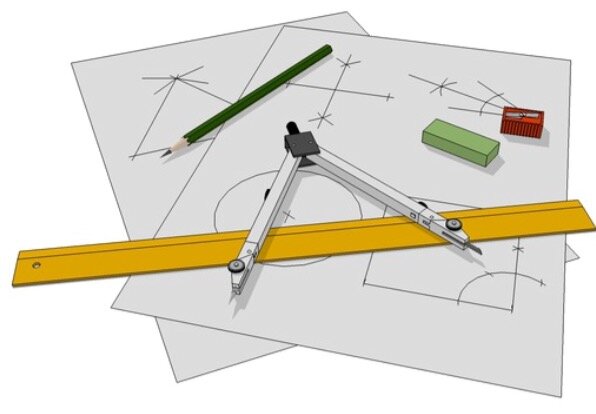
The elegance of this system is that it doesn't rely on measurement marks on a ruler. All lengths are relative, created and transferred using only the compass. This ensures that the proportions within your design are perfect, regardless of its initial scale. Let's start by creating a foundational structure: the radial grid.
Precision in Radial Grids
Most complex circular patterns begin with a simple radial grid. This framework of concentric circles and radiating lines provides the reference points for more detailed work. Creating one accurately is a crucial first skill.
Start by setting a point for your center. Use your compass to draw your first circle. Keeping the same center, adjust the compass to draw several more concentric circles. The key is maintaining a single, fixed center point. Even a tiny shift will throw off the entire grid.
Once you have your circles, you can divide them. A classic method is to set your compass to the radius of any circle. Then, 'walk' the compass around its circumference. Each step will mark a point, and six steps will bring you exactly back to the start, creating a perfect hexagon. Drawing lines from the center through these points gives you six equal sectors. You now have a precise grid of intersections to build upon.
From Grids to Networks
The points where lines intersect are the heart of advanced construction. Each intersection becomes a new vertex, a potential center for a new circle or an endpoint for a new line. This is how simple grids blossom into complex geometric networks.
Consider the ancient and powerful shape known as the . It's formed by drawing two identical circles whose centers are on each other's circumference. The almond-shaped overlap is the vesica piscis, and its two sharp points are perfect for anchoring new lines or constructing squares and triangles. By connecting the centers and the intersection points, you form a rhombus.
This is the core principle: every new shape you create adds more reference points to your drawing. Connecting the midpoints of a square creates a new, rotated square inside it. Connecting the vertices of a hexagon in different ways can produce triangles or a six-pointed star. Each action generates a new layer of possibilities.
Scaling and Proportion
How do you create a large, complex pattern without your tools' physical limitations introducing errors? The key is to rely on proportion, not fixed measurements. If you build a small, accurate version of a pattern element first, you can scale it up using ratios.
For example, to double the size of a design, you don't need to double every measurement manually. You can use properties of similar triangles. If you have a base line segment and you extend it to a point such that is twice the length of , you can use that new segment as the foundation for a proportionally larger version of your original construction.
This method allows you to construct massive, wall-sized patterns with the same precision as a small drawing. You build your design section by section, using previously constructed lines and points to establish the scale for the next part. It is a process of growth, where the pattern builds on itself, ensuring that every part is in perfect harmony with the whole.
What is the primary advantage of using a compass and straightedge for geometric constructions, as opposed to a ruler with measurement marks?
When dividing a circle into six equal sectors using a compass, what should the compass width be set to?