Mastering Generative AI and Agentic Systems
Transformer Model Architectures
How Transformers See Language
Before 2017, language models processed text sequentially, much like reading a book one word at a time. This worked, but it was slow and struggled to grasp long-range connections. A sentence like, "The woman who fed the cats on her porch smiled," could be confusing. By the time the model reached "smiled," it might have forgotten that the "woman" was the one smiling, not the cats.
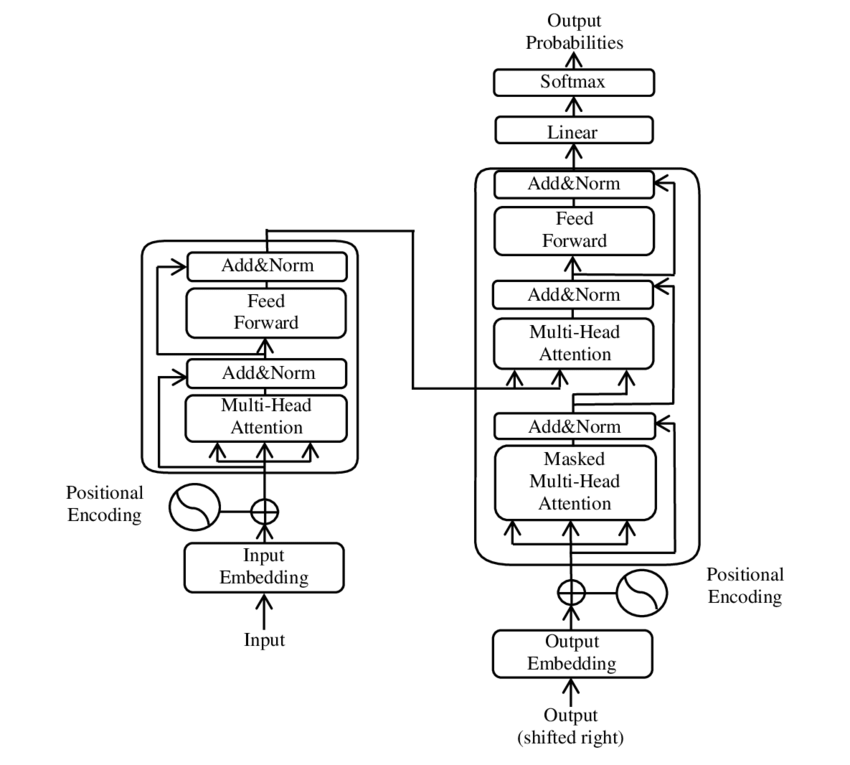
The paper "Attention Is All You Need" introduced the Transformer architecture, which changed everything. Instead of sequential processing, it uses a mechanism called self-attention to look at all the words in a sentence at once. This allows the model to weigh the importance of every word in relation to every other word, creating a rich contextual understanding in parallel.
The Transformer architecture, introduced in the 2017 paper “Attention Is All You Need,” is the foundation of nearly all modern large language models, including GPT, Claude, LLaMA, Gemini, and Mistral.
Self-attention works by creating three vectors for each word: a Query, a Key, and a Value. Think of it like a library search. Your search term is the Query. You compare it against the Key of every book (word) in the library to find relevant matches. The content of the book you pull from the shelf is the Value.
For a given word, its Query vector is compared against the Key vectors of all other words in the sentence. The result is a score that determines how much "attention" the word should pay to every other word. These scores are then used to create a weighted sum of all the Value vectors, producing a new representation of the word that is deeply aware of its context.
To make this process even more powerful, Transformers use multi-head attention. Instead of calculating attention just once, they do it multiple times in parallel with different, learned linear projections. Each "head" can focus on a different type of relationship, like syntactic links or semantic similarities. The outputs from all heads are then combined, giving the model a more nuanced understanding of the text.
Turning Words into Meaning
A model can't work directly with raw text. The first step is to break the text down into manageable pieces called tokens. This process, tokenization, can split text by words, subwords, or even characters. For example, "unbelievably" might become three tokens: "un", "believe", and "ably". This allows the model to handle unfamiliar words and understand word structure.
Once tokenized, each token is mapped to a unique integer. This integer is then converted into a dense vector of numbers called an embedding. This vector isn't random; it's a learned representation that captures the token's semantic meaning. Words with similar meanings, like "king" and "queen," will have similar embedding vectors.
Embeddings place words in a high-dimensional space where their proximity to other words reflects their relationships. For instance, the vector relationship between "king" and "queen" might be very similar to the one between "man" and "woman".
However, self-attention is order-agnostic. It sees a sentence as a bag of words, losing the original sequence. To fix this, Transformers inject information about the position of each token in the sequence. This is done through positional encoding, where a unique vector based on the token's position is added to its embedding vector. This gives the model a sense of word order, which is crucial for understanding grammar and meaning.
Model Architectures
Transformer models generally come in three main flavors, defined by which parts of the original architecture they use.
1. Encoder-only Models: These models, like BERT, are designed for understanding. They use the encoder stack to create rich, context-aware representations of the input text. They can see the entire input at once (bidirectional context), making them excellent for tasks like sentiment analysis, text classification, and named entity recognition where a deep understanding of the input is key.
2. Decoder-only Models: These models, including the GPT family, are built for generation. They use the decoder stack to predict the next token in a sequence based on the tokens that came before it. They are auto-regressive, meaning they generate one token at a time and feed it back as input to generate the next one. This makes them ideal for tasks like text generation, chatbots, and summarization.
3. Encoder-Decoder Models: Also known as sequence-to-sequence models, these use both stacks. The encoder processes the input sequence, and its final representation is fed to the decoder, which generates an output sequence. This architecture is perfect for tasks that transform an input sequence into a new one, such as machine translation (English to French) or summarizing a long document into a few sentences.
| Architecture | Primary Use | How it Works | Example Models |
|---|---|---|---|
| Encoder-only | Understanding text | Processes the whole input at once for deep context. | BERT, RoBERTa |
| Decoder-only | Generating text | Predicts the next word based on previous words. | GPT-4o, LLaMA |
| Encoder-Decoder | Transforming text | Maps an input sequence to an output sequence. | T5, BART |
At its core, a generative model like GPT works by next-token prediction. After processing the input prompt, the model outputs a probability distribution over its entire vocabulary for what the next token should be. A sampling strategy (like picking the highest probability token) is used to select the next token. This new token is then appended to the sequence, and the process repeats, generating text one token at a time.
What was a major limitation of language models that processed text sequentially before the Transformer architecture was introduced?
In the self-attention mechanism, what is the role of the 'Query', 'Key', and 'Value' vectors for a given word?
Understanding these architectural components is key to grasping how modern AI can process, understand, and generate language with such remarkable fluency.