Mastering General Organic Chemistry
Inductive and Electromeric Effects
Permanent and Temporary Nudges
In a molecule, electrons aren't always shared equally. The electronegativity of an atom creates a permanent pull on electrons in the bonds around it. This pull, transmitted through the chain of single bonds, is called the inductive effect.
This essentially is the inductive effect: it is an electronic effect that occurs through sigma (σ) bonds.
Think of it as a molecular game of tug-of-war. A highly electronegative atom, like fluorine, pulls the shared electrons in a sigma bond closer to itself. This creates a slight negative charge () on the fluorine and a slight positive charge () on the adjacent carbon. This effect is permanent and gets weaker as you move further down the carbon chain, like a ripple in a pond.
Inductive Effect
noun
The permanent displacement of shared sigma (σ) electrons along a chain of atoms due to differences in electronegativity.
We categorize groups based on how they pull or push electrons relative to hydrogen.
Negative Inductive Effect (-I): These are electron-withdrawing groups. They are more electronegative than hydrogen and pull electron density towards themselves. Halogens (-F, -Cl, -Br), nitro groups (), and carbonyl groups (C=O) are common examples.
Positive Inductive Effect (+I): These are electron-donating groups. They are less electronegative than hydrogen and effectively "push" electron density away. Alkyl groups (like methyl, , and ethyl, ) are the most common +I groups.
| Effect | Relative Strength of Common Groups |
|---|---|
| -I (Withdrawing) | (Phenyl) > -H |
| +I (Donating) | (tert-Butyl) > (Isopropyl) > (Ethyl) > (Methyl) > -H |
The On-Demand Shift
While the inductive effect is a permanent state of being for a molecule, the electromeric effect is a temporary, on-demand response. It only happens in molecules with multiple bonds (like double or triple bonds) and only when an attacking reagent approaches.
The electromeric effect is a temporary effect that remains as long as the attacking reagent is present and exposed to the organic compound.
When an attacking molecule gets close, the relatively loose pi-electrons of a multiple bond can shift completely over to one of the atoms. This creates a temporary full positive and negative charge within the molecule, making a reaction possible. Once the attacking reagent is gone, the electrons snap back to their original position.
Like the inductive effect, the electromeric effect also has two types:
Positive Electromeric Effect (+E): The pi-electrons shift towards the attacking reagent. This typically happens when an electrophile (an electron-seeker) attacks a double bond.
Negative Electromeric Effect (-E): The pi-electrons shift away from the attacking reagent. This occurs when a nucleophile (a nucleus-seeker) attacks, usually at the carbon atom of a polar multiple bond like a carbonyl group (C=O).
Impact on Dipole Moments
The permanent nature of the inductive effect has a direct impact on a molecule's overall dipole moment. A dipole moment is a measure of the separation of positive and negative charges in a molecule, essentially quantifying its overall polarity.
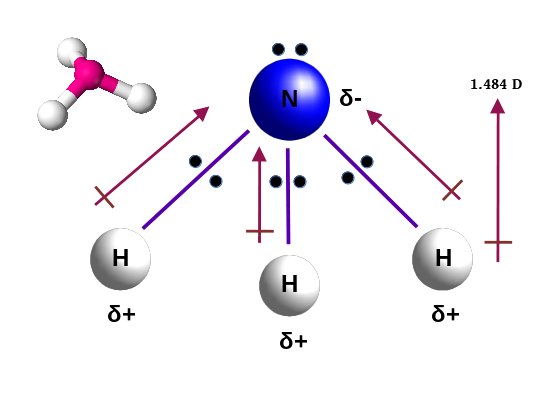
In an alkyl halide like chloromethane (), the highly electronegative chlorine atom exerts a strong -I effect. It pulls electron density away from the carbon atom, creating a permanent dipole. The chlorine end of the molecule is partially negative (), and the carbon/hydrogen end is partially positive (). The sum of these bond polarities gives the molecule its net dipole moment.
Understanding these electron-shifting effects is crucial because they explain why and where reactions happen. They dictate which parts of a molecule are electron-rich and which are electron-poor, setting the stage for all of organic chemistry.
Time to check your understanding of these fundamental electronic effects.
What is the key difference between the inductive effect and the electromeric effect?
Which of the following groups typically exhibits a positive inductive effect (+I)?