Mastering French Language Nuances
Advanced Grammar
The Subjunctive Mood
Beyond regular verb tenses, French uses moods to add shades of meaning. The subjunctive isn't about when something happens, but rather how the speaker feels about it. It’s the mood of subjectivity, expressing doubt, desire, emotion, or necessity.
Think of the indicative mood as stating facts (I am here), while the subjunctive expresses feelings or possibilities about an action (It is necessary that I be here).
The subjunctive often appears after the word que (that). Certain phrases automatically trigger it. You're not stating a fact; you're expressing a will, an emotion, or a judgment about what should happen.
Key triggers include:
- Will or Desire:
Je veux que...(I want that...),Il faut que...(It is necessary that...) - Emotion:
Je suis content que...(I am happy that...),J'ai peur que...(I am afraid that...) - Doubt or Uncertainty:
Je doute que...(I doubt that...),Il est possible que...(It is possible that...)
For example:
- Indicative:
Tu **viens** à la fête.(You are coming to the party.) This is a statement of fact. - Subjunctive:
Je veux que tu **viennes** à la fête.(I want you to come to the party.) This expresses a desire, not a certainty.
It is necessary that I leave.
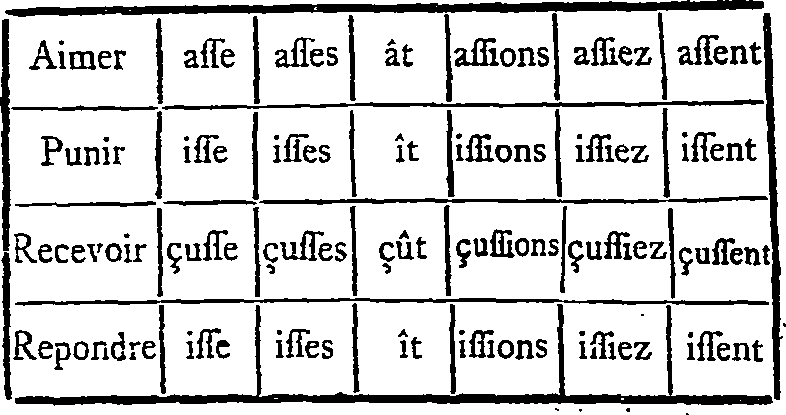
Notice how the verb form changes. You already know the conjugations; the key is learning to recognize when the situation calls for this subjective mood.
Advanced Pronouns
You're familiar with basic pronouns, but mastering French requires navigating its more complex relative pronouns. These are the words that link clauses, like "who," "which," or "that" in English, but with more intricate rules.
dont
pronoun
A relative pronoun that typically replaces a phrase beginning with 'de' (of, from, about). It translates to 'whose,' 'of which,' or 'about which.'
Using dont simplifies your sentences. Instead of saying C'est le film. J'ai vu la bande-annonce de ce film. (This is the movie. I saw the trailer of this movie.), you can connect the ideas smoothly:
C'est le film **dont** j'ai vu la bande-annonce. (This is the film whose trailer I saw.)
Another key set of pronouns is built around lequel. You use lequel (and its forms laquelle, lesquels, lesquelles) after a preposition like sur, pour, avec, or dans.
| Preposition | Masculine Singular | Feminine Singular | Masculine Plural | Feminine Plural |
|---|---|---|---|---|
pour | pour lequel | pour laquelle | pour lesquels | pour lesquelles |
avec | avec lequel | avec laquelle | avec lesquels | avec lesquelles |
à | auquel | à laquelle | auxquels | auxquelles |
de | duquel | de laquelle | desquels | desquelles |
For example:
C'est la chaise **sur laquelle** le chat dort. (That's the chair on which the cat sleeps.)
Here, laquelle is used because chaise is feminine and singular, and the preposition is sur.
Complex Sentence Structures
To express sophisticated ideas, you need to move beyond simple subject-verb-object sentences. One way is by using subordinate clauses, which add information but can't stand alone as a sentence. Conjunctions that introduce these clauses can add nuance.
Many of these conjunctions require the subjunctive, tying back to our first topic.
bien que(+ subjunctive) - although, even thoughpour que(+ subjunctive) - so that, in order thatavant que(+ subjunctive) - before
Example:
Je t'appelle **pour que** tu saches la vérité. (I am calling you so that you know the truth.)
Another technique is using the passive voice (la voix passive), where the object of an action becomes the subject of the sentence. It's formed with the verb être and the past participle. While common in English, in French it's used more formally, often in writing or news reporting.
- Active:
Le chat mange la souris.(The cat eats the mouse.) - Passive:
La souris est mangée par le chat.(The mouse is eaten by the cat.)
Using these structures allows you to vary your phrasing and emphasize different parts of your message, which is a hallmark of an advanced speaker.
Which of the following phrases most reliably triggers the subjunctive mood?
Choose the correct relative pronoun to complete the sentence: C'est le restaurant ______ je t'ai parlé.
These concepts are tools for precision. Practice weaving them into your speaking and writing, and you'll find yourself expressing ideas with more clarity and sophistication.