Mastering Freestyle Swimming
Body Position
The Foundation of Freestyle
Think of the fastest boats. They're long, sleek, and cut through the water with minimal resistance. Now think of a wide, flat barge. It pushes a huge wave in front of it and moves slowly. In swimming, you want to be the speedboat, not the barge. The key to this is your body position.
Your goal in freestyle is to create a straight, horizontal line from your head to your toes, keeping your body as close to the surface as possible. This streamlined position is the single most important factor for swimming efficiently. It reduces drag, which is the force of the water pushing against you, allowing you to glide farther with every stroke.
Your body should be parallel with the water's surface and as flat as possible.
A good freestyle position isn't perfectly flat. Imagine a slight downward slope from your head to your hips. This helps keep your legs from sinking.
Where You Look Matters
Your head position controls the rest of your body. It's a common mistake for swimmers to look forward, towards the end of the pool. This lifts your head, which acts like a brake. More importantly, it causes your hips and legs to sink, creating a massive amount of drag. It's like trying to swim uphill.
The correct position is to keep your head in a neutral, relaxed alignment with your spine. The waterline should cut across your head somewhere between your eyebrows and your hairline. Your eyes should be looking almost directly down at the black line on the bottom of the pool.
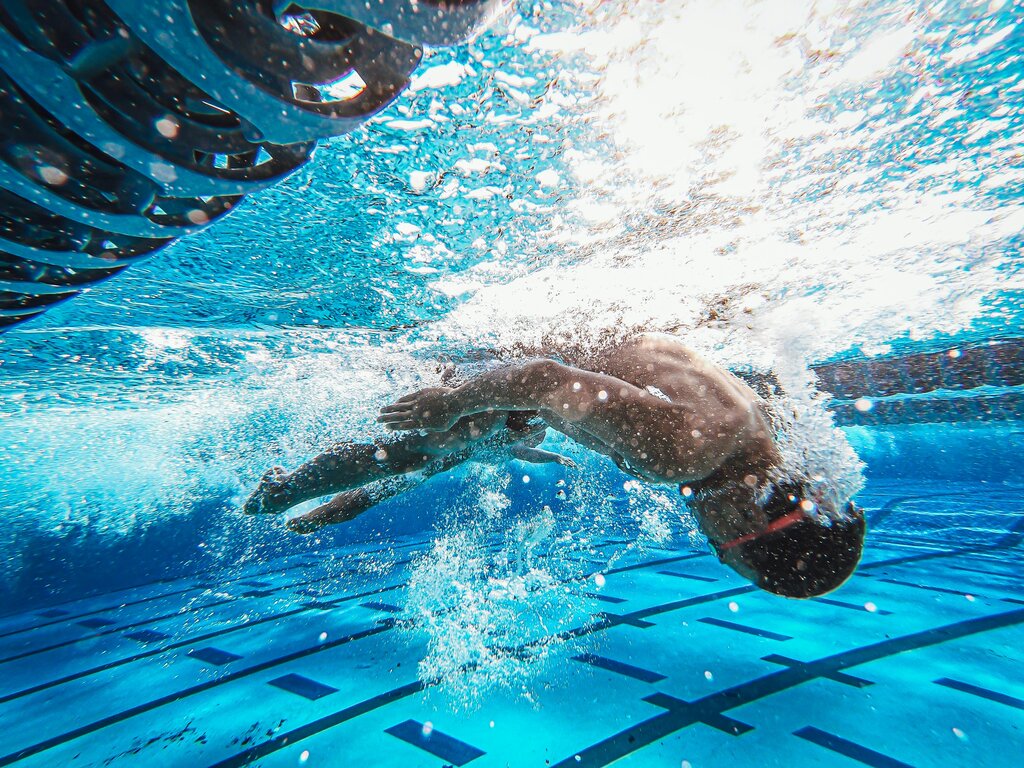
Tuck your chin slightly and look down. This simple adjustment will help bring your hips and legs up toward the surface.
Roll With It
Swimming perfectly flat isn't the goal, either. Efficient freestyle involves rotating your body along its long axis, from your head to your toes. Think of it as rolling from side to side like a log. This rotation shouldn't be jerky; it should be a smooth, coordinated movement driven by your hips and core.
As one arm extends forward to enter the water, your body rotates towards that side. Your shoulders and hips should roll together as a single unit. This rotation is crucial for a few reasons. It allows you to engage your larger back and core muscles for a more powerful pull, and it lets you reach farther forward with each stroke. It also makes it much easier to turn your head to the side to breathe without lifting it.
Sinking Legs Solution
Even with good head position, some swimmers struggle with their legs sinking. This often comes down to buoyancy. Your lungs are full of air, making your chest naturally float high in the water. This can cause your lower body to pivot downwards.
To counteract this, you need to actively press your upper body down. Gently press your head and chest deeper into the water, as if you're swimming slightly downhill. This pressure helps lever your hips and legs up toward the surface. It's a subtle feeling, not a forceful push.
Another strategy is to create a small amount of tension in your lower back, arching it slightly. This can help lift your hips. Combining these techniques—a neutral head, a steady roll, and pressing your chest down—will help you achieve that elusive, streamlined body position.
Now, let's test what you've learned about creating a streamlined position in the water.
What is the single most important factor for swimming freestyle efficiently?
Where should your eyes be looking to maintain the correct head position in freestyle?
Mastering your body position takes practice. It's the quiet foundation upon which powerful strokes and efficient breathing are built.