Mastering Fraction Arithmetic
Understanding Fractions
Parts of a Whole
Imagine you have a pizza that you need to share with a friend. If you cut it right down the middle, you both get an equal piece. You didn't get a whole pizza, but you got a part of it. Fractions are simply a way to talk about parts of a whole.
A fraction represents a number that is not a whole number. It's a piece or a portion of something bigger.
When we write a fraction, we use two numbers stacked on top of each other, separated by a line. For example, if you and three friends (four people total) share a candy bar equally, each person gets one-fourth of it. We write that like this:
Each part of the fraction has a special name and job.
Numerator
noun
The top number in a fraction. It tells you how many parts of the whole you have.
Denominator
noun
The bottom number in a fraction. It tells you how many equal parts the whole is divided into.
So, in our fraction , the denominator (4) tells us the candy bar was split into four equal pieces. The numerator (1) tells us you have one of those pieces.
Visualizing Fractions
Sometimes, the hardest part of understanding fractions is picturing what they mean. Let's look at a couple of common ways to visualize them.
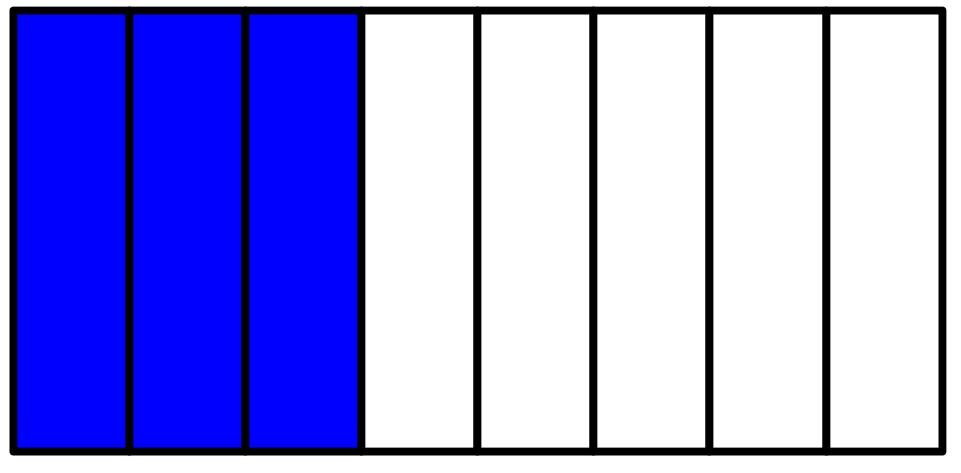
One way is with a simple bar or rectangle. If we have the fraction , we can imagine a bar split into 8 equal parts. We would then be interested in 3 of those parts.
Another popular way to see fractions is with a circle, like a pie or a pizza. If we want to see the fraction , we'd cut a pie into 5 equal slices. The fraction represents having 2 of those slices.
Same Value Different Look
An interesting thing about fractions is that two different-looking fractions can actually mean the exact same amount. These are called equivalent fractions.
Think about that pizza again. If you eat half of it, you've eaten . But what if the pizza was cut into four slices and you ate two of them? You ate of the pizza, which is the same amount as . They are equivalent.
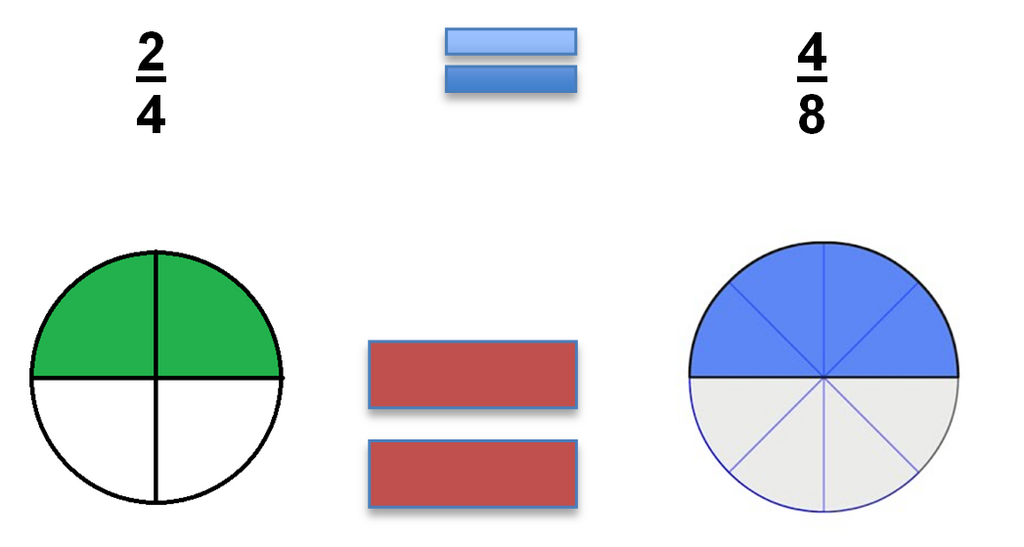
You can find an equivalent fraction by multiplying the numerator and the denominator by the same number. For example, to get from to , we multiply both the top and bottom by 2.
You can also divide to find a simpler equivalent fraction. For example, with , we can divide both the numerator and the denominator by 4 to get .
Understanding that different fractions can be equal is a key idea that will help when you start adding, subtracting, and comparing them.
Knowing how to find equivalent fractions is like having a secret code. It lets you rewrite fractions in a more useful way without changing their value.
Now, let's test your understanding of these core fraction concepts.
In the fraction , what does the number 10 represent?
If a chocolate bar is divided into 12 equal squares and you eat 5 of them, what fraction of the chocolate bar is left?