Mastering Folding Flash ADCs
ADC Fundamentals
Translating the Real World
Most signals in the physical world are analog. Think of the sound waves from a guitar, the temperature in a room, or the brightness of a light. These signals are continuous, meaning they have an infinite number of possible values. Computers, however, don't speak this language. They work with digital information: discrete values, represented by ones and zeros.
An Analog-to-Digital Converter, or ADC, is the essential bridge between these two worlds. Its job is to take a continuous analog signal and convert it into a sequence of digital numbers that a computer or microcontroller can process. Without ADCs, your smartphone couldn't record your voice, a digital thermostat couldn't read the room temperature, and a digital camera couldn't capture an image.
ADCs convert any analogue signal (e. g. of the sensors) into digital numbers that can be easily further processed by the CPU.
This conversion process happens in two main steps: sampling and quantization.
Sampling and Quantizing
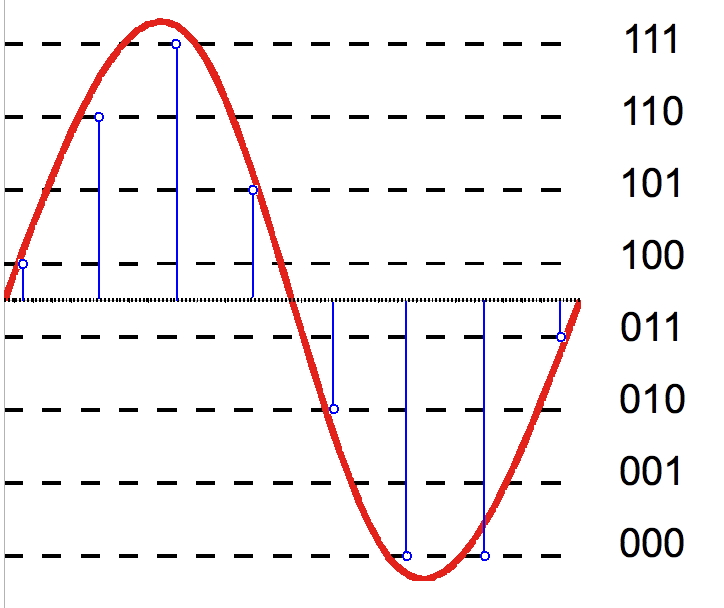
To digitize a continuous wave, an ADC first takes a series of snapshots, or samples, at regular time intervals. This process is called sampling. The rate at which these samples are taken is the sampling rate, measured in samples per second, or Hertz (Hz).
How fast do you need to sample? The Nyquist-Shannon sampling theorem gives us the answer. It states that to accurately reconstruct a signal, the sampling rate must be at least twice the highest frequency present in the signal. This minimum rate is called the Nyquist rate. For example, the range of human hearing tops out at about 20,000 Hz. That's why audio CDs use a sampling rate of 44,100 Hz, which is more than double the highest frequency we can hear.
After sampling, each sample's amplitude must be assigned a numerical value. This is quantization. Imagine measuring each sample against a ruler with a fixed number of markings. The ADC finds the closest marking and assigns that value to the sample.
The number of markings on this metaphorical ruler is determined by the ADC's resolution, measured in bits. An 8-bit ADC has $2^8$, or 256, distinct levels it can assign. A 12-bit ADC has $2^{12}$, or 4096 levels, offering much finer detail.
Because the original analog signal is continuous, there will almost always be a small difference between the true amplitude of the sample and the discrete level it's assigned. This unavoidable rounding error is called quantization error. Higher resolution reduces this error, resulting in a more faithful digital representation of the original signal.
Common ADC Architectures
Not all ADCs work the same way. Different applications call for different trade-offs between speed, resolution, and cost. Here are three common types.
Flash ADC These are the fastest ADCs available. A flash ADC uses a large number of comparators to check the input voltage against all possible quantization levels simultaneously. This parallel approach makes it incredibly fast, but it requires a lot of circuitry, making it expensive and power-hungry. They are used in high-frequency applications like radar systems and digital oscilloscopes.
Successive Approximation Register (SAR) ADC SAR ADCs offer a great balance of speed, resolution, and power consumption. They work like a guessing game. The ADC first guesses the midpoint value and checks if the input signal is higher or lower. It then adjusts its guess, halving the possible range with each step until it zeros in on the correct digital value. This makes them versatile for many applications, from industrial control systems to medical devices.
Sigma-Delta (ΣΔ) ADC When the highest resolution is needed, sigma-delta ADCs are the top choice. They are slower than other types but can achieve resolutions of 24 bits or more. They work by oversampling the signal at a very high rate and using digital filtering to reduce noise. This makes them perfect for high-fidelity audio equipment and precise scientific measurements.
Let's test your understanding of these core concepts.
What is the primary function of an Analog-to-Digital Converter (ADC)?
The process of assigning a discrete numerical value to each sample of an analog signal is called:
Understanding these fundamentals is the first step in working with the vast array of sensors and signals that interface with our digital world.