Mastering Focus and Concentration
Understanding Attention
The Brain's Spotlight
Attention is the cognitive process of selectively concentrating on one aspect of the environment while ignoring other things. It’s the spotlight your mind uses to highlight what’s important right now, pushing everything else into the background.
attention
noun
The mental process of concentrating effort on a stimulus or mental event.
Think about reading a book in a busy café. To follow the story, you have to direct your mental spotlight onto the words on the page and dim the lights on the clatter of dishes, the whir of the espresso machine, and the conversation at the next table. This ability to filter information is fundamental to how we learn, work, and interact with the world.
Types of Attention
Our mental spotlight doesn't just have one setting. It can be a laser-focused beam or a wider floodlight, depending on the task. Psychologists generally recognize a few key types of attention.
Selective Attention is the classic 'cocktail party' effect. It’s your ability to zoom in on a single conversation in a crowded, noisy room. You are actively choosing one source of information to process while tuning out dozens of others.
Sustained Attention, or vigilance, is your ability to hold that focus over time. It's what you use when driving on a long highway trip, watching a movie, or studying for an exam. It requires maintaining a consistent level of concentration, even when the task becomes monotonous.
Divided Attention is what we commonly call multitasking. This is when you try to split your focus between two or more tasks simultaneously, like talking on the phone while cooking dinner. We'll explore this more later, but it's important to know it's a distinct type of attention.
Executive Attention is the conductor of the orchestra. It involves higher-level skills like planning, decision-making, and managing conflicting thoughts or impulses. It's what allows you to set a goal (like finishing a report) and then direct your other attentional resources to achieve it, ignoring temptations along the way.
Each day, you shift between these types seamlessly. You use selective attention to read an email, sustained attention to finish it, and executive attention to decide which email to answer next. When a coworker interrupts you, you engage in divided attention—often with mixed results.
The Brain's Gatekeeper
How does your brain decide where to point its spotlight? This filtering happens through two main processes.
Top-down attention is voluntary and goal-driven. You are in control. When you decide to look for your keys on a messy table, you are using top-down processing. Your brain knows what a key looks like and actively scans the environment for that specific shape and material, ignoring the pens, papers, and coffee mugs.
Bottom-up attention is involuntary and stimulus-driven. It's when something in the environment grabs your attention. A sudden loud bang, a flash of light, or someone calling your name are all examples. These stimuli are so potent that they bypass your conscious goals and demand immediate focus. It's a survival mechanism designed to alert us to potential threats or important events.
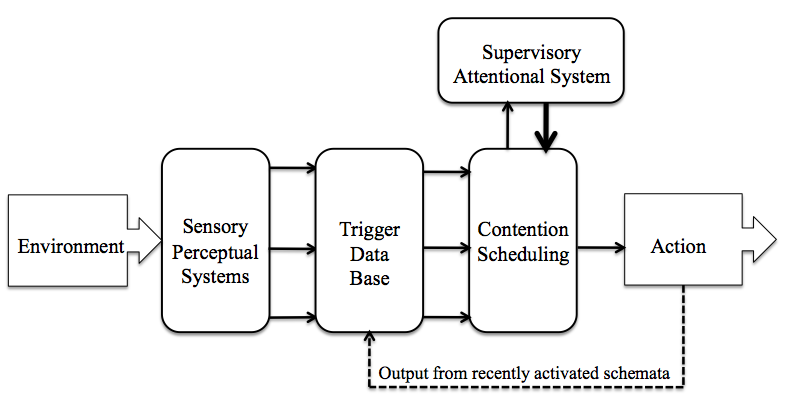
A healthy attention system is a constant dance between these two processes. You need top-down focus to get work done, but you also need the flexibility of bottom-up attention to react to your surroundings.
The Myth of Multitasking
We often pride ourselves on being great multitaskers, but neuroscience tells a different story. For any tasks that require conscious thought, the brain doesn't actually do them simultaneously. Instead, it performs rapid "task-switching."
Every time you switch from writing a report to checking a text message and back again, your brain has to disengage from the first task and load up the context for the second. This switching comes with a cognitive cost. It takes time, uses up mental energy, and increases the likelihood of making errors. It’s why talking on the phone while driving is so dangerous; your brain is constantly switching between two demanding activities, and your reaction time suffers.
True multitasking is only possible when one of the tasks is so automatic that it requires virtually no conscious attention, like walking and chewing gum.
Distractions are the primary trigger for this inefficient task-switching. A notification on your phone or a new email alert acts as a bottom-up stimulus, hijacking your top-down focus. Even if the interruption is brief, it can take several minutes to fully re-engage with your original task and regain your previous level of concentration.
Before allowing your attention to be hijacked by the next buzz or beep, pause and ask yourself: Will this distraction contribute positively to my current task or goal?
Understanding how attention works is the first step toward managing it better. It isn't an infinite resource, but a specific cognitive function that directs what we perceive, learn, and experience.