Mastering Flute Technique and Expression
Refining Tone Quality
Finding Your Core Sound
You can make a sound on the flute. Now, let's make it beautiful. The difference between an amateur and a professional tone often comes down to one thing: a focused core. Think of it like this. A standard lightbulb scatters light everywhere, while a laser produces a single, intense beam. Your initial, breathy flute sound is the lightbulb. A sound with a strong core is the laser.
This core is a clear, resonant quality at the center of the note, free of extra airiness or fuzz. It’s what allows the flute to project in an orchestra and what gives it a singing, vibrant quality. Achieving this isn't about blowing harder; it's about blowing smarter. It requires precise control over the shape, speed, and direction of your airstream.
The Physics of Your Airstream
The register, or octave, you play in is determined almost entirely by your air. Your fingers select the note, but your breath gives it life and places it in the right octave. Each register demands a different kind_ of airstream. Mastering these adjustments is key to a consistent tone across the instrument.
For the low register, think of a slow, warm, and wide column of air. Aim it downwards, across the embouchure hole towards the far edge. For the middle register, the air needs to be slightly faster and more focused. The angle comes up a bit, aimed more directly across the hole. To produce notes in the high register, your air must be fast, cold, and narrow, like a needle. You'll aim this stream higher, at a sharper angle across the embouchure hole. These adjustments are subtle, controlled by your and abdominal support.
Visualizing these angles is a great start. The next step is training your lips and breath to find them automatically. Moving between registers should feel fluid, not like you're shifting gears in a car. This is where lip flexibility comes in, and the best way to develop it is by practicing ..
Harnessing Harmonics
Harmonics are your secret weapon for diagnosing and fixing tone problems. By keeping one fingering and using only your embouchure and air to produce a series of higher notes (the overtone series), you force yourself to make the precise, efficient adjustments needed for a clear sound. This exercise builds immense control.
Start by fingering a low C. Hold it as a long tone with your best sound. Now, without changing your fingering, tighten the corners of your lips slightly, increase your air speed, and change the air angle to produce the next C an octave higher. Once that is stable, aim even higher to produce the G above that, then the C in the next octave.
Don't worry if all you get is a wispy sound at first. The goal is to make each overtone speak clearly and instantly. As you get better, you'll notice your regular tone becoming richer and less airy. That's because the harmonic exercises are training your muscles to find the most resonant 'sweet spot' for any given note. It's the ultimate embouchure workout.
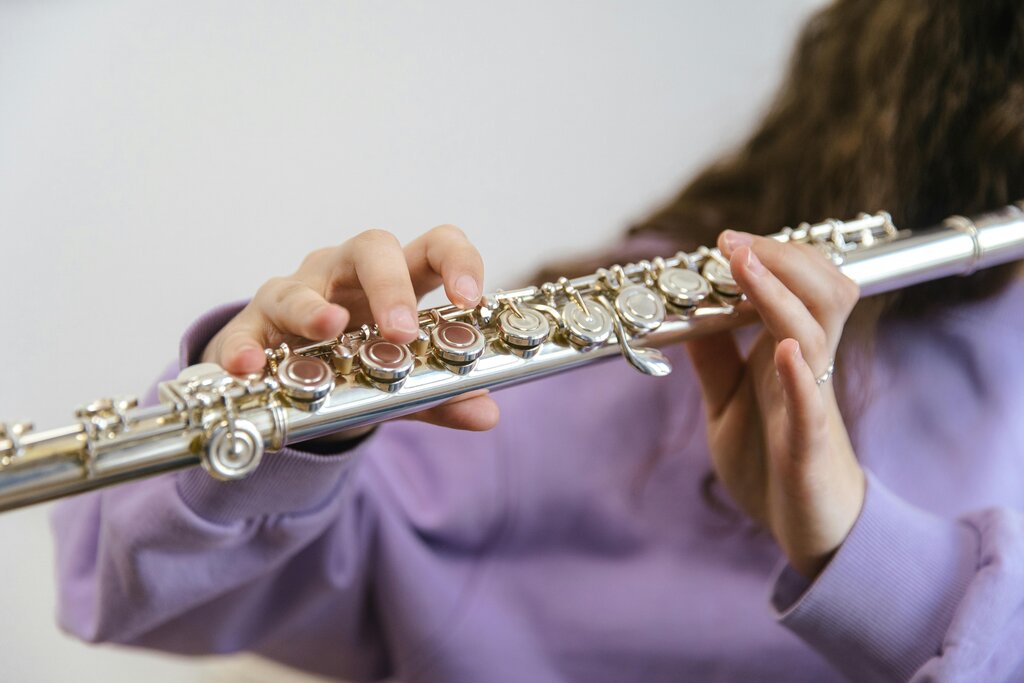
Practicing harmonics directly improves your ability to make smooth register transitions. Leaping from a low G to a high G becomes less of a gamble when you have physically practiced producing that high G as a harmonic of a lower note. Your embouchure gains the flexibility to pivot and refocus the airstream instantly.
This control is also what eliminates the cracking or flattening of notes when you play loud or soft. As you crescendo, you must subtly adjust your airstream downward to stay in tune. As you diminuendo, the stream comes slightly up. Harmonics give you the fine motor control to make these micro-adjustments without thinking, leading to a dynamic, expressive, and consistently beautiful tone.
What is the primary characteristic of a flute tone with a "focused core"?
How should a flutist's airstream for the high register differ from the airstream for the low register?