Mastering Fish Deboning
Fish Anatomy
The Fish Skeleton
Understanding a fish's anatomy is the first step to handling it properly in the kitchen. At the core of every fish is its skeleton, which provides structure and protects its internal organs. Unlike mammals, fish have a simpler skeletal system, but it serves the same fundamental purpose.
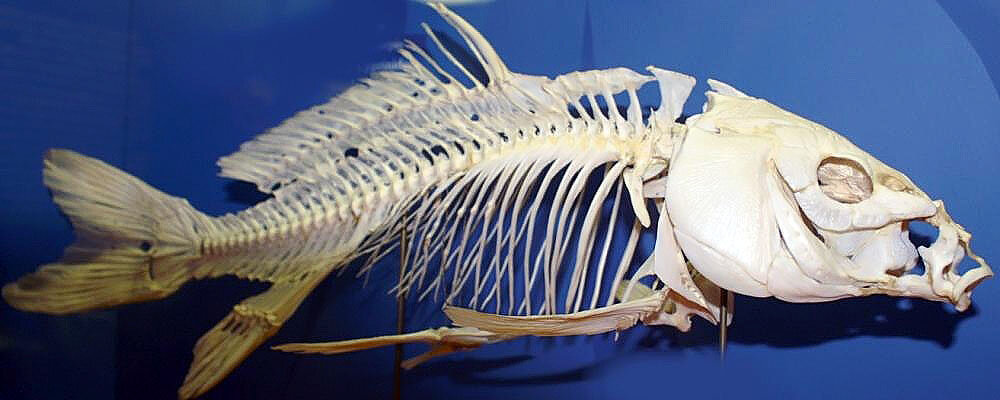
The main components you'll interact with are the spine, ribs, and the pesky pin bones. The spine, or backbone, runs from the head to the tail. It's the central structure from which everything else extends. Attached to the spine are the rib bones, which curve downwards to protect the organs in the body cavity. You can usually remove these in one go when you fillet the fish.
The most challenging bones for any cook are the pin bones. These are small, intramuscular bones that run along the length of the fillet, and they aren't attached to the main skeleton. This is why they get left behind in the flesh after filleting.
Muscle Structure
Fish muscle isn't like the meat you find on land animals. Instead of long, fibrous muscles, fish have muscle blocks called myomeres. These are stacked, W-shaped segments that run along each side of the fish's body. They are separated by thin connective tissue called myosepta.
When you cook fish, this connective tissue breaks down easily, which is why fish flakes. When you cut a fillet, you are essentially separating these muscle blocks from the skeleton.
Knowing about these muscle segments helps you understand why a fillet knife must be sharp and flexible. A good knife glides between the skeleton and the muscle, separating them cleanly along the myosepta.
Different Fish, Different Shapes
Not all fish are built the same way. The two most common body types are roundfish and flatfish, and their anatomy dictates how you approach them.
Roundfish, like salmon, trout, and cod, have a classic, cylindrical fish shape. They swim upright and have one eye on each side of their head. Their skeletal structure is symmetrical, with fillets on either side of a central spine.
Flatfish, such as flounder, sole, and halibut, are different. They are compressed laterally and spend their lives lying on one side on the ocean floor. As they mature, one eye migrates to the other side of their head, so both eyes are on top. This results in an asymmetrical skeleton. Flatfish yield four smaller fillets: two on the top side and two on the bottom.
| Feature | Roundfish (e.g., Salmon) | Flatfish (e.g., Flounder) |
|---|---|---|
| Body Shape | Cylindrical, symmetrical | Laterally compressed, asymmetrical |
| Eyes | One on each side of the head | Both on one side of the head |
| Spine | Central | Central, but fillets are top/bottom |
| Fillets | Two large fillets | Four smaller fillets |
Recognizing these differences is key. You can't use the same technique to get fillets from a round salmon as you would from a flat flounder. The location of the spine and the arrangement of the fillets are fundamentally different.
What are the stacked, W-shaped muscle blocks that make up a fish's flesh called?
The main reason fish meat flakes when cooked is that its connective tissue breaks down easily.
Now that you've got the basics down, you're ready to learn how to put this knowledge into practice with the right tools and techniques.